
By Phil Huber, ADVANCE COLUMNIST
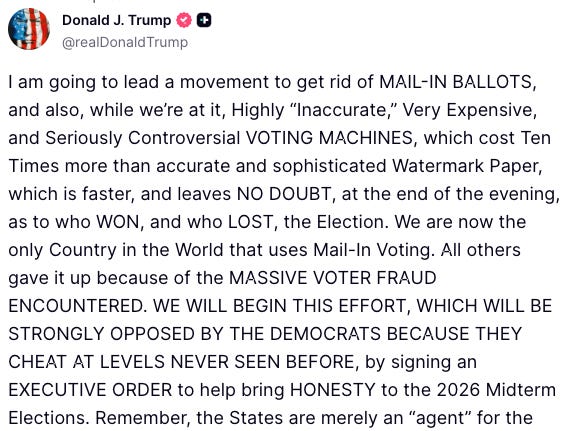
The threat to the November election is unlikely to come in one dramatic order from Washington. It is more likely to arrive through many smaller pressures: demands for voter data, questionable citizenship checks, restrictions on mail ballots, attacks on voting machines, intimidation of election workers, delayed certification, and constant repetition of fraud claims without evidence.
Some of these efforts have been slowed by states, local election officials, career public servants, civic organizations, journalists, and courts. But a strategy can do damage even when it does not fully succeed. It can confuse voters, exhaust election workers, delay results, and persuade Americans not to trust a lawful count.
Here are eleven fronts in the effort—and what must be done before Election Day.
1.Voter files and private information
The Trump Justice Department has demanded extensive voter-registration information from states, ostensibly to find ineligible voters. The broader danger is creating federal voter profiles, finding pretexts to challenge registrations, and obtaining sensitive information states are required to protect. Many states, including some led by Republicans, have resisted by providing public information while withholding protected fields. That resistance has slowed the effort, though it has not ended federal pressure on state election offices. (Brennan Center tracker)
Virginia should refuse voluntary disclosure of confidential voter data, disclose federal requests publicly, and demand clear legal authority before providing anything beyond what the law requires. Local election boards should make clear that voters will not be removed simply because a federal agency questions a name on the rolls.
2. Citizenship databases and voter purges
The administration has pushed use of federal immigration and Social Security records, including the expanded SAVE database, to identify alleged noncitizen voters. But a database match is not proof. Naturalized citizens, people who changed names, and people with incomplete federal records can be falsely flagged. The program has found far fewer substantiated cases than the administration’s rhetoric suggests. (Associated Press)
Virginia should adopt a simple rule: no voter is removed merely because a federal database produces a name. A match should trigger review, written notice, time to respond, and an opportunity to correct an error. Voters—especially newly naturalized citizens—should check their registration now.
3. Proof-of-citizenship barriers
Trump’s 2025 election order sought documentary proof of citizenship for federal voter registration. Congressional allies have pursued the same goal through the SAVE Act and related proposals. It sounds simple until one considers citizens without passports, difficulty obtaining certified birth records, or names that no longer match older documents. Major parts of the executive-order approach have been blocked, and Congress has not enacted a nationwide documentary-proof requirement. (CRS)
Virginia should protect existing registration methods and oppose last-minute paperwork barriers. Citizens should register early, update addresses early, and resolve document problems before the fall rush.
4. Mail ballots and the Postal Service
Trump has made voting by mail a major target. His administration has sought tighter absentee rules, voter-data sharing with the Postal Service, and new envelope and tracking requirements. Such changes can particularly burden older and disabled voters, deployed military personnel, students, rural residents, and others who cannot reliably vote in person. Election officials say the proposed federal changes are not feasible this close to an election: ballots are already going out, contracts are in place, and local voter and ballot systems cannot safely be rebuilt in the closing weeks. (CBS News)
Virginia should preserve workable absentee procedures and authorized backup options. Voters planning to vote by mail should request ballots early, return them early, use official return options, and track receipt.
5. Pressure on election workers
Election workers and local registrars have faced threats, harassment, and political pressure. Trump’s 2026 order raised the prospect of federal investigations of election officials, contractors, printers, and others connected with ballots if federal officials believe an ineligible voter received one. Even without prosecution, that threat can chill good-faith administration. (White House executive order)
Virginia should provide election workers security, legal support, and clear direction: follow Virginia law and count lawful ballots. Citizens should attend public meetings, ask hard questions respectfully, and defend election workers from threats and personal attacks.
6. Attacks on voting machines
Trump has again attacked voting equipment, barcode ballots, and vote-counting systems. The answer is not blind faith in machines. It is verification: paper ballots or records, public testing, documented chain of custody, bipartisan canvasses, and post-election audits. (FactCheck.org)
Virginia election offices should explain these safeguards before voting begins. Voters should demand specific evidence for claims about machines—not social-media posts, anonymous charts, or a politician’s assertion.
7. Weakening independent oversight
Trump’s administration effectively emptied the four-member Election Assistance Commission. Republican Commissioner Donald Palmer departed in April; in July, Democratic Commissioners Thomas Hicks and Benjamin Hovland were told by email that they had been removed, and Republican Commissioner Christy McCormick was permitted to resign. The EAC helps states with voluntary voting-system standards, election guidance, and other election-administration functions. With no commissioners, it lacks the quorum to take official action. (CRS)
Congress should restore independent bipartisan oversight. Virginia should rely on tested state procedures, not last-minute federal political directives. Local officials should resist sudden equipment or process changes unless they can be publicly tested, funded, and safely implemented.
8. Retreat from voting-rights enforcement
An administration can affect voting not only by imposing restrictions but also by stepping back from enforcement. Trump’s Justice Department has withdrawn from some Voting Rights Act matters while emphasizing alleged fraud, list maintenance, and noncitizen voting. That leaves states, citizens, and civic organizations carrying more of the burden of protecting communities that historically faced discrimination. (NPR)
Virginia should keep polling places accessible, provide clear ways to report problems, and examine whether election changes disproportionately burden particular communities. Local organizations should document problems quickly and connect voters with reliable help.
9. The fraud story itself
This may be Trump’s most effective weapon. He does not need to prove widespread fraud in court if he can persuade enough people that mail ballots, voting machines, and naturalized citizens are inherently suspect. This summer, Trump again promoted claims of widespread noncitizen voting based in part on an unusual Census Bureau report whose methodology and conclusions election-data experts questioned. Meanwhile, a review of Justice Department data found fewer than 150 alleged noncitizen voters referred for prosecution from January 2025 through May 2026—and 41 people charged with illegal voting or related election crimes. Repetition creates doubt. Doubt creates pressure. Pressure can bring recount demands, threats against officials, delayed certification, and refusal to accept an honest result. (NPR; ProPublica)
The response must be faster and more local than a national fact-check. Virginia election officials should publish simple guidance, absentee rules, canvass schedules, certification deadlines, and audit results. Newspapers, veterans, faith leaders, librarians, civic groups, and former officeholders should repeat one standard: an accusation is not evidence. (FactCheck.org) 2025
10. Delayed certification and congressional seating
A close House race could become a national crisis if officials are pressured to delay certification or certified winners are branded illegitimate. There is no verified public evidence that Trump has instructed Speaker Mike Johnson to refuse to seat a new Congress. But election-law experts have identified a vulnerability if enough House seats remain disputed when the new House organizes on January 3, 2027. This is a contingency, not a proven plan. (Lawfare)
The answer is preparation, not panic. Virginia should follow established certification deadlines and issue results and credentials promptly. Members of Congress should state now that duly certified winners must be seated. An unexplained delay in seating a certified representative should be treated as a serious denial of representation.
11. Violence and intimidation
No discussion of election danger can ignore January 6, 2021. Trump’s false claims about the 2020 election helped produce a violent attack on the Capitol that interrupted Congress’s certification. The House committee investigating the attack concluded that Trump was its central cause and that the attack would not have happened without him. The election was ultimately certified, but the violence injured police officers, endangered lawmakers, and demonstrated how false claims can become physical threats. (January 6 Committee materials)
The lesson is preparation. Government must protect election workers, election offices, canvass sites, and public buildings. Peaceful protest must be protected, but threats, armed intimidation, and violence must be rejected without qualification. Citizens should document threats, report credible danger, support election workers, and refuse to excuse violence from any political side.
In Summary
The defense of the vote is not a partisan project. Every Virginian has an interest in elections that are secure, accessible, transparent, and decided by lawful ballots—not intimidation, rumor, or political pressure.
Before November 3, Congress must demand transparency from DOJ, DHS, USPS, and every federal agency trying to intervene in voting. Virginia must protect voter data, prevent careless purges, support election workers, and follow clear certification rules. Local officials must explain how voting and counting work.
And residents of Fredericksburg, Stafford, Spotsylvania, King George, and Caroline should check their registration now, vote early when possible, return mail ballots early, and rely on official election information.
Democracy is protected when the voter, the election worker, and the count are protected together.
***
Phil Huber is a retired Army Reserve colonel, federal civil servant and consultant who writes on civic education. He lives in Fredericksburg.

Early in-person voting begins September 19th. I prefer to not trust the USPS with my ballot.