
By Patrick Neustatter, SPECIAL to THE ADVANCE
I can’t stand people like Shrey Parikh, the 14 year old from Rancho Cucamonga, California, who just won the 2026 Scripps National Spelling Bee.
Well, it’s not really anything I have against Shrey specifically, or the fact that he’s a hero because he knew how to spell “bromocriptine. (Last year’s winner had to spell “eclaircissement.”)
It’s all part of a resentment I’ve harbored for years because I can’t spell—a state of affairs that all too many people think means I’m a moron.
I grew up in a family that is something of a medical dynasty. My great grandfather was a doctor—a general practitioner in Australia. My grandfather was an ophthalmologist in Munich. My father was a psychiatrist in London. So when I came along, the pressure was on.
I also came from a family that was steeped in progressive education and a full embrace of the Free School Movement—founded on the idea that a school with an atmosphere of freedom and approval, and no fixed curriculum, would promote intrinsic motivation and interest in learning, and help cultivate balanced individuals with lifelong curiosity.
“Lighting the fire rather than filling the bucket,” as they used to say.
Our dad’s mother sent him to a progressive school in London called King Alfred’s, and through this she met and fell in love with one of his teachers, the educational pioneer AS. Neill, who became her second husband. They went on to found the famously archetypal progressive school Summerhill.
So, it was a given that my sister Angie and I should go to progressive schools as well.
Angie was sent to Summerhill, but I went to a place called Dartington Hall School, which sounds like somewhere Harry Potter or Prince Charles might attend. The name, though, was deceiving, as Dartington turned out to be a full blown Do-as-you-like boarding school, located in spectacular country in the rolling hills of south Devon in Britain’s south-west peninsula.
Angie and I mostly loved our respective schools, in contrast to so many of my chums in those days—to the point that we and our classmates were reluctant to leave and go back home at the end of term.
Dartington was an easygoing place where students governed ourselves and were on first name relations with the staff. There were few restrictions. Most rules were to stop us from killing ourselves, though we still rode bikes with no brakes down the steep trail through the woods, made gunpowder from fertilizer and blew things up, took trips to The Cott Inn for flagons of rough cider, and generally did things that would give any modern-day principal fits.
The downside of this idyllic place was that there were a lot of distractions to keep me from studying—including the fact that half of the pupils were tween and teen females who were as keen on exploration as us guys.
In England at that time, for school exams we sat the CGE, or General Certificate of Education—O-level at age 16, and A-level a couple of years later. University admission was based on your results.
I took six subjects at O-level, which was pretty modest. The whiz kids went for eight or 10. Exams were held at the end of summer term, and all went home to await the results.
A few weeks later my mother came to me one morning with a cup of tea and a sinister-looking envelope.
Not without some trepidation, I opened it.
I had passed two of the six subjects.
My particular problem seemed to be with spelling, and June, our long-suffering English teacher at Dartington, was conscripted to give me remedial classes when I returned to school—where I sat alone in a classroom, day after day, at one of the wooden desks liberally carved with obscenities and other pupils’ initials. A sort of one-on-one, personal, spelling bee.
But it didn’t work. I still couldn’t spell. How was I meant to know if you could hear here? Where a maid was made? What was a fare fair, or a fowl foul? The source of the sauce? How to see the sea? The role of a roll?
How could anyone be expected to spell words in a language whose roots were Old English, Danish, Norse, French, with a sprinkling of Latin, Greek, Hindi, Japanese, Dutch, and Spanish?
I was taken out of Dartington a year before A-levels and sent to Davies, Laing, and Dick Tutorial College, a ghastly “crammer” that was the last resort of desperate parents with dullard children.
My exam results were still abysmal, but somehow my dad finagled me a place at the prestigious Guy’s Hospital medical school where he had worked and had connections. He said he thought they had an interest in how someone from a progressive school would do.
I fancy I was no great ambassador.
I was plagued from the start by the worries that I was incapable of learning. It also didn’t help that I was thrown off balance the minute I walked through the doors by the abrupt change in culture from Free School to oppressive Old World hierarchy at a teaching hospital whose wards were named for famous physicians of a bygone era: Richard Bright, the Father of Nephrology, who died in 1858; Thomas Addison, pioneer in endocrinology, who died in 1860; William Gull, a veritable contemporary, who died 1890.
It was a stark contrast to Swinging London of the 60’s that was happening everywhere else—outside of Guy’s.
I struggled while sitting in the gloomy Will’s Library, a place that was all carved, heavy oak tables and chairs, glass-fronted bookshelves, and stupefying miasma.
Even when I could stay awake, I never seemed to retain what I was reading in the weighty textbooks like Gray’s Anatomy, Sampson Wright’s Applied Physiology, and Cecil Loeb’s Textbook of Surgery.
But somehow, miraculously, I got through.
***
One of my classmates at Dartington had been a chap named Mal, short for Malachy. He was a mad bugger, and we weren’t particularly close back then, but later in life we both moved to the U.S. where he settled in Boston, and became a psychologist. I, meanwhile, married an American woman and eventually found myself practicing medicine in Virginia.
Mal had travelled to India and a lot of other places I had been. We compared travel notes when I went to visit, and found commonalities in the ways we dealt with patients. We had both become parents since moving to the States, and both adopted silly English voices to amuse our American kids with such comedy classics as Monty Python’s “Dead Parrot.”
We became bosom pals, but then he got both prostate and lung cancer and died, and I’m still mad at him for that.
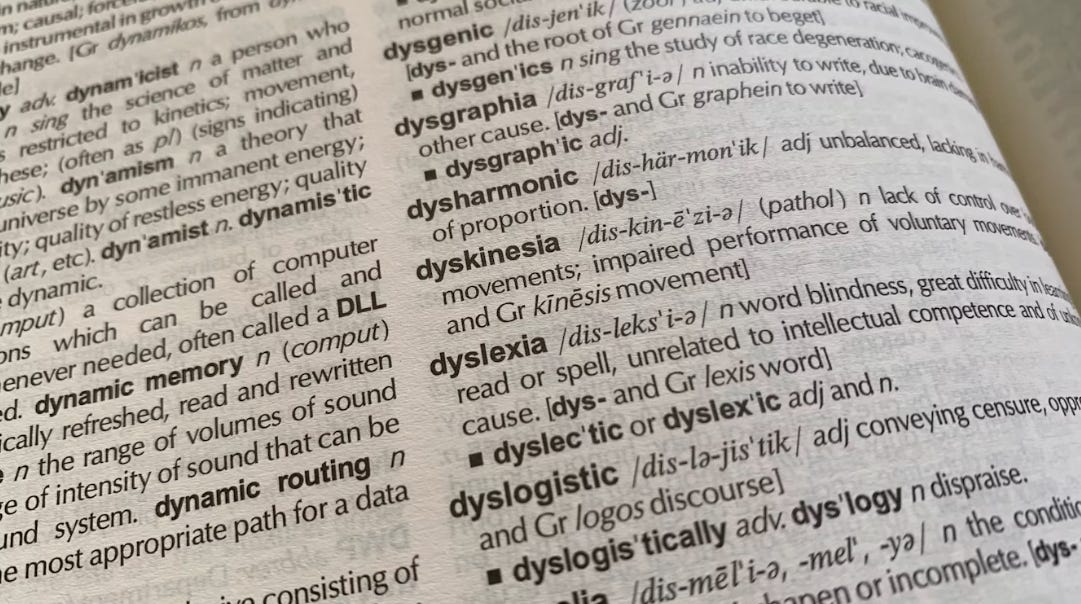
I mention Mal because once when we were talking, he casually said, “Of course you know it’s obvious from the trouble you have with spelling and passing exams that you’re dyslexic.”
This was a revelation.
Perhaps I wasn’t a dullard after all. Perhaps what I was dealing with—what had haunted me all my life—was “a phonological deficit in the left superior temporal gyrus causing poor communication between the two hemispheres,” as one dyslexia organization explained it—a glitch that was interfering with the speed at which my brain processed and retrieved written information.
That difficulty, in turn, had been complicating tasks like rote memorization all my life—and, yes, contributing to my phonetic and inconsistent spelling, which, thankfully, wasn’t much of an impediment any more, now that I was a licensed physician with no more papers to write or exams to pass at Guy’s Teaching Hospital.
Another revelation for me was discovering Audio Digest, a service that provides recorded lectures from medical meetings around the country. I didn’t have to wrestle with textbooks any longer. I could listen to the latest research in the car on the way to work instead—and sail through the boards, those periodic recertification tests doctors have to pass to remain in good standing and be allowed to continue practicing.
What I’ve never stopped doing, though, is railing against the tyranny of being expected to spell the same as everyone else. And being ridiculed or thought of as some kind of moron because I can’t. Our modern technology certainly helps, but a creative dyslexic can defeat any spellcheck.
I wrote a story for another local paper not long ago about a back-to-nature friend who “got married in his back garden in bear feet.”
I rather liked the visual of that one.
***
Patrick Neustatter is a retired general practitioner and former medical director of the Moss Free Clinic. He still volunteers at a free clinic in Orange County.

Thank you for writing this, Dr. Neustatter. I cannot spell either and come from a family who values academic performance. My mother, a teacher, would say to me, “You really can’t spell, can you?” The implication being that I was from some unknown parentage... My mother also exclaim, “Can’t you hear the way to spell it? Sound it out!” Later in life, I learned that I have a nearly profound hearing loss for certain sounds so, no, I couldn’t hear it. Thank goodness for modern spelling tools, but they have not made me a better speller.
Hey Patrick, Nice one, mate! Years ago, as a Speech-Language Pathologist in the public schools, I facilitated a Virginia Council for Exceptional Children/CEC teacher conference session on 'Dyslexia'. Titled it 'Barrier Breakers: In Our Own Voice' so the trio of presenters could share how difficult it was to access their public education. In hopes that the educators would take back these speakers' strategies to their students.
One speaker, who became a graphic artist and mapper at Quantico, shared his relief and gratitude at acquiring a 'sense of belonging' that he did not know he was missing until 'Talking Books' came out, after he graduated: The profound joy of hearing Dickens 'Great Expectations', the imagery, its hyperbole, irony, the metaphors.
So I know you will still talk to me. But I was one of the 8th grade Fairfax County Public Schools spelling bee champions who went on to the 'Scripps National Spelling Bee'. My father, a night shift proofreader with the Government Printing Office, passed on his love of the printed word to me. Early on, I could see the way the letters were arranged and the patterns. and spent hours playing with them in my head.
and I hit paydirt with attending Catholic elementary school, grades 1-7, with Franciscan nuns who faithfully scheduled in their two times per month: 'Spelling Bee'. YES! and I consistently received the prized choice of a 'holy card' with Sister's signature and dedication.
It wasn't all blissful in that blessed classroom. At our reunions, those of us with intact self-esteem talk about the anxiety we developed as young children. Some sisters did box an ear, take their omnipresent wooden pointer to harshly thwack knuckles of the child next to you to force handwriting to the right hand. We wondered, perpetually: 'Am I next?'
Sister Charlotte had a right good aim with the chalkboard eraser. The tall boy in the back of the room, taking us off track, bore the brunt of her wrath. If one dared turn to see his hair and face covered in chalk dust, you'd get a whack too.
'The guilty', fifty years later, shared with us that he didn't move out of the school's attendance zone in 8th grade, having survived the previous seven. He was expelled from 8th grade. He took a nun out with a sucker punch to her face. As an adult, he was diagnosed with ADHD.
He is repentant.
My sisters and I talk about the one year we spent in public schools. For me, it was my 8th grade year: The sacramental graduation ceremony, the culmination of 8 years of Catholic traditions and meaningful moments.
We think it came down to family finances. Our parents could no longer afford to send 4 daughters to Catholic school.
I began 8th grade at public school with a rowdy bus ride, uncomfortable in new clothes. I preferred my reliable plaid skirt, white blouse and navy blue knee highs of the past 7 years. When my first class teacher called on us to answer a question, I raised my right hand obediently, at a 90-degree angle. Did not wave it about to be noticed in a competition of 'pick me, teacher', as was happening, because we were taught that was disrespectful to classmates who also knew the answer. I was recognized.
and that's when I made the biggest mistake ever, up to that point: I stood at attention, gave the answer, and to indicate I was done, I CURTSIED. and remained standing.
The class burst into laughter. I thought I had answered incorrectly. The teacher was a pro. She didn't even yell. She was Kind to all. and simply told me that I did not have to stand when answering. At the bell, I was surrounded by dozens, who wanted to be my friend.
Within a few weeks, I was called out of class to ask if I would like to be in the school Spelling Bee. Just a few were interested. The school Bee came down to Paula and me. She was the previous year's champion and had one more year of eligibility. I won.
Gracious Paula then agreed to stay after school 3x/wk that year to practice-compete, using the National Bee's study guide: 'Words of Champions'. 4000 words. Our English teacher coached us in Latin derivatives, non-English word patterns, phonetic rules, linguistic word origin.
I made it to the National Spelling Bee in Washington DC. Saw Mark too. He was my main challenger in Catholic school. The stage was too crowded: 75 total spellers. 50 girls. 25 boys.
Don't recall how many rounds we went through. But the fateful one came on, viciously. I looked up. and realized that there were hundreds of families, teachers, and news cameras watching us in the Mayflower Hotel Grand Ballroom.
and forgot what syllable section I was spelling. 'Stage fright' did me in.
Life went on. We all returned to Catholic school because our stay-at-home mother returned to hospital nursing. We learned that not all nuns throw the chalkboard eraser. The Sisters of the Holy Cross for high school, at all-girls St. Mary's Academy in Alexandria were affirming, social justice feminists.
Decades later, my daughters, both Early Childhood/Special Educators and I presented at the Virginia and National (2022) CEC. 'Hyperlexia in Early Childhood: Seeing the World through Print'.
'Hyperlexia' is the precocious ability to read words before the age of 5. It is estimated to occur in
children with Pervasive Developmental Disorder, which closely resembles Autism Spectrum Disorder, between 5% and 20%.
Through observation of discrete behavior in public school Childfind evaluations, we had noticed that in just a few cases, the non-verbal 2- or 3- yr old enter the room, ignoring the adults, to walk to the toy table. However, these children seemed distracted in toy play by fleeting side glances at the alphabet strip on the wall.
They were fascinated by the print!
We did more in-depth evaluation to get to an individualized intervention, such as using a puzzle piece with the name of a planet on it to check for reading to using their strength of 'hyperlexia' in behavioral conditioning to start talking by reading the words.
Dr. Temple Grandin was the keynote at the Virginia CEC poster session. She quickly made the rounds to read the posters. Came back to ours. and said, frankly: 'I like it'. and left the room.
I bought the alumni baseball jacket for the celebration of '100 Years of the National Spelling Bee' in 2025. Patrick, I'll have to show it to you, OK?