Steve Rabson, ADVANCE CONTRIBUTOR
Since the end of World War II, the United States has welcomed refugees from countries where their lives were in danger from oppressive regimes. Off and on. Three of them came to join my ninth-grade class at a high school in Ohio back in the 1950s on a resettlement program organized by the Dayton branch of the American Friends Service Committee.
In 1956 Kafur Sadaji came from Iran where, three years earlier, the United States CIA and the U.K. M16 had engineered a military coup to oust democratically elected Prime Minister Mohammad Mosaddegh. They replaced him with Shah Reza Pahlavi who instigated a violent round-up of dissidents, including anyone thought to have been associated with the previous government.
With continued military and diplomatic support from the U.S., the Shah remained in power for 26 years until militants led by Muslim clerics ousted him in 1979. Their religious dictatorship also imposed thoroughgoing repression, especially against women, brutally quashing periodic outpourings of dissent.
In January 2026, during several weeks of mass anti-government protests, President Donald Trump posted messages on Truth Social urging people there to “keep protesting,” and “take over your institutions.” Thousands had died in a murderous government crackdown. A few days later Trump promised that “HELP IS ON THE WAY . . . [The U.S. is] locked and loaded, ready to go.” His statements led to anticipation, especially among Iranian expatriates abroad, of an imminent invasion to force regime change.
But attacks carried out by the U. S. and Israel in early February proved to be limited, targeting a few government leaders and military installations. Unlike in Venezuela a month earlier, the U.S did not send in ground troops to force changes in government and take control of its finance and foreign policies. Since then, Iranian security forces have escalated their deadly assaults with shootings of protestors in the streets, arrests, and executions. The Trump administration’s ban on immigration from majority Muslim countries makes it unlikely that these Iranians will be offered asylum in the United States.
This was not the first time the U.S had urged on the citizens of another country in their organized opposition to an oppressive government—and pledged American support, only to abandon them.
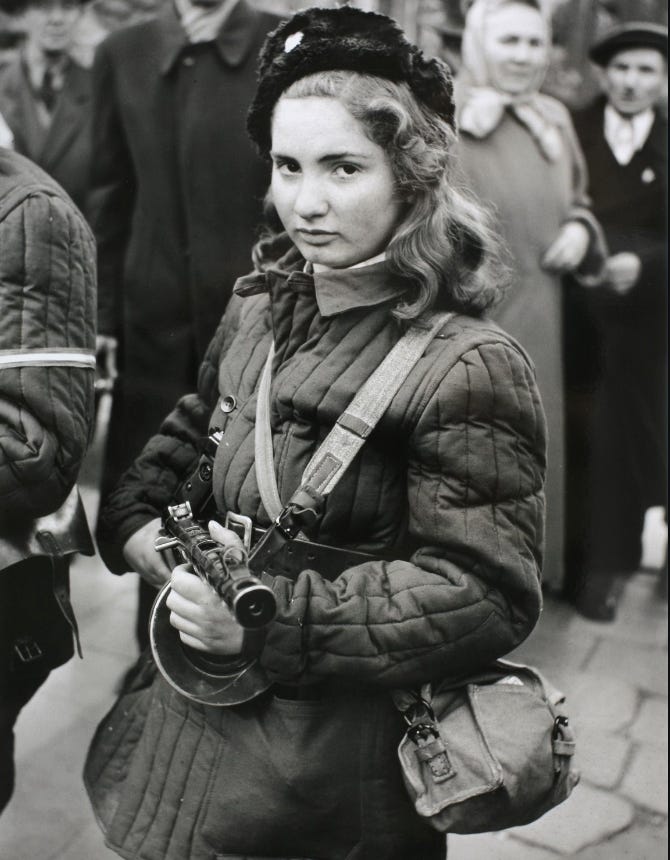
In 1956, the same year Kafur Sadaji came to our high school from Iran, Andy Shayo joined our class as a refugee following what is now called the Hungarian Uprising. In the fall of that year, university students led armed insurgents who briefly succeeded in bringing down the Soviet-backed government and installing a new president who promised free elections and announced Hungary’s withdrawal from the Warsaw Pact military alliance led by the U.S.S.R. Twelve days later, the Soviet Union sent in soldiers and tanks to crush the uprising. 2500 Hungarians died and 200,000 left the country, relocating mostly to Austria with 30,000 settling in the U.S.—including Andy Shayo.
Information from historical archives, available after the fall of the Soviet Union, along with the personal accounts of Hungarian refugees, show that broadcasts by the CIA-operated Radio Free Europe gave Hungarian listeners the impression that Western military support or United Nations intervention was imminent. Commentators made passionate calls for continued resistance, even offering tactical advice for supporting the insurgents.
That all came to nothing.
After Iran in 1953, the U.S. supported military coups in Guatemala (1954), South Vietnam (1963), Greece (1967), and Chile (1973). In 1959, a revolution led by Fidel Castro brought down Fulgencio Batista, the reigning Cuban dictator the U.S had long supported. From 1959 to 2017 our government offered immigration status to refugees leaving Cuba.
One of them, Augoretto “Augie” Batista, also joined our high school class. (He was rumored to be a nephew of Fulgencio Batista, the deposed dictator.) But today Trump’s immigration policies have stripped away long-standing protections, leaving hundreds of thousands of recent Cuban immigrants and their families at risk of detention and deportation. Trump has also canceled the legal residency status of people granted asylum from other nations in the Caribbean, the Middle East and Africa, which he calls “shit-hole counties,” though many have lived here for decades.
In 1961, the U.S. played a more direct role than in earlier actions to effect regime change. The CIA recruited, financed, armed, and trained a rag-tag gang of Cuban exiles for a planned invasion of Cuba. Persuaded that this would spark a nationwide uprising to overthrow the Castro government, this hapless band of ex-patriots landed their small boats at the Bay of Pigs only to be swiftly captured and imprisoned by Cuban security forces.
Though unsuccessful, the ex-pats’ quixotic fiasco led the U.S.S.R., determined to defend its Cuban ally, to deploy medium-range ballistic missiles at air bases on the island. This set off the 1962 Cuban missile crisis between the Soviet Union and the United States, the closest the world has come so far to catastrophic nuclear war. By that time, I was a sophomore at the University of Michigan living with other students in an apartment building off campus. Bob Molay, the student in the apartment next door, who prided himself on being cool, seemed unconcerned. “Oh, they’ll pull something out of the hat,” he assured us. I wasn’t so sure.
Five years later, as an Army draftee stationed at a nuclear weapons storage base in Okinawa, I learned that the Cuban Missile Crisis had been the only time the U.S. military had been put on DEFCON 2 alert, meaning war was considered “imminent,” and nuclear-armed B-52 bombers were ordered on continuous airborne missions.
But maybe Bob was right. Fortunately, President Kennedy resisted demands by military leaders for an immediate invasion of Cuba, and negotiated a compromise with the Soviet Union to remove its missiles in exchange for a U.S. pledge not to invade Cuba and to remove our nuclear-armed missiles from Turkey in range of the U.S.S.R. (Currently the U.S. stores thermo-nuclear gravity bombs at an air base in Turkey.)
Today, Trump’s war against Iran drags on past the half-year mark, and the Iranian government continues its refusal to capitulate to his demands. Trump appears to have lost interest in supporting protestors there, and seems unlikely to offer them asylum here.
Instead, he continues to threaten an Armageddon in which “A whole civilization will die tonight, never to be brought back again.”
***
Dr. Steve Rabson is a retired professor emeritus of the Department of East Asian Studies at Brown University, and currently an adjunct instructor in the Department of Modern Languages and Literatures at the University of Mary Washington.