
By Martin Davis
EDITOR-IN-CHIEF
Email Martin

Virginians voted Tuesday night to approve mid-cycle congressional redistricting, though redrawn lines are not a done deal. As David Poole has reported, the courts still have to weigh in, beginning with the Virginia Supreme Court on Thursday.
Democrats will keep the champagne on ice for a couple days, but in the meantime they should pay careful attention to what voters were telling them Tuesday night. And the message is pretty clear.
Virginia remains a solidly purple state.
Start with the margin of victory, which is far from the overwhelming advantage Gov. Abigail Spanberger enjoyed in November. “Yes” voters Tuesday were 51.44% of the total vote. Spanberger won six months ago by 15 percentage points.
More notable than the tight margin of victory for the referendum, however, is that a dozen localities that went for Gov. Spanberger in November, voted against the referendum Tuesday night.
These twelve localities tell an important story about Virginia voters.
.
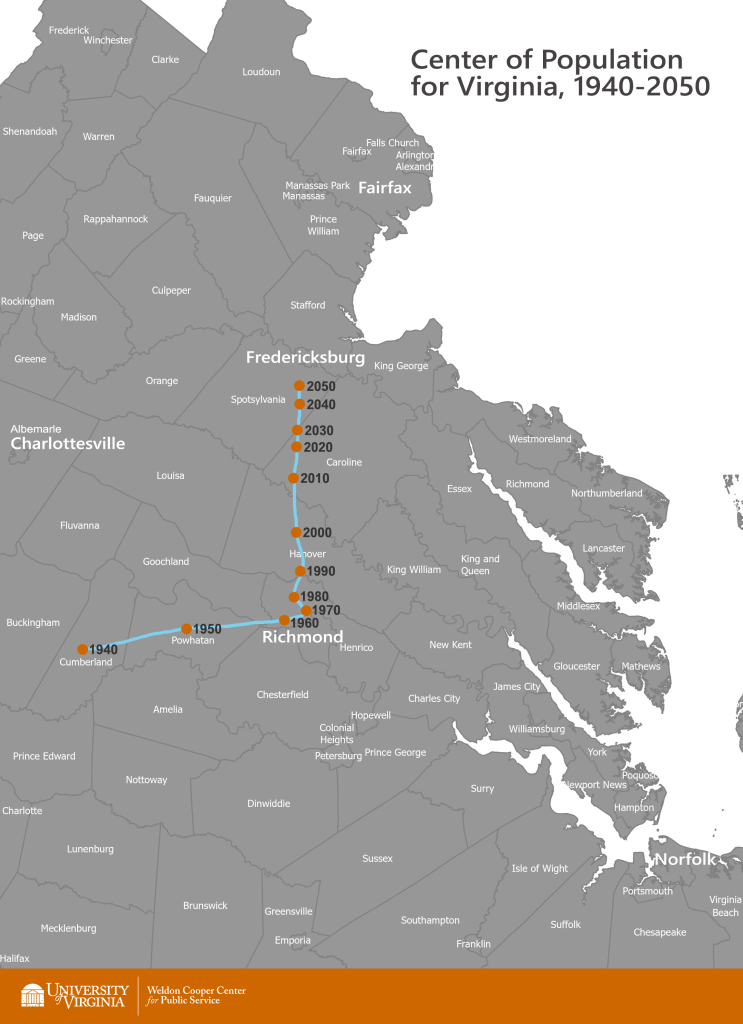
Twelve That Changed
None of the dozen localities that supported Gov. Spanberger in 2025 and then voted “No” on Tuesday’s referendum were in Northern Virginia. Rather, they were spread across the central, southern, and western parts of the state. More importantly, with but a few exceptions, they’re localities that are experiencing growth.
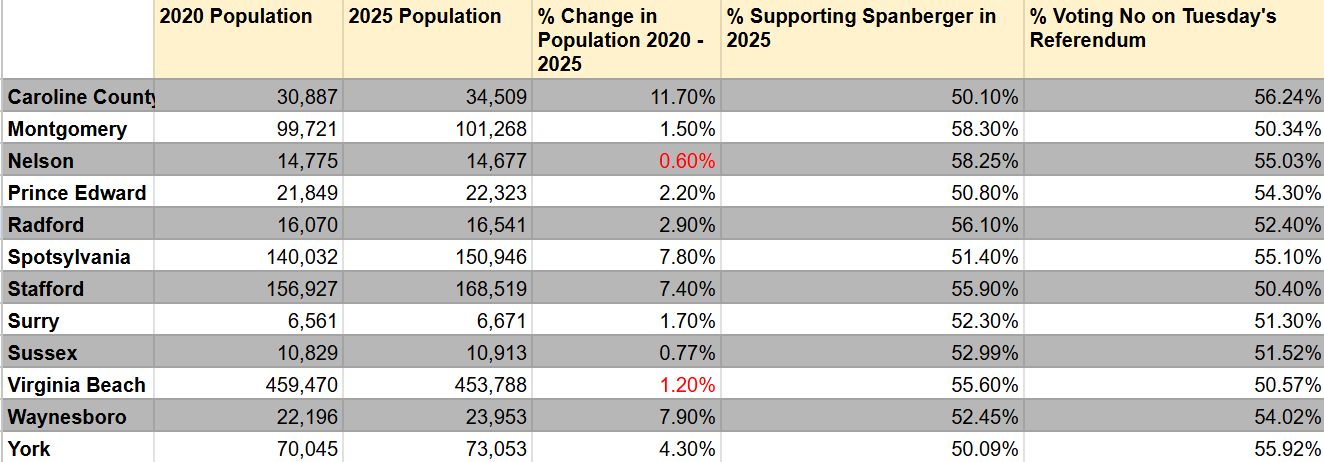
Three of these localities — Caroline County, Spotsylvania County, and Stafford County — are in or near the heart of where the Cooper Weldon Center pegs the population center of the state. In short, if you want to understand where Virginia is headed both demographically and politically, these three localities demand attention.
Before diving in, however, let’s pull back and put Tuesday’s vote in context with that from this past November.
It is tempting to dismiss these dozen shifts in voter habits as predictable. Most of these were won by narrow margins on the back of a highly energized base of Democratic voters. Spanberger, after all, did carry the state by 15 percentage points.
To minimize what happened, however, would be a mistake.
It was Spanberger’s election in November that was unusual. Not Tuesday night’s results.
Unlike in November, both Democrats and Republicans were motivated on Tuesday, with high early-voting turnout, and a total turnout only about 365,000 less than voted in November. An extraordinary number considering the referendum was the only item on most ballots.
(In November, there were 3,426,443 ballots cast in the gubernatorial race; Tuesday’s referendum saw 3,061,376 votes cast.)
Assuming that last November’s election was the anomaly, given that the state has for nearly two decades been politically purple, a reversal in Democrats’ fortunes in 12 localities they flipped in 2025 suggests that Gov. Spanberger’s hold on power is more tenuous than November’s vote would suggest. This could prove important in 2027, when all 100 House seats are once again up for grabs.
Caroline, Spotsylvania, and Stafford are particularly instructive here.
In November, Nicole Cole flipped HD 66 from R to D by unseating the then-longest serving member of the House — Bobby Orrock. Cole’s district includes the eastern part of Spotsylvania County and the western portion of Caroline. Both areas are urbanizing rapidly, and with Spanberger turning out voters Cole’s victory was not entirely unexpected.
Tuesday’s vote is a reminder that when Republicans are motivated, they still hold the power in both counties — though, demographically that power is beginning to shrink.
In other words, Caroline and Spotsylvania have become true purple districts. Cole’s seat could prove vulnerable if she alienates more-moderate conservatives.
In Stafford County, not only did Stacey Carroll flip HD 64 from red to blue, but Democrats ran the tables to win control of the Board of Supervisors. Further, Democratic backed candidates won control of the School Board.
Stafford has shifted Blue in recent years — Spanberger barely lost the county during her final run for Congress in 2022, and carried the county comfortably in 2026.
This makes Stafford going “No” on Tuesday’s referendum more surprising than either Spotsylvania or Caroline.
Overreach
It’s become passe that each election’s winner believes they have a mandate. But as we have witnessed over the past couple decades, mandates rarely happen anymore. And the swings in power are more pronounced than that have been since the 1940s.
Tuesday is one election, and it’s dangerous to read too much into these — or any single election’s — results. Especially when it’s a special election.
However, the state’s Democrats would do well to pay attention to the dozen localities that supported Spanberger in 2026, only to vote No on Tuesday.
The lesson is that Virginia remains a solidly purple state, where the power can easily flip. And this vote suggests that the Democrats ongoing control of Richmond is not guaranteed.
Gov. Spanberger is known for her ability to work across the aisle.
Tuesday’s result should remind her that it will be important that she demonstrate those skills between now and next November.


Local Obituaries
To view local obituaries or to send a note to family and loved ones, please visit the link that follows.

I imagine many Democrats, including both senators and the governor, held their noses as they voted for the measure. Gerrymandering is not good governance. But if the other side is playing hardball, it is political malpractice not to respond in kind. The good thing is that it's temporary.