
Co-Intelligence: Living and Working with AI
By Ethan Mollick
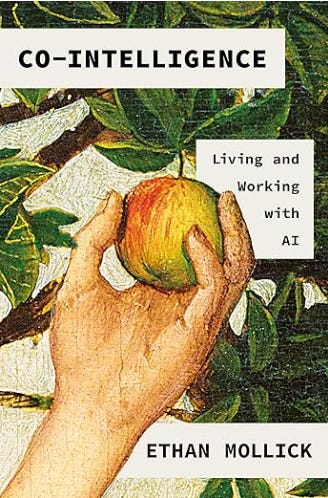
Published by Portfolio (April 2024)
Amazon (Hardcover): $19.52
Kindle: $14.99
Virginia is the backbone of the world’s internet connectivity, and over the past two years the reactions against its growth have reached a fevered — and at times irrational — pitch.
What puzzles is that the same people raging against the data centers springing up — bringing enormous tax benefits and proffers to localities — rely heavily upon them. From cell phone use to smart devices, cars and public transit, banking and shopping, it is well-nigh impossible to not benefit from this backbone daily, hourly, even moment-by-moment (this newspaper isn’t possible without that backbone).
Why the disconnect between the lives people demand, and the infrastructure required to deliver it?
The answer is surely complex, but the rapid change we are experiencing and the uncertainty about where we are headed is undoubtedly a significant factor.
Ethan Mollick’s new book about artificial intelligence is a model for how to make the changing world around us a bit less scary.
A professor at the University of Pennsylvania, Mollick is neither tech guru intimately familiar with the architecture of AI nor humanities professor wrestling with the ethical complexities of what he artfully terms co-intelligence.
Mollick is a business professor with a knack for explaining what AI is, and why it is both exciting and emotionally unsettling.
Even AI’s creators can’t explain how AI generates the solutions it offers up. Mollick explains why this is the case, exposing the tools’ greatest strengths and inherent weaknesses.
When one enters a prompt into AI, the system doesn’t pull from the vast models it learned from and reproduce results, but rather takes that body of knowledge and then begins to predict at a very sophisticated level what should come next. It’s like when typing an email and Gmail begins to try to complete your sentences for you. Only on a far more complex scale.
Mollick uses the analogy of a novice chef to explain what is happening.
When one begins in culinary arts, one confronts a bewildering ranges of spices and flavors that one is learning how to work with. The shelf that holds those spices is cluttered and confused because the aspiring chef hasn’t learned to use or organize them.
As he learns from a master chef, the young chef begins to see patterns and put things together. With time, the young chef becomes a master himself, and at that stage can begin to innovate and experiment in remarkable ways.
Artificial Intelligence learning from Large Learning Models are akin to an aspiring chef. It takes time, but with training and direction, AI systems order the information they gather and begin to anticipate how to respond.
Mollick explains how to take advantage of this anticipation, and shows readers how to “be the human in the technology,” reminding us that we remain in control.
The book is both primer for the uninitiated and intellectual guide for those learning to harness this new technology to extend humans’ ability to think.
And in the process, it manages to lower the fear we are collectively experiencing about the future.
That should also help bring balance to the discussion about the backbone that powers AI.


Local Obituaries
To view local obituaries or to send a note to family and loved ones, please visit the link that follows.

"What puzzles is that the same people raging against the data centers springing up — bringing enormous tax benefits and proffers to localities — rely heavily upon them." Well, the whole wifi'd world relies heavily on them, but data centers are highly concentrated in our area of the world. If data centers were as dispersed as the humans who use them, Virginians wouldn't be so enraged. It's akin to having to live next to a new dump for toxic waste - waste created by all, but its effects suffered by few.
Also, I haven't used AI myself. I have had, on two occasions now, people provide me AI-generated answers to questions for which I already knew the answers. AI was wrong. Provably wrong. In trying to determine why, I've settled on this answer: humans err, but AI doesn't seem to be able to recognize when its source material - produced by humans - is in error. Ergo, AI errs.