
By Steve Watkins, ADVANCE EDITOR
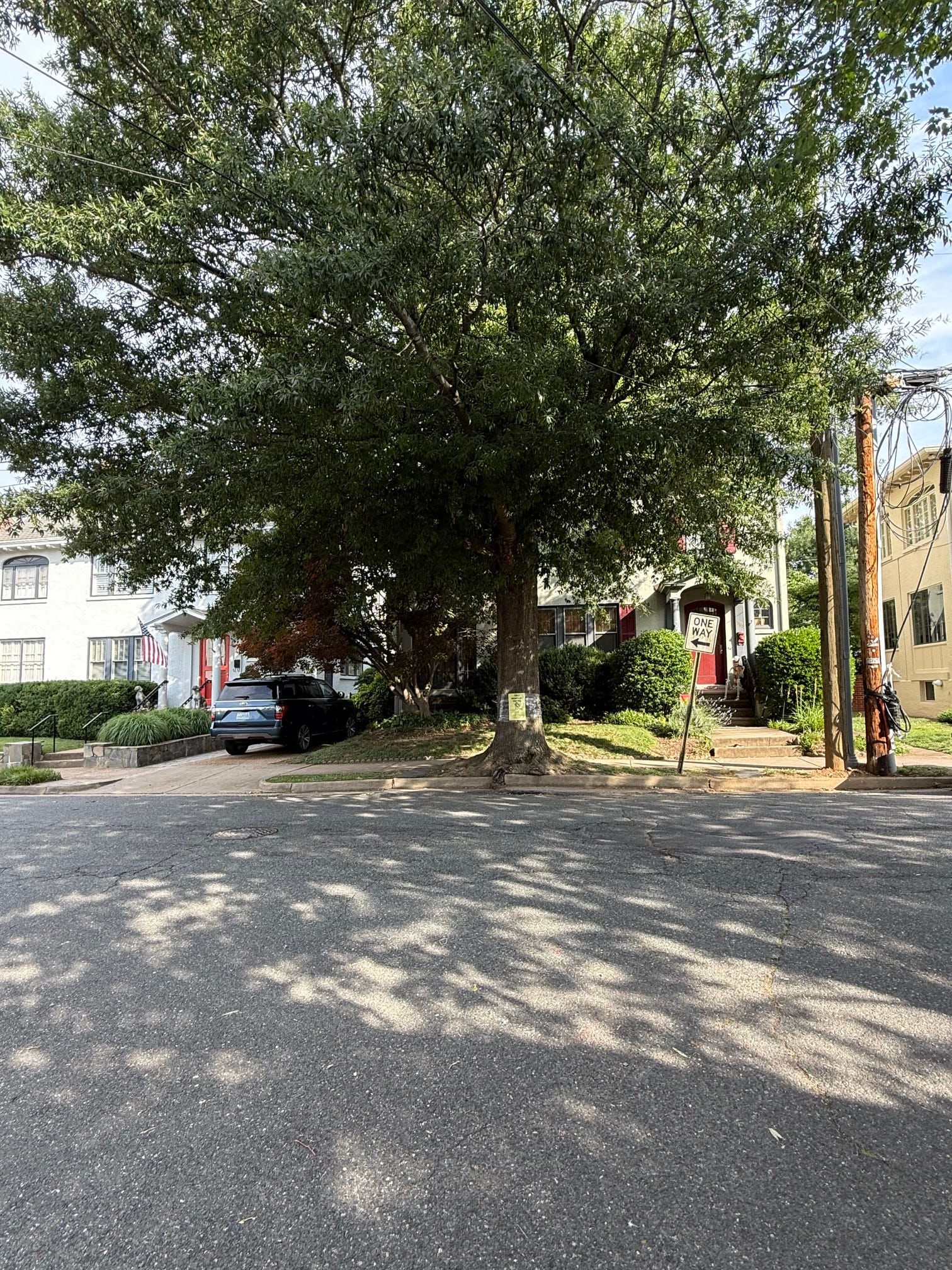
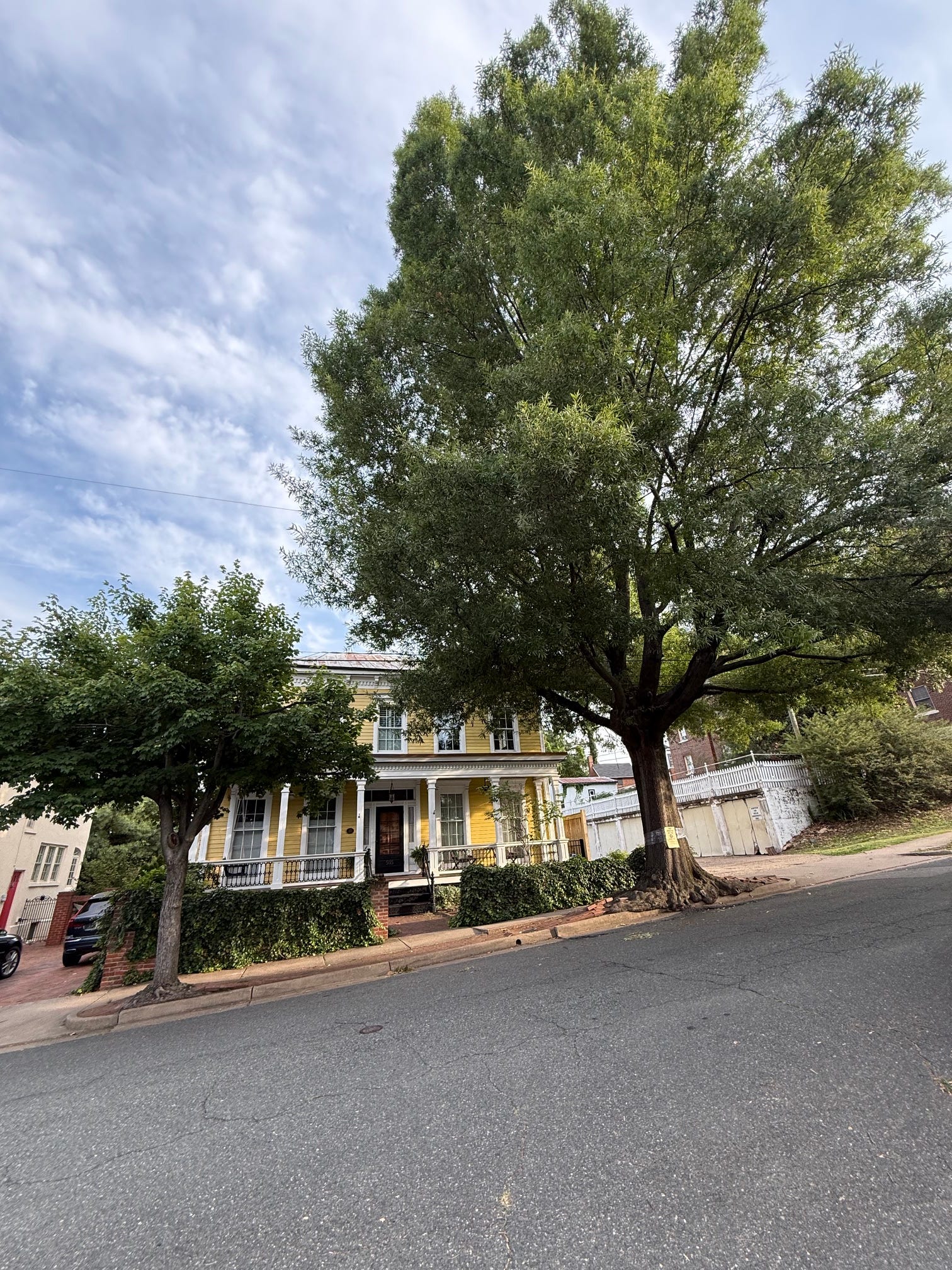
The stay of execution for two 30- to 40-foot willow oaks on the 500 block of Charlotte Street has turned out to be temporary. The Fredericksburg Public Works department announced this afternoon that both are on a list of 10 large heritage trees in the city targeted for removal, possibly as early as this fall.
Residents’ vigorous protests back in June managed to save the willow oaks over the summer, pending a survey documenting the” condition, sidewalk conflicts, and repair feasibility” of 46 large city trees, including the two on Charlotte.
The city arborist has now completed that survey, with 10 trees identified for removal, 14 requiring coordinated sidewalk repairs, and 33 with sidewalk damage, 28 of which are considered fixable.
There were no health issues reported for either of the Charlotte Street oaks. The areas of concern cited—and the reasons given for “Priority tree-risk review/removal”—were “Sidewalk damage; fixable; curb damage; street damage.” It’s not clear from the report what aspect of the damage was deemed “fixable.”
Teri McNally, who lives in the neighborhood and helped launch the June protest,said she was disappointed. She was out of town when she heard the news. “Ugh,” she wrote in an email. “Should have known they were always going to do that.”
The city hasn’t yet announced when they’ll be taking down the targeted trees, two of which are on Charlotte Street, two on Caroline, and one each on Sylvania, Moncure, Lafayette, Jackson, Winchester, and Washington Avenue.
The city also hasn’t announced when sidewalk and street repairs will begin for the other big trees evaluated in the survey.
Piper Brock, another local resident, joined McNally and dozens of others back in June to protest the then-scheduled removal of the Charlotte Street willow oaks, and to request a temporary postponement until the city could conduct an “independent arboricultural review.”
“These mature oaks provide significant canopy, environmental, and property value benefits, and I am concerned removal is being justified based on predicted future decline rather than current condition,” she said at the time.
After a deluge of emails and calls, City officials agreed at the last minute to put the temporary brakes on the removal.
“We heard the concerns raised by the community and wanted to take an extra step to better understand the condition of these trees and the impact on our sidewalks,” said Will Morris, director of Public Works, in a statement released Monday. “This survey gives us a clearer picture of where repairs can be made while preserving healthy trees and where removal may be necessary for safety. Our goal is to protect our urban forest while also maintaining safe, accessible sidewalks for our community.”
City Arborist Bicknell Robbins said the decision to remove the large heritage trees was difficult.
“As trees age, they become increasingly unstable and prone to failure,” he said. “They also have a greater tendency to damage the sidewalk and curb. The trees selected for removal were either not healthy enough to warrant the expense to make the sidewalk safe, or the repair needed cannot be completed without destabilizing the tree.”

Sidewalk trees can be dangerous because their roots are too shallow to hold the tree in a wind storm. Two or three years ago i stood at my rear window watching a storm when my neighbor's tree split in two and half of it crashed, tearing into my house on Brompton st., and missing me by about 18". The same storm blew over another neighbor's sidewalk tree and demolished a car parked across the street. Just up the block it blew over a third sidewalk tree, happily falling onto a vacant space. Its root ball was wider and than my head. it could have done some serious damage if it had fallen the other way.