

By Alan Herrmann
CLASSIC FILM EDITOR
Ever since films have been around, audiences have been thrilled by courtroom dramas. Some of the best were made in the 1950s and 1960s by talented directors like Billy Wilder, Stanley Kramer, Otto Preminger, Robert Mulligan, and Sidney Lumet.
The Caine Mutiny (1954), Witness for the Prosecution (1957), 12 Angry Men (1957),
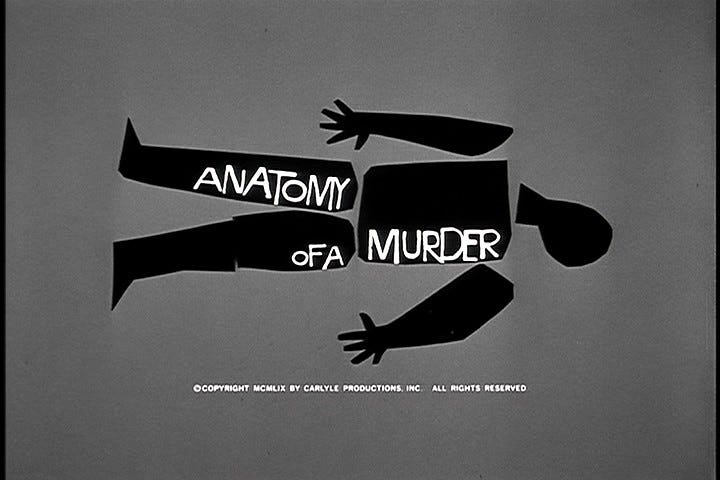
Anatomy of a Murder (1959), Inherit the Wind (1960), Judgement at Nuremberg (1961), and
To Kill a Mockingbird (1962) are highly regarded today as excellent courtroom classics because of their realistic approach to how the law actually works.
My personal favorite is To Kill a Mockingbird because it’s a great story. But my favorite courtroom drama is Anatomy of a Murder because of its flawlessly accurate portrayal of how the legal system works without the typical drama and last-minute solutions often found in films concerning the law.

Based on a best-selling novel by Robert Traver – the pen name of Michigan Supreme Court Justice John D. Voelker – Anatomy of a Murder took its plot from a true murder trial that occurred in upper Michigan in 1952. The story concerns Army officer Frederick “Manny” Manion who is accused of murdering Barney Quill, an innkeeper whom he claims raped his wife, Laura.
When Manion states that killing his wife’s rapist is part of the unwritten law, his lawyer points out that the unwritten law is a myth. Manion then claims he could plead a form of temporary insanity known as “irresistible impulse.”
For authenticity, director Otto Preminger and crew opted to film on location in Michigan’s upper peninsula. Preminger had a reputation for being difficult to work with, but that wasn’t the case during this production. Things went smoothly with the exception of the battles Preminger had with the censors. Many considered the story unfilmable unless changes were made to its shocking subject matter and dialogue. Terms like rape, slut, sperm, climax, contraceptive, and the repeated use of the word
panties were considered too strong for the American public.
Preminger argued that these were legitimate, even clinical, terms used in a trial where a supposed rape occurred. The director stood his ground and the dialogue remained intact.
Preminger gathered an excellent cast for the film and was able to get some of the best performances of their careers. James Stewart plays Paul Biegler, a seemingly quiet small-town lawyer who enjoys fishing and jazz music. He agrees to defend Lt. Manion because he needs the paycheck and is intrigued by the complicated case. At first Manion sees Biegler as the simple country lawyer but quickly learns he’s actually quite crafty and adept at legal gray areas.
Lee Remick is excellent as Laura Manion. She makes her young character more multi-dimensional than expected by playing Laura as both a sexy, fun-loving center of attention and as a vulnerable, lonely, and abused housewife. Ben Gazzara as Lt. Manion does a superb job of portraying her husband, the admitted murderer. He plays Manion as an arrogant, temper-fueled jealous husband in search of a legal out in a complex case.
Claude Dancer, the high-profile prosecutor from the “big city” is played by George C. Scott in one of his finest roles. He is confident and at times a mix of charming and pompous, especially when dealing with the small-town folks. Scott’s cross-examination scenes show the more dangerous and misogynistic side of Dancer, particularly when Laura Manion is on the stand.
The wonderful character actor Arthur O’Connell plays Parnell McCarthy, an alcoholic attorney and friend of Biegler who assists him with the case. Parnell sees the case as a gift and perhaps redemption as he even swears off drinking during the trial. Eve Arden
plays Maida, Biegler’s secretary whose sardonic wit makes her a worthy foil to Stewart’s “stuck in his ways” bachelor.
Duke Ellington, the highly revered jazz composer and musician, wrote the score and even has a cameo as “Pie-Eye” who shares piano duty with Biegler during a bar scene.
Judge Weaver is played by non-actor and real-life lawyer Joseph N. Welch, famous for representing the U.S. Army against the unfounded accusations of Sen. Joseph McCarthy and who deflated the over-zealous politician with his famous “have you no sense of decency” remarks. His performance in this film is realistic and very funny at times. Murray Hamilton and Kathryn Grant round out the rest of the major characters.
The movie was a great success and earned several Academy Award nominations. Audiences were engrossed by the unpredictability of the story and its characters. They found the frankness of the lawyers as they maneuvered in and out of legal boundaries refreshing and the somewhat ambiguous ending satisfying.
This is an entertaining film, but it’s also an important study of how the law is not black and white, as many wish it were, but a battle of who presents the best arguments, witnesses, evidence, and clear communication to the jury.





Local Obituaries
To view local obituaries or to send a note to family and loved ones, please visit the link that follows.

Support Award-winning, Locally Focused Journalism

The FXBG Advance cuts through the talking points to deliver both incisive and informative news about the issues, people, and organizations that daily affect your life. And we do it in a multi-partisan format that has no equal in this region. Over the past year, our reporting was:
First to break the story of Stafford Board of Supervisors dismissing a citizen library board member for “misconduct,” without informing the citizen or explaining what the person allegedly did wrong.
First to explain falling water levels in the Rappahannock Canal.
First to detail controversial traffic numbers submitted by Stafford staff on the Buc-ee’s project
Our media group also offers the most-extensive election coverage in the region and regular columnists like:
And our newsroom is led by the most-experienced and most-awarded journalists in the region — Adele Uphaus (Managing Editor and multiple VPA award-winner) and Martin Davis (Editor-in-Chief, 2022 Opinion Writer of the Year in Virginia and more than 25 years reporting from around the country and the world).
For just $8 a month, you can help support top-flight journalism that puts people over policies.
Your contributions 100% support our journalists.
Help us as we continue to grow!


This article is published under Creative Commons license CC BY-NC-ND. It can be distributed for noncommercial purposes and must include the following: “Published with permission by FXBG Advance.”