
THE FXBG ADVANCE THURSDAY 10/15/26 EVENING READ
By Steve Watkins, ADVANCE EDITOR
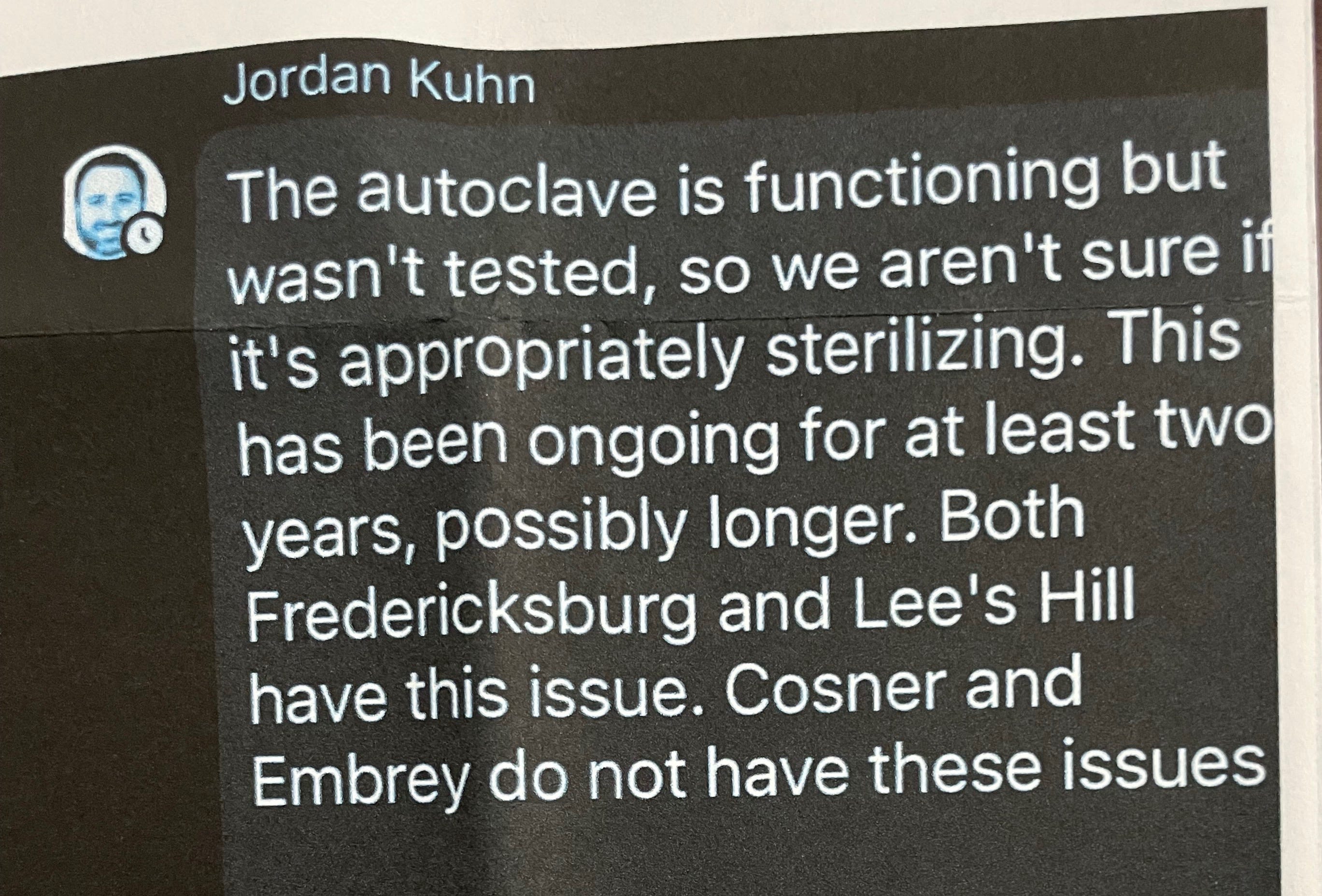
Below are confidential Mary Washington Healthcare emails hand-dated “July 28th, 2026,” and recently provided to The Advance. All were screenshotted, like the one above. None have been edited; grammatical errors and typos have been left in for accuracy. Most were written by Dr. Jordan Kuhn, chief of Obstetrics and Gynecology at MWHC.
Posted after the emails is a list of questions submitted by The Advance to Dr. Kuhn, followed by the MWHC response—with few direct answers—sent to The Advance late Thursday by Kendra Gerlach, MWHC vice president of marketing and corporate communications.
The Virginia Department of Health, contacted earlier yesterday, was not able to confirm receipt of a whistleblower complaint about MWHC, or any subsequent investigation of the hospital corporation.
Centers for Disease Control guidelines require that spore testing, a form of biological monitoring, be conducted at least weekly on steam sterilizers known as autoclaves to verify that the sterilization cycle has completely destroyed highly heat-resistant microorganisms on surgical—and in this case gynecological—instruments to be used on or inserted inside patients’ bodies.
RhoGAM is an injectable medication made from human blood plasma used to prevent often fatal Rh incompatibility between Rh-negative mothers and their Rh-positive babies.
MWHC EMAILS
[Author name cut off]
Hi Team,
Effective immediately, do not use the metal speculums. Until the autoclaves have been spore tested and cleared by the Medical Group Lead Nurse (Jennifer Freeland) and the compliance team. For the patients who needs pap smear tomorrow, please use the plastic speculums. Thank you.
***
Jordan Kuhn
This also extends to anything that is autoclaved: tenaculums, uterine sounds, suture removal kits, tischlers for colposcopies etc.
***
Ashley M. Goss [Director, Ambulatory Women’s Health, MWHC]
Until our AVP, Jen Freeland is able to provide next steps and a recommendation, if we need disposable suture/staple removal kits, uterine sounds, or any other single-use instruments, please let me know. I will work with the service line team, the hospital, and supply chain to try and obtain what is needed for patient care.
***
Jordan Kuhn
It’s all in the the process of being addressed. Other things were found during the inspection and they’re being addressed. The first issue we worked through involved the RhoGAM injections. A temperature indicator on one of the shipment boxes was triggered, and we couldn’t determine whether the indicator changed before or after any doses were administered.
One dose from the affected box had already been given. Out of an abundance of caution, we contacted every patient who received a dose from that shipment, informed them of the situation and discuss the next steps. All affected patients are being offered a repeat dose. That was done yesterday.
We are working on the autoclave situation and how it will be managed next. I’ll give more information when I have it.
***
Jordan Kuhn
For what I’ve been told when this was discussed:
If the current spore testing passes, it confirms that the autoclaves are functioning properly and are capable of achieving sterilization now. It doesn’t prove that every load processed over the past several years was sterile.
That said, if there have been no mechanical issues, routine maintenance has been performed, the chemical indicators and cycle parameters have been appropriate (which they have), and the autoclaves pass spore testing, the likelihood of a long-standing, undetected sterilization failure is considered to be very low. Which is a different situation than if they fail it now.
The extent of the issue determines the response.
***
Jordan Kuhn
Just to provide some context on why the Fredericksburg office is currently using disposable plastic speculums instead of instruments that require the autoclave: during an administrative walkthrough of the office yesterday, several significant issues were identified, including concerns related to autoclave testing and maintenance.
These issues are actively being addressed, and the plan is to return to using the autoclave once everything has been corrected and is fully compliant. In the meantime, the office will be undergoing a comprehensive review of its processes and operations to ensure everything meets the appropriate standards.
***
Jordan Kuhn
The autoclave is functioning but wasn’t tested, so we aren’t sure if it’s appropriately sterilizing. This has been ongoing for at least two years, possibly longer. Both Fredericksburg and Lee’s Hill have this issue. Cosner and Embrey do not have these issues.
All of the points and discussions you have mentioned have been discussed and are being worked through. Danny and Jen Freeland are taking charge of addressing and fixing the issues personally.
ADVANCE QUESTIONS SUBMITTED FOR DR. KUHN
Why did it take two years--and possibly longer, as many as five, as I understand it--before hospital staff and administrators discovered the lack of spore testing of autoclave machines, which CDC guidelines say should be tested at least once a week, more often with heavy use?
How will you be able to find out how far back the lack of spore testing actually goes?
What are the results of testing of autoclave machines since this was discovered back in July (and if the discovery was earlier than that, please let me know)?
Are your Fredericksburg and Lee’s Hill OB/Gyn offices still using plastic/disposable speculums, tenaculums, uterine sounds, etc.? What has been the cost of this increased use of disposables?
Do you still intend to use the autoclave machines that weren’t spore-tested the past two years+, or replace them? What will be the cost of replacement?
What are your plans for notifying patients of the lack of testing for safe and proper sanitization of anything autoclaved, and patients’ possible exposure to STDs? How many patients would that be?
It’s been suggested [in a hospital whistleblower letter addressed to the Virginia Department of Health] that all patients who came in for annual exams, pap smears, or any procedure that required a speculum, including those used during certain pregnancy exams, be notified and receive STD testing. For pregnant patients, it’s been suggested that their children, spouses, and sexual partners also be tested. What is your position on this? What would this cost MWHC?
Have you been made aware of any cases of STD transmission possibly related to this lack of proper sanitization and testing?
How do you account for proper spore testing and testing logs being maintained at the Cosner and Embrey locations, but not at Fredericksburg and Lee’s Hill?
Who made the discovery of the lack of spore-testing, and when was that? Who was responsible for the lack of spore-testing, and is that person or persons still employed at MWHC?
It’s been at least three months since the discovery but there’s been no public notification of these concerns. Why is that?
Have you been in contact with the Virginia Department of Public Health about this, or have they contacted you and done any follow-up investigation?
Has there been any penalty by the state for Mary Washington’s failure to follow CDC guidelines for spore-testing autoclaves?
MWHC RESPONSE
Autoclave Sterilization
When Mary Washington Healthcare leadership learned that autoclave machines at its Fredericksburg and Lee’s Hill practices were not meeting routine spore-testing requirements, immediate action was taken to investigate and address the issue. The machines were removed from service, disposable instruments were put into use, and reusable instruments were sterilized at another MWHC location.
Infection Prevention, Infectious Disease and external sterilization experts were consulted, and the machines underwent thorough inspection and testing.
Repeated spore testing yielded negative results for all machines tested. MWHC also identified no evidence of sexually transmitted or other bacterial infections at either location related to this issue.
Following its investigation and consultation with clinical experts, MWHC determined that notifying patients as well as the Department of Health was not needed.
MWHC has addressed the testing and compliance issues identified during its investigation and reinforced sterilization procedures through additional associate training and education. Patient safety remains our highest priority, and we are committed to maintaining rigorous standards of care across our practices.
Rhogam
Regarding Rhogam, we identified a patient safety concern and addressed it swiftly with zero harm to our patients. Only one Rhogam dose from a box of five was found to be not at proper temperature. Out of an abundance of caution, all 11 patients who received doses from that batch were immediately contacted and provided a second dose.
***
Steve Watkins is editor of The FXBG Advance. You can contact him HERE.
Yet another failure of leadership under CEO Chris Newman.
When is the hospital board going to step up and clean house? Who is looking out for the community?
I have no words....