By Claire Marshall Watkins, ASSOCIATE EDITOR
Like many twenty-somethings, I’ve done a few stints on dating apps over the years. I’ve made a few friends this way and met a special someone once or twice, but I am also a big critic of these platforms. Dating apps, to me, are comparable to cigarettes. People who use both know these things are bad; they know it’s unhealthy, but they do it anyway. So a while after my relationship ended––as did my graduate program, and thus a major part of my social life––I downloaded Hinge to meet new people. I soon forgot I had downloaded it, and a few weeks went by before I checked it again.
I kept the Hinge app separate from my home screen in the same little bubble where I attempt to hide Instagram from myself. As I went to sneak an Instagram scroll earlier this week, I noticed Hinge also sitting there—like old leftovers in the fridge. Curious to see if it was digestible, I opened the app and saw a message from the most recent user who attempted a match. His profile didn’t have a name, just “A,” like the anonymous stalker from the teen drama Pretty Little Liars.
I read it, reported “A,” and deleted Hinge––not just the app, but my whole account. I think a lot of people go through the download-and-delete cycle when it comes to dating apps, but it’s safe to say this was my final turn-off. Here’s what “A” wrote:
Go to ChatGPT, upload one of your photos, and type a prompt like, “Can you create a Kerala wedding bride look for me?” You can see how beautiful you look in a Kerala bridal style. You can see our wedding look!
:) please check out
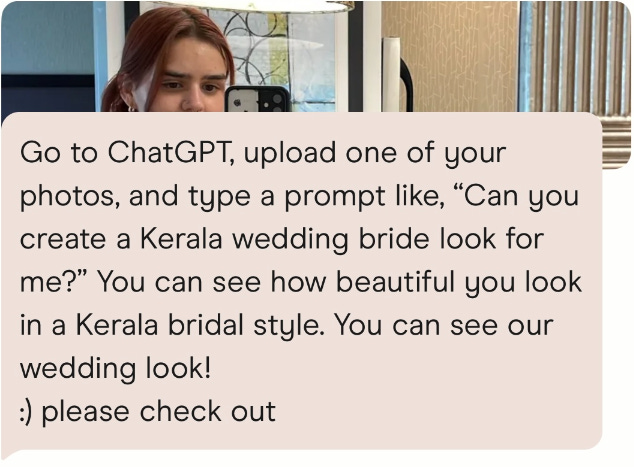
“A” had confessed to using one of the photos from my profile––coincidentally, or maybe not, he left this message attached to a photo of me in a small, crocheted crop top––and uploading it into a generative AI server without my consent.
A few things occurred to me.
One: It could have been so much worse. He could have made a deepfake, but to my knowledge, he didn’t.
Two: If he hadn’t told me he had done this, I would never have known. Anyone can take any photo from a dating app and upload it into ChatGPT or similar platform and do whatever they want with it. I hadn’t realized that was something that could happen; I’d never thought about it. Nor, I assume, has any other decent, rational person.
With the rise of AI and other invasive technologies, women face new, uncharted threats in their dating––and everyday––lives. Meta Glasses, which have built-in cameras to record the user’s point of view, are one major part of this. Since the start of 2026, the BBC has run several articles about women finding videos of themselves online recorded on Meta Glasses that they were unaware had even been filmed.
Deepfakes are another threat; the Metropolitan Police in London defines them as “digitally created and altered content often in the form of fake images, videos and audio recordings.” The only categories that make them illegal, however, are intimate image abuse or “revenge porn,” child sexual abuse material, hate crime, fraud, false communication, terrorist activity, stalking and harassment, and blackmail.
So reporting “A” on Hinge was really all I could do. But of course, as I thought about the message, more scenarios occurred to me. Now that “A” has uploaded an image of me, ChatGPT has that information––what my face and body look like––to generate anything at any point. If “A” wanted to generate another image or video using my likeness, he could. A random person anywhere in the world could ask ChatGPT to generate a photo or a video of a woman, and ChatGPT could pull characteristics of mine from that photo to use.
According to the site itself: “OpenAI’s foundation models, including the models that power ChatGPT, are developed using three primary sources of information: (1) information that is publicly available on the internet, (2) information that we partner with third parties to access, and (3) information that our users, human trainers, and researchers provide or generate.”
I know that everything posted on the internet is there forever, but I certainly didn’t anticipate that fact to manifest in such a harsh, invasive manner as generative AI training itself on that material.
Most––if not all––dating apps have protocols in place to ban users for inappropriate behavior and language. They also give users the option to report inappropriate behavior and language. But they could be doing more in terms of prevention. If Snapchat can alert users when their chat, story, or photo has been screenshotted, and Netflix can block screenshots on their platform, Hinge can adopt a similar protection. I think Hinge, and all dating apps, should ban screenshots entirely to block users from doing what “A” did, or worse.
I get it; it’s fun to show your friends who you’ve found on the apps. You want their opinion or to show them a sweet or funny message. I’ve taken a screenshot or two of endearing messages to show my friends, but now that I realize what risks there are, I am happy to give up that option for the sake of safety. Blocking screenshots won’t rule out 100 percent of digital threats or deepfakes, but it would make these things a lot harder to do. I’ve given up on the apps entirely, but for those who haven’t, I say that if they want to show something to their friends, they ought to do it in person.
***
Claire Marshall Watkins is an alumna of the University of Mary Washington, and has just completed a master’s in journalism at Goldsmiths, University of London. You can read more of her writing on her Substack, Virginia Magnolia.