
By Martin Davis
EDITOR-IN-CHIEF
Email Martin

Presidential election postmortems are a quadrennial exercise in self-flagellation. As hindsight they’re little more than speculative. As foresight they have the dependability of a Magic 8 Ball.
The 2012 Republican postmortem, for example, dinged the party for being out of touch, narrow-minded, and the party of “stuffy old people.” A cascade of Republican presidential wannabes zigged toward those findings in 2015. Donald Trump zagged and has controlled the party ever since.
Even by the low standards of post-mortems, however, the release this week of the Democratic Party’s analysis of the 2024 election is embarrassing.
To begin, the Democratic National Committee disavowed the report, as made clear by the following disclaimer on page 1, and each page thereafter, of the 192-page slog.

Things only get worse from there, with notes throughout the Report that annotate the sloppy research.
Hence:

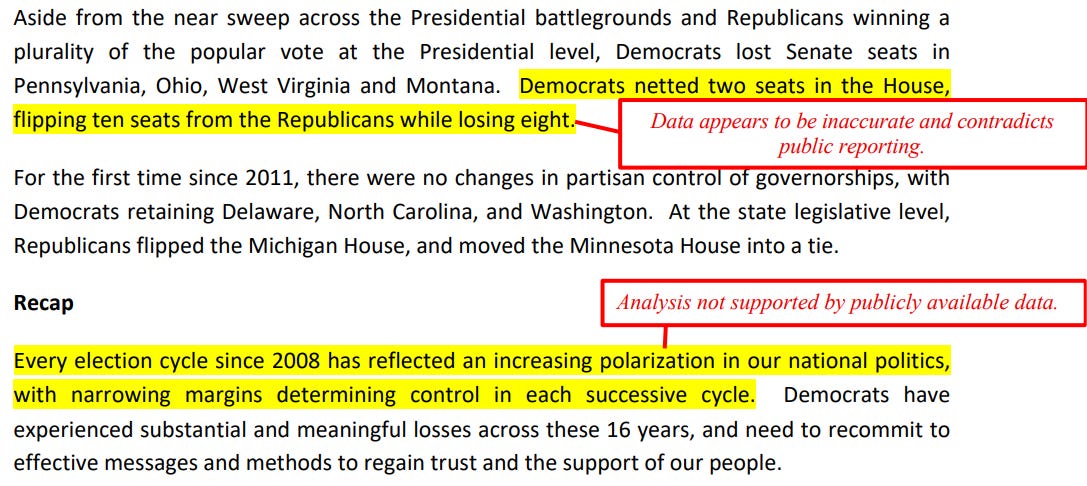


As such, this “Report” reads more like a college professor’s brutal beatdown of a young graduate student’s research than a mature breakdown of a challenging problem.
A poorly crafted report, however, still offers insights that are worth exploring.
Reading Between the Lines
There are plenty of summations of what is in the report. Its findings are not of great interest. Read between the lines, however, and a narrative quickly becomes clear.
This postmortem reveals that the Democratic Party, like its Republican counterpart, is a party at war with itself.
Whereas the factions within the Republican Party are pretty well understood, the Democrats don’t seem to have a handle on the factions that are tearing the party apart. Perhaps they can’t see them because the party’s vociferous distaste for Donald Trump masks the divisions resting below the surface.
While the Dems seem to be in the dark, however, the British publication The Economist has done a good job of creating a typology of the divisions that are hamstringing the party at every level.
Four Tribes
Analyzing 19,000 responses from Democrats to the Co-operative Election Study, The Economist identified four major tribes within the party.
Understanding these tribes is important for grasping what the 2024 postmortem has to offer. Herewith, a breakdown of The Economist’s findings.
Progressives — Led by Bernie Sanders and Alexandria Ocasio-Cortez. They represent some 40% of Democrats and have an average age of 45. Other hallmarks include:
Largest, youngest, whitest grouping
56% are college-educated or higher
Pro social spending, tax rises on the rich
98% believe in white privilege
Establishment Dems — Led by Mark Kelly and Gretchen Whitmer. They are 29% of Dem voters and have an average age of 58. Other hallmarks include:
Oldest group of Dems
Pro-border patrols and police spending
90% support raising corporate tax
Bootstrap Dems — Leaders are Henry Cuellar and Marie Gluesenkamp-Perez. They are 18% of Dem voters and have an average age of 50. Other hallmarks include:
Most religious group
Support increasing police expenditures
Fewest believers in white privilege
Lowest support (70%) among Dems for abortion
Isolationists — Leaders are Ro Khanna and Barbara Lee. They are 13% of Dem voters and have an average age of 47. Other traits include:
Highest share of women (70%)
Highest share of Black/Hispanic voters
Against involvement in Ukraine War
Regarding what these tribes mean for the party’s ability to win in 2028, the Economist said the following:
The party will not cohere, if it ever does, until the 2028 presidential primary is over. But this work makes clear that the eventual winner of that contest cannot afford to alienate the party’s progressive bloc, which has swollen during the Trump era.
That reality — that the party has to find a way forward that doesn’t alienate its progressive core — sits at the heart of the Democratic Party’s problems. And that problem stands front-and-center in the 2026 postmortem.
How to Solve a Problem Like Progressives
The progressive wing of the party — like the MAGA wing of the Republican Party — doesn’t deal in the language of compromise. Indeed, compromise is the antithesis of a progressive wing that demands action right now on the pet issues that drive them.
That is the point that former Massachusetts Congressman Barney Frank made in a New York Times interview before his passing this week.
“The key to liberal democracy being able to come back,” he said:
is to get rid of the perception, that we have allowed to grow, that the entire Democratic Party is committed to a series of very drastic social reconstructions that go beyond the politically acceptable.
In particular he points to the issues of transgender sports and Medicare for All. His argument isn’t to not advocate for these issues, but rather to understand that winning on those issues will only come over time and will require winning on more palatable issues related to each before winning on the components that are politically the most challenging.
Referring to his own advocacy for gay rights, Frank told the Times that:
When we were fighting for gay rights …. we knew that some issues were more popular than others. So we tended to start by trying to win the ones that were most popular. Gays in the military. Employment. … [W]e didn’t make marriage a litmus test, until the very end.
What this disjointed Democratic postmortem reveals is that at least some in the party see this problem.
From the Report: “Democrats must accept it is more important,” he wrote, “to deliver on what they promise and then make sure our constituents are aware we are fighting for the things they care the most about.” [Emphasis added]
The Report also acknowledges that the attack ads on Kamala Harris’ stance on transgenderism were highly successful. The Report’s flaccid analysis? Rather than build a platform that most voters actually care about, lean into “But Trump …”
If the Vice President would not change her position – and she did not – then there was nothing which would have worked as a response. The pollsters generally concurred with the opinions shared by campaign leadership - given the stakes and timing, the focus needed to be on attacking Trump.
This is the problem that Democrats are going to have to learn to solve. And they won’t solve it by running on transgendered high school athletes and Medicare for All.
There are elements of the Democratic Party that get this, and they have enjoyed success. Abigail Spanberger rode to the Governor’s Mansion in Virginia by leaning into the day-to-day pain Virginians are facing simply trying to survive in an increasingly expensive environment.
Yet, Spanbeger is not embraced by the progressive wing, which deems her too friendly to corporate interests and too slow to embrace radical societal change.
It took Spanberger less than a month to cave to progressive pressure and transition from what brought her into office to focusing on redistricting — a position that appeals more directly to the progressive wing of the party and has little interest among establishment, bootstrap, and isolationist Dems.
Her shift proved to be a political faux pas that not only detracted from the legislative victories gained in the General Assembly on affordability issues, but has simultaneously energized Republican voters in the state, thereby potentially shifting Virginia this November from solid blue back to purple.
Building Coalitions
So where does the party go?
While progressives hold the party by the numbers, Democrats must come to terms with the reality that progressive ideas are not going to win elections. And they can’t allow progressives’ anger-fueled policy ideas to push the adults in the room to the corner as happened in Virginia on the redistricting issue.
This means getting real about how to fight the battles Democrats want to fight in a way that brings people along with them, as opposed to pushing litmus tests.
Yes — it takes time. No — they will not get everything they want right now.
Democracy is about compromise. It’s about building coalitions and bringing people along. Not beating people into submission.
Even Donald Trump is finding the limits of what he can get away with. Republicans are joining with Democrats to push back on his $1.8 billion slush fund, and having tax payers foot the bill for his ballroom.
The push for transgender sports, defunding police, and an unwillingness to seriously engage on immigration is costing Democrats elections. Right now, they only win because they have Trump to run against.
This Report does acknowledges as much:
“Our candidates have proven incapable of projecting strength, unity, and leadership,” the report says, “and voters have drifted away. Indeed, many of our critical Democratic wins can be attributed to negative partisanship – where Republicans have nominated deeply flawed candidates, and we have been able to convince some Republicans and most Independents to support Democrats in those contests.”
But rather than discuss how to deal with the extremists in its own party, this postmortem perpetuates the canard that the party is just a whisker away from the glory days of Obama.
Indeed, it argues explicitly that elections are really much closer than they look, and all the party really needs to do is organize better, and watch the victories come.
That this Report can both finger the problem, and then continue to spread the misguided belief that the country is ready to rally to Democrats with just a few minor changes, is the best example of the dangerous hold progressives have on the party.
Indeed, expect the party to continue leaning into the progressive’s anger. And losing elections.
Anger, after all, gets one only so far.
At some point, the adults have to check that anger and do the hard work of governing.
The Republicans forgot that and got Donald Trump.
The Democrats refuse to learn that, and have a backbench of progressive demagogues lined up to run.
The Coalition We Need
The race is now on to see which party will check its noncompromising extremes and actually engage in the hard work of governing.
The Democrats best chance to win in 2028 is to embrace realistic ideas and front candidates who make clear they will do the hard work of governing.
In doing so, they will find some unlikely partners in governing — Republicans who are trying to check the extremists in their own party and lean again into ideas.
It’s a coalition the country can grow with.
Updated May 23 to reflect Barney Frank representing Massachusetts.


Local Obituaries
To view local obituaries or to send a note to family and loved ones, please visit the link that follows.

Barney Frank was from Massachusetts, not New York.