
By Martin Davis
EDITOR-IN-CHIEF
Email Martin

Digital Insights is a weekly feature usually appearing on Thursdays that explores the role of data centers in our region. These columns will focus on four areas: tracking the development of data centers in our area, exploring projected and actual tax revenue trends, explaining what data centers are and how they affect our daily lives, and reporting on research and emerging trends in the industry. These columns are made possible, in part, by a grant from Stack Infrastructure.
People attending the debate at the University of Mary Washington’s Seacobeck Hall earlier this month can be excused for believing a brawl might break out.
The post advertising the always-spirited debates sponsored by the Center for AI and the Liberal Arts showed the individuals — Anand Rao, head of the center, and Stefan Baushard, founder of EducatingForAI — in their best gladiatorial postures.

And then there’s the topic. Artificial Intelligence has its evangelists and doomsday prophets, with most people expressing levels of concern about where this is all going. Surely suggesting that UMW should become an AI university would stir the dust.
The debate itself is worth the time (watch it here). Rao and Baushard are debating champions from their early days at the University of Pittsburgh, so what looked adversarial was really two spirited friends trying their best to win over a room of obeservers.
At the end of it all, Baushard — arguing against making UMW an AI university — carried the day. But a critical question raised during the event remained unanswered.
Is AI just another tool, or is it fundamentally altering the way we think about interacting with institutions?
Though an “academic” debate in the confines of ivy-covered halls, that question is far from academic outside those walls.
Struggling to Understand, Eager to Learn
The Virginia Chamber Foundation recently published a “Virginia AI Landscape Assessment” that involved 520 attendees from across the nine GO Virginia regions.
While the individuals taking part were spread across the AI enthusiasm scale, the report suggests that AI is far more than just “another tool” for business to marshal.
Responding to a question about training for AI, one participant said they wanted:
Dynamic solutions that… “transcend” training as one-shot knowledge transfer is not likely to align with the new normal.
AI, in other words, is not simply being integrated into the work force, it is fundamentally altering what work is and how we experience it.
And it is happening rapidly here in Virginia.
In fact, it is happening here more rapidly than in most other parts of the country. The report says, for instance, that, according to a July 2025 OpenAI study “Virginia had the highest quarter-over-quarter growth in use of ChatGPT among all states.” The tool is being used for “learning and upskilling, writing and communications and programming/data science/math activities.”
With more-complex Generative AI tools like Claude by Anthropic, Virginia ranks 5th nationwide in use.
As aggressively as AI is being adopted, however, there’s considerable concern about the incongruous ways it’s being adopted.
More than 60% of participants either aren’t offering training, or are beginning to think about offering it.
Nearly 50% of respondents, however, say that AI is being used daily, while another 32% say it is being used several times a week.
This means that employees are largely figuring out on their own how to use this technology.
This haphazard approach is largely due to the rapid evolution of the technology at a time that senior level officials are still trying to grasp what AI can do and how to deploy it effectively.
Consequently, just 3% of participants said they are redesigning whole units or businesses around AI.
Expect that number to grow rapidly as understanding begins to catch up to AI’s potential.
Getting there, however, is going to require a radical reform in what’s expected of employees.
As one commentor noted, “To be effective in Gen AI, we need to demystify critical thinking. We must teach people how to think.”
That marks a fundamental shift in what is asked of employees. Noted another participant: ““For the last century, we have taught our workforce to be makers. Now we need to teach them to be thinkers, problem solvers.”
Changing Institutions
This shift to demanding people be thinkers, and not makers, has ramifications that will fundamentally require restructuring several core institutions — starting with education.
A quarter century on, the U.S. educational system, as here in Virginia, remains slavishly committed to rote memorization and outcomes measurements based on tests that reward memory over problem-solving.
The report also found, however, that at this point Virginia is trailing other states like Maryland and Arkansas that are more aggressively exposing students to AI in their K-12 and higher-ed environments.
It could also profoundly affect government. As Ezra Klein noted in his book Abundance, government has become too focused on restrictions and roadblocks to innovation, as opposed to an organization that solves problems and moves society forward.
Though unsettling, the participants in the study grasped that while revolutionary, such changes are not likely to lead to massive replacement of workers, but rather a massive realignment of how people work.
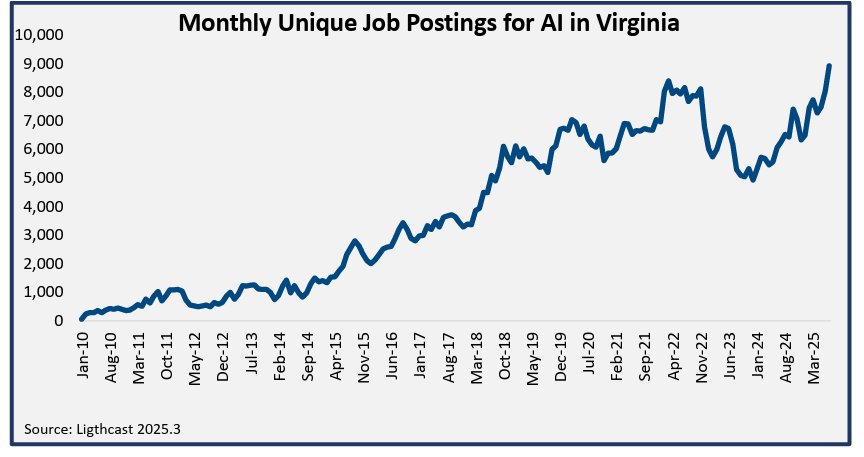
We’re already seeing this in Virginia, where unique job postings for AI focused roles are on the rise. Leading the way are Capital One and Amazon, along with other contracting groups like CACI, Booz Allen Hamilton, and Deloitte.
Not surprisingly, these jobs are mostly being generated in Northern Virginia’s Region 7.
Debate Won?
Anand Rao may have lost his debate at UMW earlier this month, not convincing the audience that the school should become an AI university, but he may well prove to be right in the long-run.
The high level of uncertainty in the business world, as well as the educational world, about what to do with AI is understandable. Adoption is uneven, and both businesses and schools are struggling to figure out how to train people in its use, much less aggressively integrate it into day-to-day work.
Yet despite that, Virginia is adapting and adopting quicker than most states in the union.
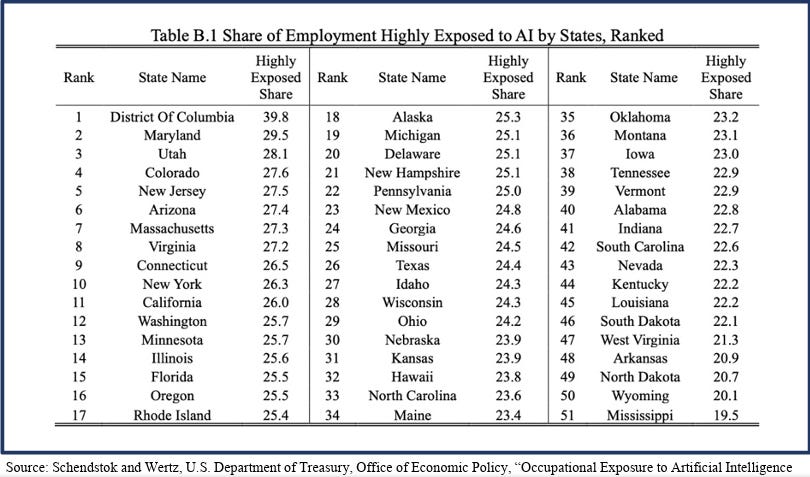
Fully 27% of jobs in Virginia are “highly exposed” to AI, according to a Treasury Department study. The two states at the top of that list — the District of Columbia (39.8%) and Maryland (29.5%) are intertwined with Northern Virginia’s and Hamptons Road area economies.
And the technology is only celebrating its 4th birthday.
Where this technology is taking us, and how it will shape our institutions and the way we interact with them, remains to be seen. The changes are coming so quickly and are so significant that prognostications are unlikely to have shelf lives beyond a couple months.
But Rao is likely more correct than he may even know. Perhaps he lost the debate not because he didn’t have the better arguments, but because the question he was addressing didn’t go far enough.
Rather than should UMW become an AI university, perhaps the better question is will non-AI universities survive the ongoing integration of AI in our lives?


Local Obituaries
To view local obituaries or to send a note to family and loved ones, please visit the link that follows.

Better ramp up the propaganda. The dominos are starting to fall.
https://www.reuters.com/business/oracle-plans-thousands-job-cuts-data-center-costs-rise-bloomberg-news-reports-2026-03-05/