

By Martin Davis
EDITOR-IN-CHIEF
Email Martin
Digital Insights is a weekly feature usually appearing on Thursdays that explores the role of data centers in our region. These columns will focus on four areas: tracking the development of data centers in our area, exploring projected and actual tax revenue trends, explaining what data centers are and how they affect our daily lives, and reporting on research and emerging trends in the industry. These columns are made possible, in part, by a grant from Stack Infrastructure.
Golfing the Back Nine on a sunny afternoon with a cold beer in the cart and green grass underfoot isn’t where one’s thoughts typically turn to data centers. But the two share something in common.
The same water that is often used to keep fairways verdant and putting greens green is being applied to cool data center projects — and it’s not the water that comes from the tap when one needs a cool drink.
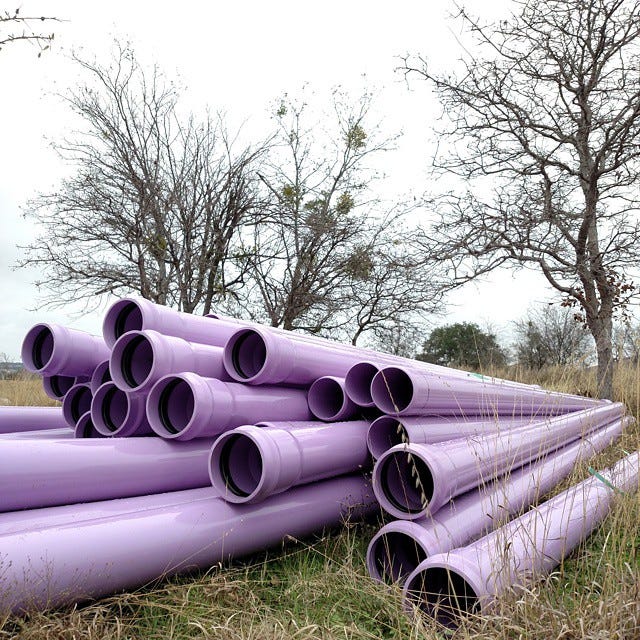
Rather, it’s water that pours from so-called “purple pipe.”
Purple pipe was born in the 1980s when the city of Irvine, California, needed a color-coding system to keep drinking (or “potable”) water separate from reclaimed water. Coloring reclaimed water pipes purple makes clear what is safe for human consumption and what isn’t.
In the American West, where concerns about the supply of drinking water are acute in desert-based cities like Los Angeles and Phoenix, the idea of using reclaimed water gained popularity throughout the 1980s and 1990s as a tool for supplying water to public sites like golf courses for watering. Using reclaimed water meant public sites could be kept green without decreasing the supply of potable water.
More recently, purple pipe water has become central to cooling data centers. Loudoun County, Virginia, has been on the cutting edge of this trend.
As the county’s data center industry expanded, the county turned to reclaimed water in 2010 to address concerns about using fresh water to cool the chips that are the backbone of the nation’s digital network.
Today, Loudoun Water provides nearly 800 million gallons of reused water available to industrial customers through its purple pipe network.
What Makes Purple Pipe Effective?
There are two water-cooling techniques that data centers can use to cool their chips. One involves combining water with cooling chemicals. It’s effective, but it requires considerable energy. For an industry that already is placing extraordinary demands on the energy grid, that is a concern.
The other is “evaporative” cooling. It works by forcing warm air over moisture-soaked pads that cause evaporation. As water evaporates, it’s turned into a gas, and its temperature is lowered. This system isn’t as energy intensive, but it does require a considerable amount of water.
That’s problematic if the water is potable water. Enter purple pipe and reclaimed water.
For every gallon of reclaimed water used in data center cooling, that’s one gallon saved for human consumption.
And that’s not just true for data centers. Reclaimed water has an expanding list of uses across the United States, meaning that communities set up to reclaim water for local use can sell the excess reclaimed water to surrounding communities.
Here in Virginia, Fairfax County has been selling reclaimed water for some time. The county earns about $1 million annually selling reclaimed water.
Just the Start
As with every aspect of the tech sector, innovation in cooling technologies is ongoing. In the next edition of Digital Insights, we explore some of the promising new approaches to cooling data centers.


Local Obituaries
To view local obituaries or to send a note to family and loved ones, please visit the link that follows.

Support Award-winning, Locally Focused Journalism

The FXBG Advance cuts through the talking points to deliver both incisive and informative news about the issues, people, and organizations that daily affect your life. And we do it in a multi-partisan format that has no equal in this region. Over the past year, our reporting was:
First to break the story of Stafford Board of Supervisors dismissing a citizen library board member for “misconduct,” without informing the citizen or explaining what the person allegedly did wrong.
First to explain falling water levels in the Rappahannock Canal.
First to detail controversial traffic numbers submitted by Stafford staff on the Buc-ee’s project
Our media group also offers the most-extensive election coverage in the region and regular columnists like:
And our newsroom is led by the most-experienced and most-awarded journalists in the region — Adele Uphaus (Managing Editor and multiple VPA award-winner) and Martin Davis (Editor-in-Chief, 2022 Opinion Writer of the Year in Virginia and more than 25 years reporting from around the country and the world).
For just $8 a month, you can help support top-flight journalism that puts people over policies.
Your contributions 100% support our journalists.
Help us as we continue to grow!


This article is published under Creative Commons license CC BY-NC-ND. It can be distributed for noncommercial purposes and must include the following: “Published with permission by FXBG Advance.”