By Michael Aubrecht, ADVANCE CONTRIBUTOR
[Editor’s Note: Mary Washington Heritage Museums and local tree activists have been working for several months on renovation and landscape design at the Mary Washington Monument and Caretaker’s Lodge, including protection and care of the famous Eskridge Oak, which Tree Fredericksburg President Anne Little discusses, above, in an interview with Ted Schubel for B101.5. With all that in mind, we thought it would be a good time to ask our resident Colonial-era (and Civil War-era) historian, Michael Aubrecht, to send over a refresher essay on the mother of the father of our country. Here’s Michael’s report:]
Mary Ball Washington, the mother of the father of our country, was born in Lancaster County Virginia in 1708, one of many siblings in a combined family. Her father was a gentleman named Joseph Ball, and her mother the widow Mary Johnson. The first Ball family home was located at Epping Forest where Mary Ball’s grandfather, William Ball, had immigrated from England around the year 1650. Unfortunately, as often happened in Colonial times, both of Mary’s parents died when they were still young parents, leaving her fatherless at 3 and motherless at 12 or 13.
In accordance with the terms of her mother’s will, the orphaned Mary was placed under the guardianship of. George Eskridge, a local attorney and friend of the Ball family. For the next decade, she lived with the Eskridge family, along with her married half-sister Elizabeth Bonum. Although there are not many records on this part of her life, it is apparent that Mary was well cared for. She was educated, an avid reader, and a skilled equestrian.
By 1731, Mary had reached the age of 23, which was considered old-maid status by Colonial standards. Once again, fortune favored her as she met a strapping entrepreneur named Augustine Washington. Augustine’s family, much like Mary’s, had been in the colonies since the mid-1600s. He too was educated and had been schooled in England. Augustine was a well-established widower, 14 years Mary’s senior, with three children, Lawrence, Augustine, and Jane.
Obviously there are no photographs of Mary Ball Washington, but there are several documented impressions of her as a young woman. She was considered to be tall for a female, and later said to resemble the man who would become her eldest son, George. Augustine’s son Lafayette was said to have likened Mary to a Roman matron, while a contemporary, Eleanor Parke Custis, described her as “remarkably plain in her dress.”
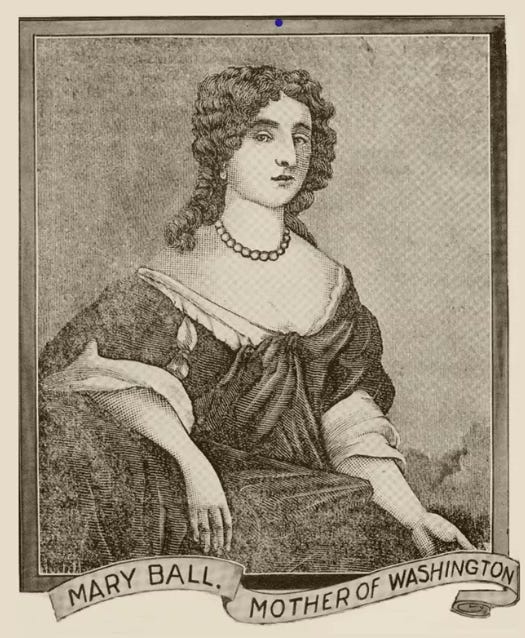
After a brief courtship, Mary and Augustine Washington were married Augustine filled the much-needed role of provider while Mary became a nurturer for his children.
When she married Augustine, Mary brought her inheritance, including over 1000 acres of land at Epping Forest, a plantation in Lancaster County, Virginia, and enslaved labor, which was typical for wealthy Virginia families of the time. Mary had inherited three slaves from her father. It is recorded that 57 enslaved men, women, and children served the family on the Washington farm.
The Washington family lived on a 150-acre plantation called Pope’s Creek, which was later renamed Wakefield, where they prospered and the family grew. The following February Mary gave birth to a son, the first of six children. They named him “George” after George Eskridge, Mary’s adopted father. Mary and Augustine eventually had six children altogether: George, Betty, Samuel, John Augustine, Charles, and Mildred, who died at 16 months. Remarkably, most of the entire Washington-Ball clan found success in their adult lives. Betty married Fielding Lewis and built the Kenmore Estate in Fredericksburg. Samuel served as a justice of the peace and a lawman in Stafford County. John Augustine founded the Mississippi Land Company. Charles helped to establish Charles Town in West Virginia. George, of course, went on to become the first president of the United States of America.
The Washingtons moved to Hunting Creek in 1736, which was later christened Mount Vernon, and in 1738 Augustine purchased what would later be named Ferry Farm in Stafford County to be closer to his iron business. Here was where the tall tales that would become ingrained in George Washington’s legacy originated: a young George confessing to chopping down a cherry tree, and throwing or skipping a silver dollar across the Rappahannock River. After settling at the new homestead, Mary kept busy with overseeing the day-to-day operations of the farm and tending to her children, while Augustine focused his energies on his other business interests.
In 1743 tragedy repeated itself in the life of Mary Ball Washington, as her husband passed away unexpectedly at the age of 49, making her a widow, with five children, at 35. George was only 11 at the time of his father’s death. In accordance with Augustine’s will, Mt. Vernon was left to George’s half-brother Lawrence, while the 600-acre family farm across the river from Fredericksburg was left to George. Provision was made for Mary to receive the benefit of the crops for five years and possession of the property until George came of age. Various portions of other land holdings and personal property were divided among the all of the siblings, including the slaves.
Although there were tumultuous years that followed, Mary was said to have remained a vigilant parent. Historians over the years have traced George’s epic honesty and fortitude to the influence of his parents, some even crediting his mother alone with his rise to greatness.
Mary remained in mourning and lived in Fredericksburg for more than 45 years after the death of her husband. She never remarried, which could be viewed as a testament to her constitution and strong will. She was, by all accounts, a self-supportive woman, although she was obliged, once George came of age, to rely on his generosity for financial support. As George’s military and political career prospered, his mother continued to be manage the land that her husband had purchased at Ferry Farm.
Years passed, and the relationship between Mary and George was said to have deteriorated. Although Mary was by no means poor, she regularly complained to outsiders that she was destitute and neglected by her children—much to George’s embarrassment. This led to an animosity between mother and son that persisted for years. Despite the strain on their relationship, George remained in contact with his mother and made it a point to send her correspondence while deployed on military affairs. One preserved letter, dated 1755, followed a military engagement early on in his career and was meant to reassure Mary of his safety. George concluded his letter with the phrase “Your most dutiful son.”
At 64, Mary became too old to run the farm, and in 1772, George purchased a home for her in downtown Fredericksburg, where she lived for the remaining 17 years of her life. When the War for Independence began, General George Washington took command of the Continental Army in June of 1775 and didn’t see his mother again for nearly 10 years. During this time Mary remained in town and rarely visited the family farm.
It was recorded that Mary’s stubbornness began to rear its ugly head. She requested that the Virginia House of Delegates—formally the House of Burgesses—provide her with an allowance, since she was, after all, the mother of the Continental Army’s supreme commander. She then petitioned for a state pension, and also to have her taxes lowered. None of her requests were granted.
Despite their rift, Mary’s proudest moment may have come during a visit by her son to Fredericksburg in February 1784. After being awarded the honors of the town, George responded with a declaration honoring “My reverend mother by whose maternal hand, early deprived of a father, I was led to manhood.”
George continued to pay Mary’s rent for the livestock and enslaved workers at Ferry Farm, and in 1787 he strongly urged her to move in with one of her children. It was thought that she might live with her son John, however John died soon after, and she never agreed to go elsewhere.
Two years later, in April 1789, President-elect George Washington, en route to New York for his inauguration, paid his last visit to his mother at the house in Fredericksburg—four months before she died. It was reported that the two were reunited and repaired their relationship.
Mary Ball Washington died at 81 from cancer during George’s first year in office. She was buried at Kenmore on the Lewis plantation, a few steps from what became known as Meditation Rock, her favorite retreat for reading, prayer, and meditation. A plaque laid at the base of the rock reads, “Here Mary Ball Washington prayed for the safety of her son and country during the dark days of the revolution.”
In the 1830s, the women of Fredericksburg banded together to raise funds for a monument dedicated to Mary’s memory. The following year, the prominent Silas Burrows, a successful New York merchant who also owned an international shipping business, offered to pay for it himself. In laying the cornerstone, then-President Andrew Jackson said this about the mother of the father of the country:
“Mary Washington acquired and maintained a wonderful ascendancy over those around her. This true characteristic of genius attended her through life, and she conferred upon her son that power of self-command which was one of the remarkable traits of her character. She conducted herself through this life with virtue and prudence worthy of the mother of the greatest hero that ever adorned the annals of history.”
Mary’s first marker was destroyed during the Civil War, but another one was placed in 1893, formally dedicated by President Grover Cleveland in May of 1894 and featuring an inscription that paid tribute to what may be considered her greatest accomplishment.
It reads, simply, “Mary the Mother of Washington.”
But it was George himself who most fittingly summed up the life of Mary Ball Washington when he later wrote, “My mother was the most beautiful woman I ever saw.
“All I am I owe to my mother.”
***
Michael Aubrecht is a historian, author, documentarian, and lecturer. You can find out more about his work, including his new book project on Virginia Loyalists During the Revolutionary War, at his website The Naked Historian.