
And Follow-Up on Fredericksburg Data Center Forum
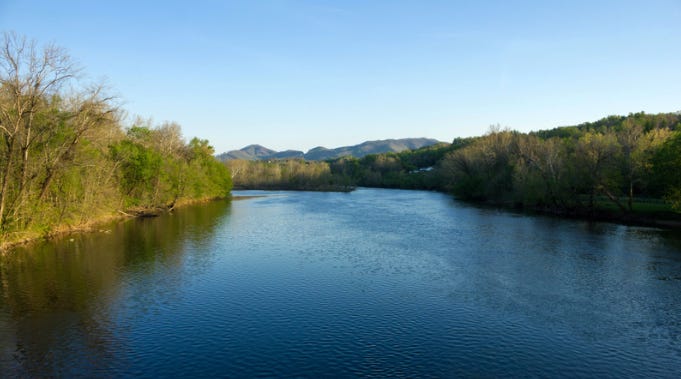
[From “Data Centers Are Destroying Virginia’s Countryside — Even in Places That Have No Data Centers,” in the the D.C.-area publication NOTUS.]
By Dana Milbank, NOTUS
The editors sent me on a hardship assignment this week. I went paddling on the James River in central Virginia.
And that wasn’t the worst of it. I had to visit a particularly beautiful section called Seven Islands, in rural Fluvanna County, much of it protected by private conservation easements and a nearby state wildlife management area.
The water rippled around rocks and under the branches of towering sycamores. Smallmouth bass scattered when my canoe approached—this was likely a favorite fishing ground of the Monacan people for thousands of years—and a red fox flushed from the tall grass. An American goldfinch called, and a spicebush swallowtail butterfly alighted on its eponymous plant, now bursting with fragrant, red berries. Pawpaws drooped under the weight of their ripening fruit.
“You’re floating down the river and it’s forest in every direction,” said Vic Sorrell, a retired school principal who, with his friends, bought 390 acres here over the years. “This area is as far away from people as you can get in Fluvanna County, and we considered ourselves safe.”
After a pause, he added, bitterly: “Nowhere is safe.”
Read the rest of Dana Milbank’s column HERE. [You may have to register to access, but it’s free.]
Meanwhile, in Fredericksburg:
Data Center Forum Brings Crowd to Downtown Library
By Jeff Eastland, ADVANCE CONTRIBUTOR
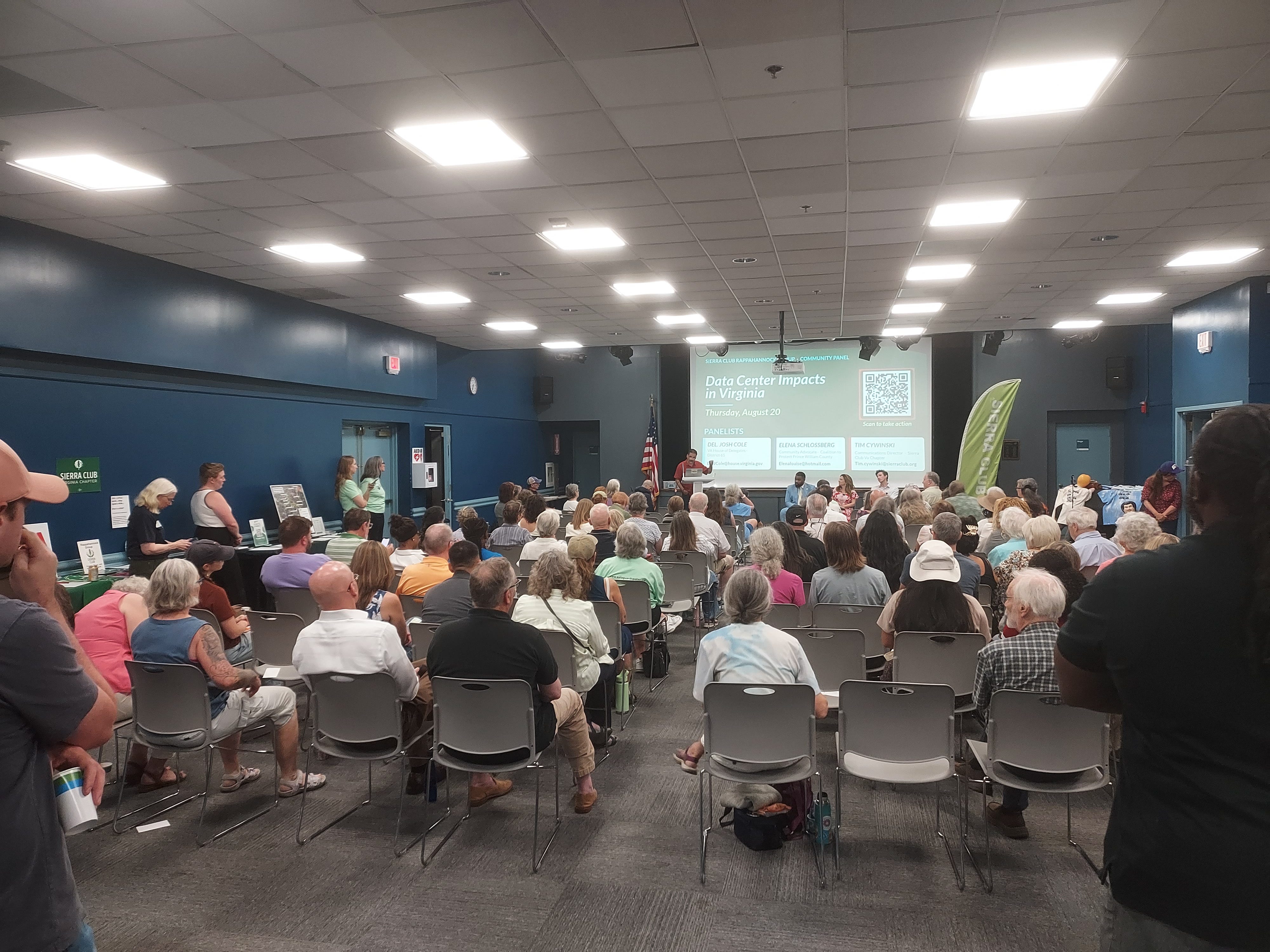
On Thursday August 20, a standing room crowd of approximately 150 people gathered for a data center forum at the downtown library in Fredericksburg. Titled “Data Center Impacts in Virginia,” the event was hosted by the FXBG Neighborhood Coalition, the Rappahannock Group Sierra Club, and the Climate Reality Project.
The forum was moderated by Ranjit Singh, associate professor of Political Science and International Affairs at the University of Mary Washington. Singh is a noted Environmental and Nature Writer on his Substack No Lines in Nature and as environmental columnist for The FXBG Advance. He also teaches a seminar on “Politics and the Environment” at the university.
Forum panelists included Delegate Joshua Cole, who represents parts of Stafford and Spotsylvania counties and the city of Fredericksburg in the 65th District. Cole acknowledged that he was still new to the data center conversation— “about 90 percent there”—unlike many of his colleagues in the legislature, who he said seem to think they know more than their active constituents about data centers.
Also on the panel was a person many see as the true leader of the data center opposition movement, Elena Schlossberg, director of the Coalition to Protect Prince William County. Schlossberg emerged 12 years ago as one of the first persons to speak out against the rampant proliferation of data centers in Northern Virginia when she formed the Coalition in 2014. The Coalition’s relentless and dogged opposition to the Prince William Digital Gateway, a proposed data center campus that would have been the largest in the world—located right next to the Bull Run/Manassas Civil War Battlefield Park—resulted in the defeat of the project on a technicality earlier this year, after it had already been approved.
Schlossberg discussed a number of problems now coming to light about data centers, including the electric load, transmission lines, and water use. She also focused on how Dominion Energy is what she called “out of control,” in reference to the proposed merger of Next Era and Dominion which would create the largest utility company in the world.
The third member of the panel was Tim Cywinski, director of Communications for the Virginia chapter of the Sierra Club, who focused on problems with development in rural areas of Virginia, particularly environmental racism where large projects are often built on top of minority neighborhoods.
Cywinski discussed the number of diesel generators used by data centers in Virginia14,000, of which 9,000 are the dirtier Tier 2 type—and the lack of standards and enforcement. He also talked about discharge by data centers of chemicals into lakes and watersheds, a practice known as “blowdown.”
Also represented were several advocacy groups who set up tables containing flyers and information, including the Fredericksburg chapter of the NAACP, ProtectStafford, the Rappahannock Chapter of the Sierra Club, the recently formed group SafeguardSpotsy, and Citizens 4 Data Transparency—joining the 70 percent of Americans who oppose data centers, according to recent polling.
***
Jeff Eastland is a retired antique dealer, lifetime activist and writer, and one-time Environmental Studies major. He lives on a seven-acre farm in farm that is a certified Wildlife Habitat in Stafford, Virginia. You can find an earlier version of this essay on his substack HERE.

Thanks Jeff for the coverage on Community Forum #3: DATA CENTERS IN OUR REGION. The Forum Planning Committee saw that this educational community engagement had to be a REGIONAL effort because we're ALL going to be affected by what happens in each locality. So we need to work 'in solidarity' with each other.
Here are some sample PUBLIC COMMENTS that were available as flyers at the Fredericksburg Neighborhood Coalition table at the forum. The PENZANCE application will be heard, again :(, by City Council on Tuesday, Aug 25, 2026. Go through the glass doors on the sidewalk adjacent to JBrians on Hanover St. 7:30 PM. If you are speaking, sign in on the list at the speaker podium at the front of the room.
Although the PENZANCE proposal is to put their DATA CENTERS right up near the GREAT OAKS NEIGHBORHOOD (near the Good Car Wash), we are asking all 22401 residents to show up and speak at the mic for no more than 5 min. If this is not possible, then send in a written comment, no more than 3 min.
Here are some examples. The email must be in by 1:30 PM Tues, 8/25/26.
To: Brenda Martin, Clerk of Council (bmartin@fredericksburgva.gov)
Send this comment to Brenda by 1:30 PM on 8/25/26. It does not matter if this is the same comment as others. What matters is that you took the time to Speak UP on NO MORE DATA CENTERS IN 22401 FREDERICKSBURG.
***********PUBLIC COMMENT TO BE READ OUT LOUD BY STAFF AT THE 8/25/26 COUNCIL MTG Re: PENZANCE 1500 Gateway DATA CENTER application***********.
Good Evening. My name is ________________________________________________________________________
I live at (street): _________________________________________________________________________________ or vote in Ward ____________________________________________.
ZIP is 22401.
DATA CENTERS have net zero value. They will harm our Tree Canopy, Air Quality and the small amount of green space left here in the city. We residents will NOT trade this green space to have PENZANCE spew its fine particulate matter, which causes lung cancer and premature death. We need ‘responsible’ and ‘sustainable’ development in Fredericksburg, NOT DATA CENTERS. I am asking you to VOTE NO on PENZANCE. There’s a TOD. It will have 8-12 DATA CENTERS near the Fred Nats ballpark. There was no Environmental Justice in putting them near the apartments. That’s it for DATA CENTERS in 22401 Fredericksburg.
To: Brenda Martin, Clerk of Council (bmartin@fredericksburgva.gov)
Email to Brenda by 1:30 PM on 8/25/26.
***********PUBLIC COMMENT TO BE READ OUT LOUD BY STAFF AT THE 8/25/26 COUNCIL MTG Re: PENZANCE 1500 Gateway DATA CENTER application***********.
Good Evening. My name is ________________________________________________________________________
I live at (street): _________________________________________________________________________________ or vote in Ward ____________________________________________.
ZIP is 22401.
8-12 DATA CENTERS are already going in the Technology Overlay District. I am not in favor of them. Penzance is outside the TOD. It is too close to the Great Oaks neighborhood. Fredericksburg is only 10 sq miles. 22401 has run out of space.. The Penzance higher-ups get NON-residents to come speak at our city mic. There are lots of people in this area who have to drive to well-paying jobs in NoVA. If they don’t want that money, then find another job. Don’t make 22401 residents have to bear the burden of funding this billion-dollar DATA CENTER industry.
To: Brenda Martin, Clerk of Council (bmartin@fredericksburgva.gov)
Email to Brenda by 1:30 PM on 8/25/26.
***********PUBLIC COMMENT TO BE READ OUT LOUD BY STAFF AT THE 8/25/26 COUNCIL MTG Re: PENZANCE 1500 Gateway DATA CENTER application***********.
Good Evening. My name is ________________________________________________________________________
I live at (street): _________________________________________________________________________________ or vote in Ward ____________________________________________.
ZIP is 22401.
I am writing to ask you to VOTE NO on PENZANCE. On 2-25-25, Council voted for a Technology Overlay District for 8-12 DATA CENTERS to go near the Fred Nats ballpark. That’s it for DATA CENTERS in 22401 Fredericksburg.