
By Steve Watkins, ADVANCE EDITOR
THE FXBG ADVANCE WEDNESDAY 8/26/26 AFTERNOON READ
As expected, Fredericksburg City Council has voted down a developer’s rezoning application to build a million square feet of data center on 84 acres of undeveloped city property. The vote, which was unanimous, came after several hours of spirited public comments Tuesday night and into Wednesday morning.
The Advance had reported on August 3, shortly after news of the proposal surfaced, that the majority of the board would oppose the measure. That story was headlined “Four City Council Members Say Hard No to 1500 Gateway Data Center in Fredericksburg.”
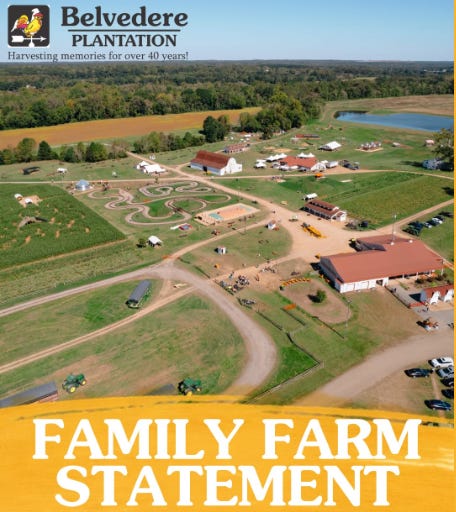
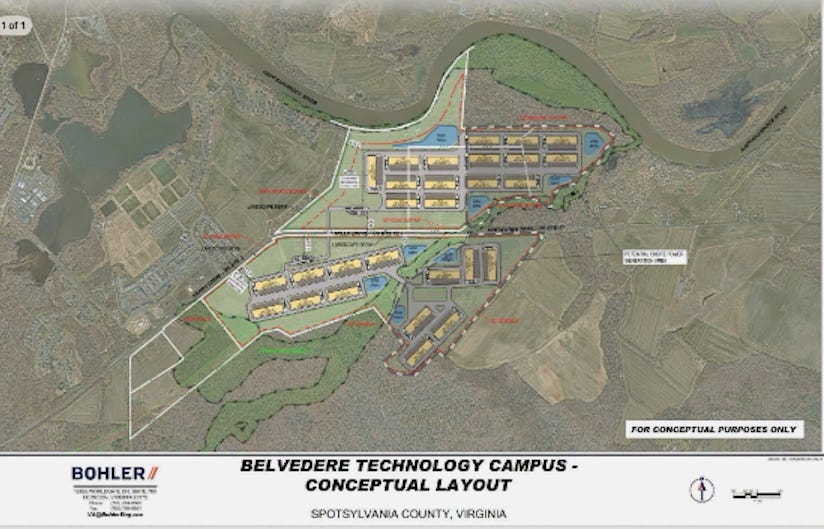
Meanwhile, like Data-Center Whack-A-Mole, the Fulk family—five-generation owners of Belvedere Plantation, which has long hosted the popular Fall Harvest Festival—confirmed plans to convert their 645-acre farm property into a massive “technology campus.”
Here’s the statement they posted earlier today:
We’ve heard from many of you these past few weeks, and we want you to hear from us directly.
The Fall Harvest Festival opens September 12, just like it has for decades, and the family is committed to the future operation of the festival going forward. Nothing about the festival changes this year and we look forward to welcoming you all as we have done for 44 years.
The decision about our farm’s future was made around our dining table, including now the fifth generation, and it was not made lightly. This land has been in our family’s life since 1968. Every memory you’ve made here, we’ve made too.
We have begun working with a very reputable organization that is looking to properly site a technology campus on this property. When there is more to share, we will, directly and honestly. For now, we hope you’ll come see us this fall like always. We’ll be in the pumpkin patch.
Here’s the “conceptual layout” for the proposed Belvedere Technology Campus:
‘In Wildness Is the Preservation of the World’
One of the dozens of speakers at Tuesday night’s City Council meeting in Fredericksburg was Mike Huff, a longtime friend. Here’s what he had to say to Council members during public comments:
Remarks to the Fredericksburg City Council, Public Hearing—Proposed 1500 Gateway Boulevard Data Center, August 25, 2026
My name is Michael Huff, and from October of 2019 until May of this year I lived at 2506 Manor Court, Fredericksburg, 22401—right above Smith Run Trail and near the 83 acres you are considering tonight. I grew up in Spotsylvania’s woods in the 1970s, left to serve as a U.S. diplomat for a couple decades, came back, and trained as a Virginia Master Naturalist last autumn.
For six and a half years I walked Smith Run Trail. So, let me give you just a glimpse of what’s back in those woods.
A family group of deer. A rafter of wild turkeys. Red fox and black snakes. Pileated woodpeckers with their jungle calls, and red-shouldered hawks screeching up in the canopy. Oak and hickory, persimmon and sassafras, Christmas ferns and southern lady ferns.
And just off the trail, in swampy ground, a small grove of bald cypress, near the northern limit of where that species will grow.
Then the smaller creatures: salamanders, toads, tree frogs, and box turtles. And the many mushrooms I have spent years learning to name.
An island of wildness, wildness in the middle of residential and business development.
The property before you is mostly a stand of pine, a different ecosystem from the oak-hickory forest along Smith Run. But that pine stand is a buffer between I-95 and the trail. Take the buffer away, add New Gateway Boulevard, and you have not spared the hardwood forest. You have exposed it.
What arrives are buildings at 75 feet where the ordinance sets 50. A heat sink at the edge of a forest under stress.
And noise. On my balcony in the evening, hearing the distant roar of Interstate 95, I would close my eyes and pretend the sound was the surf. But you can only pretend so much. Peer-reviewed research, which I’ve given the Clerk, has found, as one example, that constant industrial noise cuts the distance at which an owl’s call can be heard by about half. I would like someone to tell me how the hum of a data center will sit on top of the roar of I-95. The applicant’s study stops 500 feet past the property line.
There’s much talk of revenue. I would ask whether it’s guaranteed.
Nearly everything said in public about these facilities is about what artificial intelligence will do. Almost nothing is about how—how it is powered, how long it lasts.
Serious people warn of an artificial intelligence bubble. I don’t know whether they’re right. Neither does the applicant.
But consider what each side of this trade can survive. You are being asked to trade maybe a half-century of forest for short-term speculation. If that market corrects, a company takes a financial loss. That forest does not come back, and a windowless building on a slab cannot be turned into anything this city needs. One loss can be written off. The other cannot.
Your Planning Commission has heard this project twice. Both times, seven to nothing, it recommended you deny it. You are offered proffers. The one that matters is this: Transmission lines routed away from Hugh Mercer Elementary. But the State Corporation Commission sites those lines, not this Council. A proffer that cannot bind the body that decides is not a promise. It is a prop.
Henry David Thoreau wrote that ‘In Wildness is the preservation of the world.” He also wrote that every town ought to hold a primitive forest—“a common possession forever, for instruction and recreation.”
We do not own that forest. Thoreau’s argument was never about property deeds—it was about what a town decides to protect. That decision is yours tonight. I am asking you to deny the rezoning, and to deny the special use permit. Thank you.
***
Mike Huff was born up on the Allegheny Plateau in the early 1960s, raised in the woods of Spotsylvania in the 1970s, attended Mary Washington College (now UMW) throughout the Reagan years of the 1980s, trained and worked as a librarian with the Central Rappahannock Regional Library system in the 1990s, and then spent the first two decades of the 2000s as a diplomat with the U.S. Department of State. As a Foreign Service officer, he was a liaison with national, university, and public libraries in East and Southeast Asia, Oceania, Eastern and Central Europe, and Afghanistan. Now retired, he spends much of his time aimlessly sauntering on the trails along the Rappahannock River, his eye on the ground, looking for mushrooms. You can reach him at on.smith.run@gmail.com.

I applaud Mike Huff, Caitie Finlayson, and many other brilliant, well-prepared speakers who made remarks before the Council last night.
Heartbroken about Belvedere.
Terrific environmental remarks by Mr. Huff. Thank you sir. From a kindred spirit in Stafford.