
By Phil Huber, ADVANCE COLUMNIST
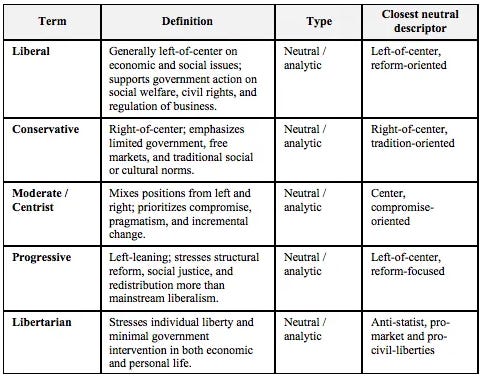
For most of American history, you could tell where someone stood by a handful of familiar labels: liberal, conservative, moderate, maybe libertarian or socialist. Today, that vocabulary has been scrambled by partisan branding, attack rhetoric, and outright misuse. It’s hard to keep track of who is what, and why they are being called it.
What citizens increasingly need is a scorecard—a simple way to distinguish terms that describe actual political ideas from terms that are designed mainly to rally the faithful or smear opponents. The table below offers one such scorecard. It separates neutral civic descriptors from partisan attack language and tribal slogans, and it adds a “closest neutral descriptor” so you can see what each hot‑button label is really gesturing toward once the heat is stripped away.
If you’ve ever wondered how “MAGA,” “woke,” “socialist,” “communist,” or “extreme unitary executive presidency” fit alongside older terms like liberal, conservative, and progressive, this table is meant to help. You don’t have to agree with any of these positions to understand them; but democracy does require that we know what we’re talking about when we describe one another.
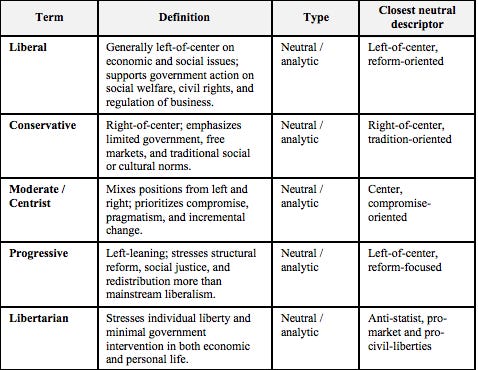
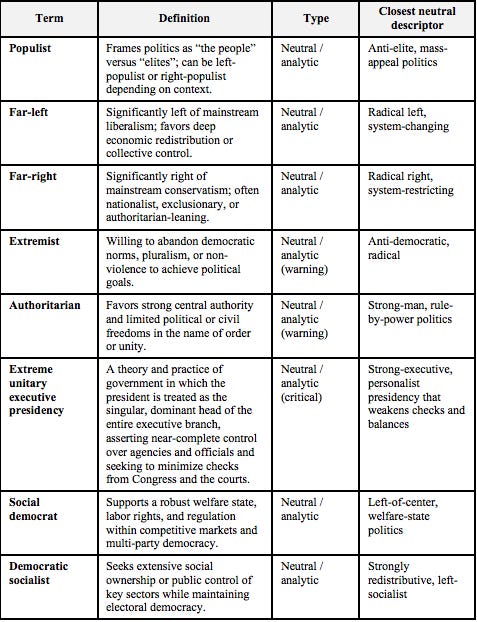
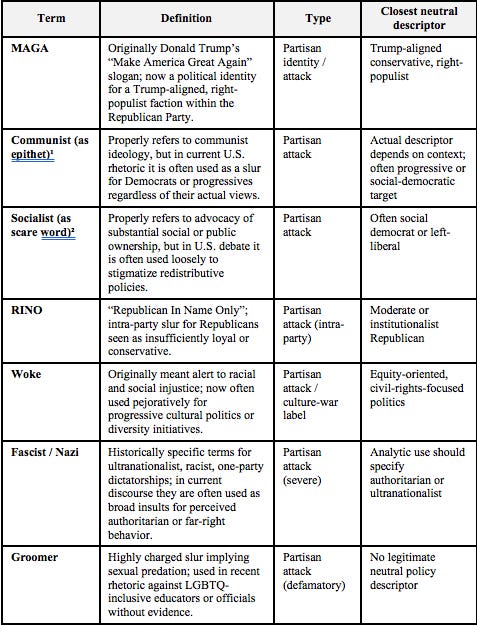
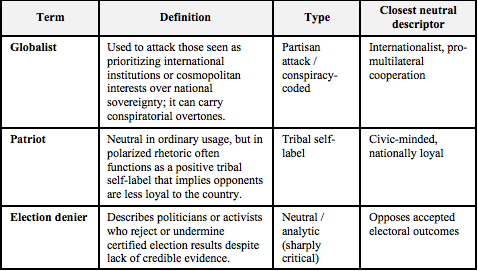
Language will keep evolving, and partisan operatives will keep inventing new labels. But if you can recognize which words describe ideas and which ones are weapons, you are far less likely to be manipulated by the next round of slogans. The hope is that, with a clearer scorecard in hand, readers can argue as citizens—not just as teams trading insults.
¹ Communism: In political theory, communism aims at a classless society in which major property and the means of production are held in common rather than privately owned. In Marxist theory, communism is the end stage beyond capitalism and socialism; in common modern usage, it is also associated with one-party states that controlled the economy and political life from the top down.
² Socialism: Socialism is a broader family of theories and movements that place property, major industries, or the distribution of wealth under social, public, collective, or governmental control rather than leaving them entirely to private markets. In practice, socialism ranges from democratic and mixed-economy forms, such as social democracy, to more state-centered systems, which is why the term is broader and less precise than partisan rhetoric often suggests.
***
Phil Huber is a retired Army Reserve colonel, federal civil servant and consultant who writes on civic education. He lives in Fredericksburg.


This article is published under Creative Commons license CC BY-NC-ND. It can be distributed for noncommercial purposes and must include the following: “Published with permission by FXBG Advance.”