
By Martin Davis
EDITOR-IN-CHIEF
Email Martin
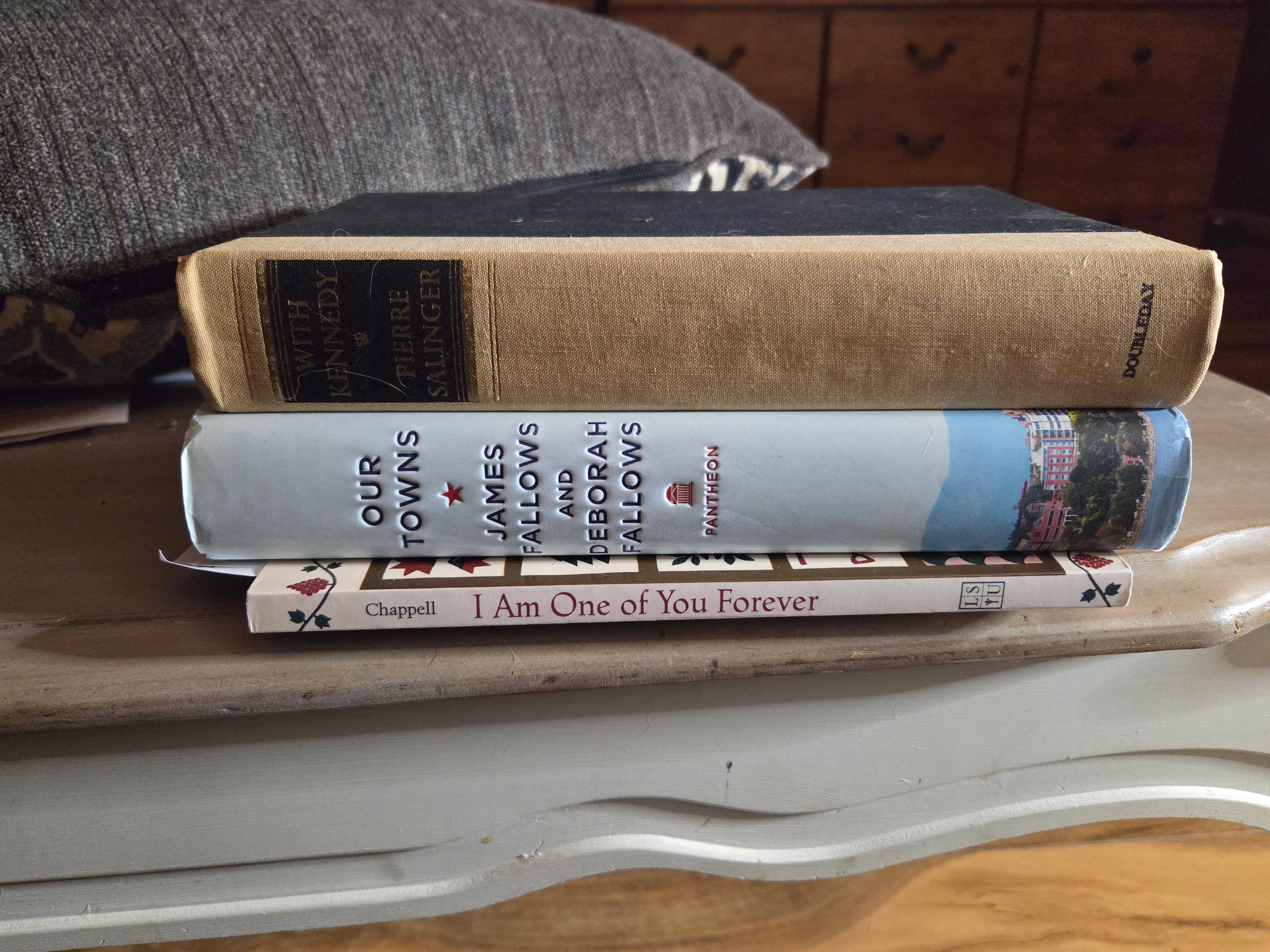
Fred Books opens just one week a month, operating out of a nondescript store in a strip mall near New Post in Spotsylvania. Off-the-beaten path doesn’t quite capture the location, but the unbeaten path is right next door.
Once inside, however, the atmosphere and titles on the shelves square with the better-known bookstores in San Francisco (City Lights), Berkeley, California (Moe’s), Durham, North Carolina (The Book Exchange), and Chicago (Seminary Co-op) — each supported by some of the finest universities in America — The University of California Berkeley and Stanford University, Duke University, and the University of Chicago.

Though far from the cities and universities that nurtured me and countless others who were fortunate enough to study inside their walls but no longer live in the urban centers that create the conditions for these universities’ success, the books that form the backbone of a first-rate education are within reach — and affordable.
A half-hour’s perusal revealed titles I already owned, and new-found pleasures that now grace the table in my living room that serves as the “What we’re reading in our house now” display.
With Kennedy was an unexpected treasure. Written by Pierre Salinger, President Kennedy’s press secretary, it is his recollection of his time in the White House. Published in 1966, it takes the reader inside the world that Salinger lived in Washington, and it brings you into the horror of November 22, 1963.
I interviewed in Salinger in 2001 via phone from his home in France, where he had moved with his wife. Disillusioned by what America had become, and frustrated with politics that were a distant shadow of American politics in the 1960s, Salinger was among those with first-hand experience of President Kennedy who would soon be gone. He died three years after our conversation.
Discovering that title brought back memories of that call — a reminder of how lucky I have been in my life — and offers an opportunity to learn about the complexities of politics even in an administration that is generally looked back upon with appreciation by historians and critics across the political spectrum.
It has proven a treasure in the first few days of reading. And it will take its place when done next to the book Counselor: A Life at the Edge of History by Ted Sorensen, Kennedy’s speechwriter whom I also interviewed the same week I interviewed Salinger. Twenty-five years on, I still remember every detail of the two hours we spent together on the phone.
Our Towns, by James and Deborah Fallows, was a pleasant surprise. One of America’s most-distinguished journalists, Fallows has written some of the most important pieces of the 20th and 21st century. I met him once in the offices of National Journal, where I worked at the time.
This piece of travel writing follows James and his wife as they traversed America in their small plane for three years, visiting America’s small towns and finding hope in an America that too few see. Published in 2017, it’s a reminder that America is not lost, but also serves as a reminder how quickly things can go awry.
The odds of finding either if browsing shelves is dropped in favor of internet searches? Small.
Books require more of us. Even in the finding.
Bring One’s Whole Self
Books require much of the writer — often years of research — before writing even begins. There are no places to hide. One’s sources, notes are laid out for the reader to see. Book writers are expected to know the bibliography of what has come before and anticipate the questions their contribution to the greater body of knowledge will raise.
Books demand even more of the reader. Arguments are not simple. They’re layered and require that the reader wrestle with hard ideas. Books invite one to sit and ponder over passages and sentences and words, rather than rush on to the next tantalizing video.
Most important of all, books demand that one engage fully with the writer. To understand what they are saying.
“I don’t agree with,” or “I don’t like,” the argument simply won’t do. It demands a thoughtful response — often setting the reader on a years’ long quest for better understanding.
For now, the fight for books feels like a losing battle.
Books are out at the Washington Post. One more victim of marketers’ obsession with click bait. A deep dive into the most important book written in America about religious experience? Too hard even for the Post’s educated readership. Another story about Donald Trump’s bottomless, pathetic need for attention? That’ll drive the traffic.
Indeed, the only thing falling faster than the president’s approval ratings are Americans’ appetite for anything that requires deep thought.
Dana Gioia, former head of the National Endowment for the Arts, has long tracked Americans’ unwillingness to read and summarized the consequences in his 2007 NEH report To Read or Not to Read: “This report,” he wrote, “confirms—without any serious qualification—the central importance of reading for a prosperous, free society. Tehe data here demonstrate that reading is an irreplaceable activity in developing productive and active adults as well as healthy communities. Whatever the benefits of new electronic media, they provide no measurable substitute for the intellectual and personal development initiated and sustained by frequent reading.”
Things have only gotten worse since.
Last fall, a study out of the University of Florida found that reading for pleasure is in “free fall.”
A sweeping new study from the University of Florida and University College London has found that daily reading for pleasure in the United States has declined by more than 40% over the last 20 years — raising urgent questions about the cultural, educational and health consequences of a nation reading less.
The consequences of that collapse in reading are already with us.
We see it in the ascent of Machiavellianism, which surges when the hard work of democracy is more easily dealt with by force than thought; by memes rather than debate.
We see it in the rise of “advocacy,” a poor substitute for insightful analysis. Advocacy begins with the end — here’s the solution we desire and works backwards. It makes us cocky, arrogant, and intellectually weak.
Books demand that we begin in the past, and wrestle with what is known, before moving on to the new information to be offered. Where it takes us is not provided. The book starts healthy discussion. It is incumbent upon us to have it.
Discovering Meaning
Books, and the art of engaging with and reading them, is ultimately about our search for meaning. And books are uniquely positioned to take us there.
Ron Charles, the longtime Washington Post book reviewer who was unceremoniously dumped in favor of producing still more nationally focused political news — as if we weren’t drowning in a sea of it already; but hey, click-bait — found in his dismissal the real value of books. Meaning.
“I’m not so cocooned in self-pity,” he recently wrote, “that I can’t see my relative good fortune. Many folks laid off from The Post — and a thousand companies beyond — are facing far more devastating challenges. But my sympathy for them can’t slake my own thirst for purpose.”
And so Charles pushes on.
He ended that column with this anecdote:
In Annie Hall, little Alvy Singer stopped doing his homework because, he tells his doctor, “The universe is expanding.”
Goldstein acknowledges that fate. “But meanwhile,” she says, “we can seek to matter by resisting entropy in ways as expansive as possible, allying ourselves with life and not with death, with happiness and not with sorrow, with creativity and not with destruction.”
What are you waiting for?
Perhaps it’s not what we’re waiting for, but what we fear.
That the demands books place upon us will shake us from our insular worlds, perceived comfort, and sense of righteousness.
Do books still matter? Oh, yeah.
Now, more than ever.


Local Obituaries
To view local obituaries or to send a note to family and loved ones, please visit the link that follows.

David Brooks, recently asked about the use of AI, reflected something like this: "Ten or 20 percent of the people will use AI to think more. And 80 or 90 percent will use it to think less."
And some, I suppose, will simply continue reading and writing in the manner of great civilizations.