
By Martin Davis
EDITOR-IN-CHIEF
Email Martin
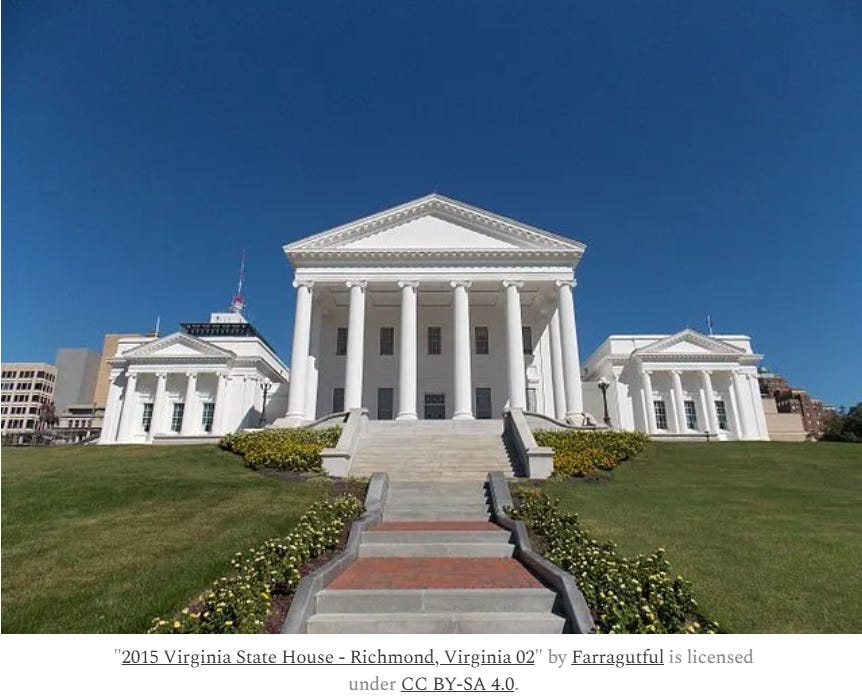
When the Senate reconvenes in June to begin work anew on the state budget, the question of what to do with the exemption carved out for data centers will be front and center — just as it was in the just-completed session.
The political factors that pushed the state to a stalemate on that question, however, and forced the extended session have changed significantly.
What’s at Stake
In a few words, billions of dollars in state and local tax revenues and future data center growth that benefits communities far beyond Northern Virginia.
In 2008 Virginia carved out a tax exemption for qualifying data centers that has grown from a benefit of several millions to billions. Critics argue that data centers are getting a free ride and depriving Virginia of much-needed tax dollars.
A report issued by the Virginia Department of Taxation in January 2026, however, shows otherwise.
The tax exemption permitted to qualifying data centers totaled $1.292 billion in 2024, and $1.941 billion in 2025. Over two years, that means the Commonwealth exempted $3.233 billion in tax revenue.
However, the same report shows that in 2024, Virginia realized $2.274 billion in state and local tax revenues. That number climbed to $3.070 billion in 2025.
In total, Virginia state and localities took in $5.345 billion in data center tax revenue.
Altogether, Virginia netted $2.111 billion more in tax revenues taken in than in tax revenues exempted. That, according to the report, represents an average annual return-on-incentive of 11%.
Should the tax exemption go away, the concern is that data center development in the state will dry up at the very time data center growth is beginning to distribute its financial benefits beyond Northern Virginia.
According to a report released in March by the Northern Virginia Technology Council, in 2025 data centers generated $31.8 billion in economic output in Northern Virginia and nearly $40 billion statewide. (Download the NVTC report here.) Any anchor on that growth would mean the windfalls that have benefitted Northern Virginia would be less likely to be realized further south in the commonwealth.
Locally, Stafford, Spotsylvania, and Caroline counties are set to begin benefitting from data center tax revenues as soon as this year. Projects in the Shenandoah Valley also look to significantly change the revenue projections for the counties of Botetourt and Wythe in the near future. More expansion is surely on the horizon.
What’s Changed Politically
While the numbers are on the side of the data center industry in terms of the financial benefits to Virginia, the commonwealth’s newly elected Democratic majority finds itself in troubled seas.
The Senate’s senior-most member Louise Lucas, D-Portsmouth, led the push to end the exemption. But since the session ended, Lucas has become the target of a federal investigation.
Further, both she and House Speaker Don Scott (D-Portsmouth), along with Senate Majority Leader Scott Surovell (D-Fairfax) were the principle drivers of the effort to gerrymander Virginia’s congressional districts to a 10-1 advantage for Democrats. The referendum passed, but the decision was close and outside of Northern Virginia few showed much enthusiasm for the naked power grab the gerrymander would have produced.
The State Supreme Court later vacated the vote declaring the redistricting unconstitutional.
This was a political miscalculation of significant measure that undercuts their ability to push through contested issues.
Gov. Abigail Spanberger was also deeply hurt by the redistricting push. Though she spoke against a 10-1 redistricting while running for office, she ran public ads in support of the measure and ultimately signed the legislation that allowed the election to take place.
Since then, she has, in the words of the Washington Post’s editorial board, been working to “reclaim the moderate image that got her elected.” On Thursday she said that the congressional elections would occur under the existing map. That statement effectively kills the effort to get the U.S. Supreme Court to override the State Supreme Court decision.
She has also vetoed pieces of legislation that Surovell has pushed.
This leaves Democratic leadership weakened and searching for new direction. The heavy hands of Lucas and Scott have been forced to pull back, and Spanberger is likely looking to reclaim some of the political high ground she forfeited by going along with the redistricting referendum.
The data center issue gives her a new opportunity to flex her muscles and show herself friendly to economic development.
The Union Factor
Gov. Spanberger has enjoyed strong support from unions throughout her career.
Trade unions tend to also be strong supporters of the data center industry, which are fueling a renaissance of union growth and work in Virginia and across much of the nation.
A recent story in the Independent reported that “Data centers consume at least 40% of work hours done by members of the Columbus-Central Ohio Building and Construction Trades Council, a top official, Dorsey Hager, estimated. It’s at least 50% for the International Brotherhood of Electrical Workers Local 26 in metropolitan Washington, D.C., spokesperson Don Slaiman said.”
This puts Virginia Democrats in a difficult position. Any move that would stifle data center growth in the commonwealth could upset that union support. And with critical congressional elections coming, that is support Virginia Democrats cannot afford to lose if they hope to capture put up one to two seats this year.
The Catch — Popular Opinion
If unions are backing data centers, Virginia Democrats are turning against them.
A recent Washington Post Scharr poll found that 61% of people identifying as Democrats opposed the following question:
As you may know, data centers are large buildings filled with computer servers to support internet services. Do you support or oppose the state government providing tax breaks to companies that build data centers in Virginia which create at least 1,000 jobs?
When asked if they support continuing the tax exemption, 72% of Democrats said “No.”
Interestingly, while Republicans are about evenly split on providing tax breaks (50% support, 48% oppose), they also overwhelmingly reject continuing the support (34% support continuing it, 65% want it ended).
Complicating the issue is the oversimplification of issues such as water, electricity, and noise. While critics cite data centers as the cause for electricity rate increases, for example, they often fail to note that grid infrastructure and energy production are the real culprits. And the reason we are behind in both are nuanced.
Then there is a need to improve people’s understanding of the extent to which we depend upon the infrastructure. Netflix, cat videos, and using ChatGPT to write papers and streamline work are just a few examples of how people are creating the very demand driving data center growth.
A Complex Debate
The Senate debate will occur against a backdrop totally unlike the backdrop that framed hearings and budget discussions just a couple months ago.
The major Senate players behind the first push to eradicate the tax exemption for data centers are significantly weakened; the governor — being humbled by the redistricting debacle — is not likely to let Lucas Surovell simply have their way, and unions are pushing hard for the exemption — a faction the Democrats will need in November.
At the same time, popular opinion is turning against data centers, especially among Democrats, while more-rural portions of Virginia are looking forward to reaping the economic benefits that have flowed mostly to NOVA to this point.
Expect each of these factors to have a role.
To follow the debate in the Senate Finance and Appropriations Committee, click here.


Local Obituaries
To view local obituaries or to send a note to family and loved ones, please visit the link that follows.
