
By Martin Davis
EDITOR-IN-CHIEF
Email Writer

For reasons that are not known at this time, two teenagers attacked the Islamic Center of San Diego on Monday, killing three people.
It is an all-too-common story in America today. Whether the violence is against religious groups or politicians, aimed at marginalized communities or fueled by conspiracy theories, we are all feeling the strain.
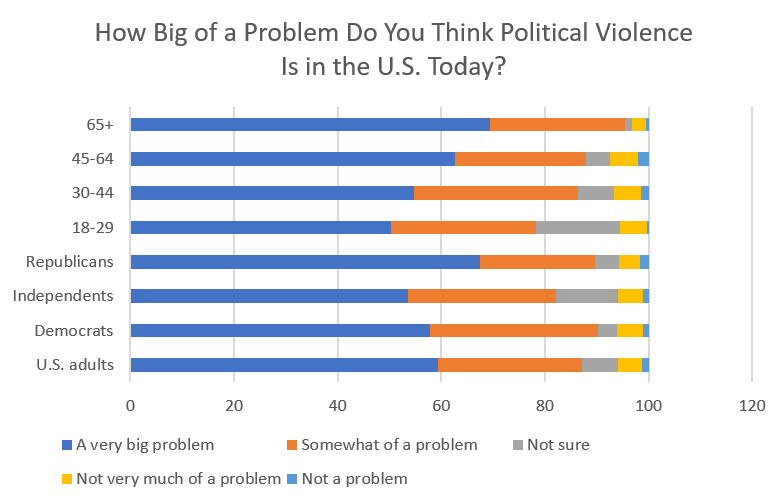
A YouGov survey from September 2025, for example, found that while Republicans and people over the age of 65 are most likely to say that political violence is a “very big problem,” all but one age group and every political identity surveyed said by an overwhelming 80% of respondents that political violence is a “very big problem” or “somewhat of a problem.”
Understanding the extent of such violence, however, is no easy task.
While there is general consensus that political violence remains relatively low compared to all violence in the U.S., episodes of political violence have an outsized impact on the public consciousness. Consequently, concerns about hate speech and people’s willingness to accept violence and mental illness stir people’s emotions.
None of these factors in political violence are to be discounted. But understanding the extent of political violence and what’s driving it is a far more complicated calculus.
Data Sets
There is no unified data set that captures and defines political violence. This creates a significant problem when trying to capture and understand the scope of the issue.
Both the Federal Bureau of Investigation and Homeland Security “use the term ‘domestic violence extremism’ to refer to DT threats,” according to a June 2023 report by the FBI and Homeland Security. “The word ‘violent’,” the report continues, “is important because the mere advocacy of political or social positions, political activism, use of strong rhetoric, or generalized philosophic embrace of violent tactics does not constitute violent extremism and is constitutionally protected.”
Thus, acts that some would construe as causing violence — hate speech, violent language, or related traits — are not captured in this reporting. This makes it difficult to understand the connection between acts of violence and the underlying ideas that may drive it.
Similarly, the Prosecution Project out of the University of Cincinnati has cataloged some 10,000 prosecutions of felony criminal cases from state courts and the U.S. Department of Justice to provide researchers and citizens with more information as to perpetrators’ ideological orientation, group affiliation, criminal method, and length of sentence. This adds shades of texture to political violence, but again doesn’t move us to a comprehensive understanding of the problem and its causes.
The Bridging Divides project at Princeton University is working to bridge the gap between collecting data on prosecutions and “violent extremism” by building a data set that captures threats and harassments against local officials using a variety of approaches. This is one of four projects in the Bridging Divides initiative.
The threats and harassment study will provide insights into how violence and the threat of violence are affecting our political landscape. This is a promising approach but early in the process.
The Global Terrorism Database is another tracker of violence both domestically and around the globe. It is frequently cited in academic research because it holds more than 200,000 incidents. It allows us to look at political violence in the United States not in isolation, but in the sphere of global political violence.
Advocacy groups and think tanks often pull from these data sets, among others. They also compile their own to produce reports that cover topics they feel require deeper exploration.
A report from the Center for Strategic and International Studies in September 2025, for example, catalogued 750 incidents to produce its study of political violence. Those incidents pulled both from data collected by ACLED and the ADL.
Finally, advocacy groups collect and release their own data. CAIR, for example, tracks the ways in which government bodies are restricting civil rights from Muslim-Americans. And the ACLU has long been an important source for tracking hate groups.
Parsing Findings
Of late, much of the debate about political violence has focused on placing blame against one political party or another for the problem. The Trump administration has been vocal in attacking left-leaning organizations for promoting hate speech. At the same time, groups like the ACLU have focused mainly on right-wing extremism.
The reality is far more challenging, however, than simply assigning blame to one political group or another.
The CSIS study last year, for example, is a good case study.
The headline many media outlets picked up on was the report’s finding that in 2025 left-wing extremism was on the rise. This led to distorted findings about left-wing violence that the report itself itself makes clear its findings don’t support.
Our analysis of terrorism trends in the United States shows that, indeed, left-wing violence has risen in the last 10 years, particularly since President Donald Trump’s rise to political prominence in 2016, although it has risen from very low levels and remains much lower than historical levels of violence carried out by right-wing and jihadist attackers.
For CSIS researcher Daniel Byman, it isn’t the rise in left-leaning violence that matters, but the fall in right-leaning violence, and why.
The single act that the CSIS study coded as right-wing terrorism during the first half of 2025 was the assassination of Minnesota state representative Melissa Hortman and her husband, and the shooting of Minnesota state senator John Hoffman and his wife. Byman surmises the drop-off in frequency of right-wing incidents may be due to a feeling that the Trump administration has operationalized policy objectives, such as increased immigration enforcement, that previously animated violence on the right.
This is one example of how limiting the search for answers to political violence only through the lens of party or political ideology is too limiting.
A Gallup Poll published this past December, for example, found in its survey data that age and loneliness are other important factors to take into consideration.
“Age is the strongest predictor of attitudes toward political violence,” the survey found, “with young adults aged 18 to 29 more likely than other age groups to say that it is sometimes OK to use violence to achieve a political goal.”
It continues: “This attitude is also more prevalent among heavy social media users than those who use social media less frequently or not at all and among men more so than women.”
Most interesting, however, may be that the poll found that “differences in views by political affiliation and educational attainment are smaller, and no differences are observed based on income or other socioeconomic factors.”
Other factors surely come into play — the ready availability of firearms, the prevalence of violence in films and video games are two other factors that are less well understood in fueling violence and the American propensity toward violent solutions.
No Simple Matter
As with so many of the grand problems that face us, political violence is not reduceable to simple cause-and-effect equations that easily explain the range of factors that drive people to violence.
Certainly, we as a people should work to curtail the level of violence we deploy in our conversation — from the President of the United States to Virginia’s Attorney General whose deplorable statements in 2022 about then-Virginia House Speaker Todd Gilbert— to seemingly harmless jokes around the watercooler.
But we also need to curtail our desire to explain every incident of violence with accusations that blame one party or the other for the problem. Particularly in an already hyperpolarized environment where opposing parties are relentless in their effort to dehumanize one another.
Rather, we’d all do well to spend more time exploring the available research, wrestling with the available data, and push for a more-unified approach to the information we collect.
Sources
Below are a few prominent data sets and studies that readers may dig into for a better understanding of political violence.
Data Sets
Key Political Violence and Resilience Trends From 2025 | Bridging Divides Initiative
What NIJ Research Tells Us About Domestic Terrorism | National Institute of Justice (This study was removed recently from the DOJ site, apparent because the findings contradict the current administration’s arguments about political violence.)
Studies/Articles
Left-Wing Terrorism and Political Violence in the United States: What the Data Tells Us
Is the U.S. in a new era of political violence? Experts say it’s complicated | Scientific American


Local Obituaries
To view local obituaries or to send a note to family and loved ones, please visit the link that follows.
