

By Martin Davis
EDITOR-IN-CHIEF
Email Martin

This Christmas Eve, Mirna Benitez should be at her home with her family. Waiting.
Waiting for the arrival of Christmas morning. Waiting for the joy that sharing gifts with family brings. And waiting — if Benitez is a woman of faith — for the “cry of triumph,” as the late German theologian Dietrich Bonhoeffer described the exultation of Christmas morning. “Christmas comes. Christians rejoice!”
Instead, Benitez is spending this final day of Advent — a five-week period in the Christian tradition when the faithful enter a period of waiting for their messiah — in El Salvador.
She no longer waits to open gifts in the morning, but she waits on the U.S. government to process an I-130 form — a petition for an “alien relative” — to bring her back to the United States.
Her waiting has just begun.
“Right now, the estimate is four years for her to come back,” Benitez’s daughter Laura told the Advance on Monday.
As the Advance reported last week, Benitez was summoned to the U.S. Immigration and Customs Enforcement office in North Chesterfield at 8 a.m. on December 7. Upon arrival she was detained, then shuttled between a Richmond jail and detention centers in Texas and Louisiana. The conditions on the plane flight to Texas, and in the detention centers, were so awful, she decided to self-deport rather than remain in “unsanitary” facilities.
Why was Benitez targeted for deportation?
When the U.S. government began its aggressive campaign to force out immigrants, President Donald Trump’s Executive Order stated:
It is the policy of the United States to faithfully execute the immigration laws against all inadmissible and removable aliens, particularly those aliens who threaten the safety or security of the American people.
Yet, Benitez appears to have not met either of these criteria.
Benitez was in the U.S. on a work visa, according to her friend Duane Edwards, vice chair of the Fredericksburg chapter of Virginia Organizing. And throughout her 13 years in the United States, she had faithfully reported to immigration officials when requested.
On December 4, 2025, the U.S. Citizenship and Immigration Services announced more aggressive screening and vetting of “aliens working in the U.S.,” citing the attack on National Guard personnel in Washington, D.C., that killed one and left a second seriously wounded.
It’s not clear if Benitez’s detainment was tied to this change in policy.
The second reason for Trump’s aggressive deportation effort was to target those who “threaten the safety or security of the American people.”
Benitez was no threat to anyone. The only thing on her criminal record, according to an online search of local court records, is a 2016 charge for failing to obey a highway sign, for which she paid a $30 fine.
Cruel In Its Normalcy
Benitez’s story shocks because it has become normal.
The University of California at Berkeley is home to the Deportation Data Project, which uses the Freedom of Information Act to obtain immigration enforcement data from the U.S. government, and they post the data sets that they obtain.
Reporting at the national level has leveraged these data sets to reveal how widespread the arrest of nonviolent immigrants has become.
A story earlier this month in the New York Times found that “In high-profile Immigration and Customs Enforcement operations in Los Angeles; Chicago; Washington, D.C.; and across Massachusetts, more than half of those arrested had no criminal record….” Further, “Less than 30 percent of the people arrested in any of these operations had been convicted of a crime, an analysis of the data shows, and a very small share had been convicted of a violent crime. The most common non-violent convictions were for driving under the influence and other traffic offenses.”
Summoning people to a meeting, then detaining them when they are in the country with a work permit, have done everything that has been asked of them, and are not a threat to the public is not an act meant to instill a sense of safety.
Behind the national numbers that numb use, however, are communities that are being traumatized by what is happening. As one person told the Advance following our first story about Benitez, her arrest “has really torn the [place where she works] apart,” and people are “doing everything they can to help her and her daughter out.”
If the goal is to make “Americans” safer in their communities, as the Executive Order explicitly stated, it’s failing spectacularly.
Summoning people to a meeting, then detaining them when they are in the country with a work permit, have done everything that has been asked of them, and are not a threat to the public is not an act meant to instill a sense of safety.
It instills fear. And it feels cruel.
That would seem to be the point of all this.
New reporting by the Washington Post suggests that instilling fear and cruelty, far from unintended consequences of the administration’s immigration overreach, are the whole point.
Post reporters reviewed thousands of internal ICE messages that make clear the agency is working overtime to make cruelty go viral. Walking orders it is taking straight from the White House.
When ICE arrested over a 100 people in Houston, ICE communications team members realized they had a problem.
“We made several dozen arrests today very quickly. Not sure if these all had criminal histories beyond being in the US illegally,” wrote an ICE communications member the Post identified as Video Producer 2.
A person identified as ICE Official 2 responded: “I’d like to try to put this out without focusing on the aliens or their crimes, but to demonstrate that we’re out working hard.”
A bit more discussion, and the decision was made to create a post focused on “illegal aliens … behind the wheel.” The final product that posted on X:

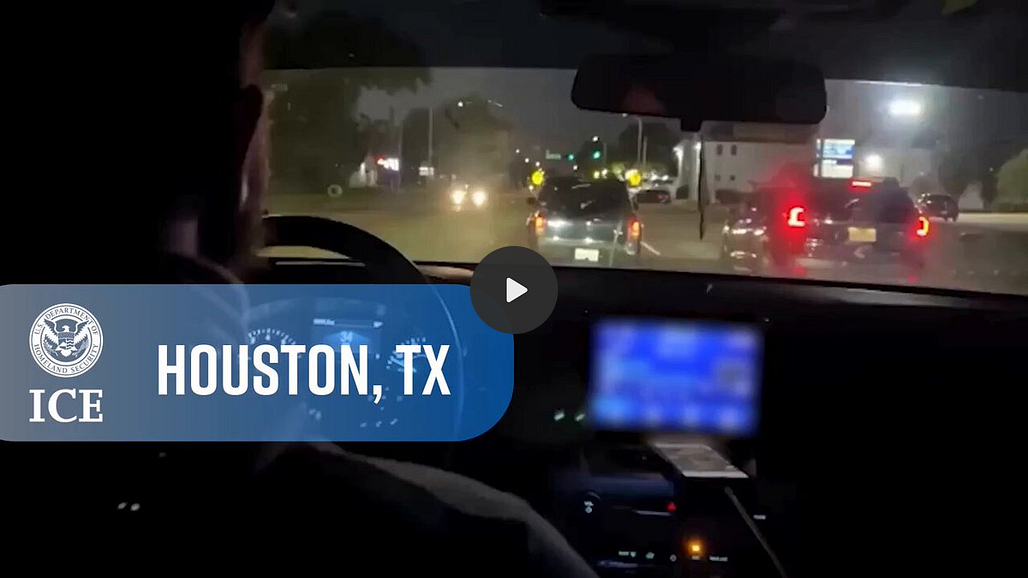
It’s the tip of the ICE-berg of misleading social media and video posts whose sole objective is to instill fear and elevate the agency’s cruelty.
That was the assessment of David Lapan, Trump’s DHS press secretary in his first term who has turned critical of the current administration.
“We were supposed to present the facts, not hype things up. But this veers into propaganda, into creating fear,” said Lapan, a retired Marine Corps colonel. “We didn’t have this meme-ification of various serious operations, these things that are life or death. … It’s not a joking matter. But that’s the way they’re treating it now.”
If Cruelty Is the Point …
There is a well-documented gap between the way people feel about immigration nationally (70% of voters see it as a national problem) versus locally (only 37% of voters believe immigration is a problem in their community).
This disconnect between national and local is not unusual in American politics. A similar gap exists in feelings about education. People believe that public schools nationally are a failure, yet they routinely express confidence in their local schools.
When we see the problem in the abstract — immigrants are “invading” America or diluting American “culture” — it is easy to turn a blind eye to the cruelty being played out in communities that aren’t our own. It’s a problem for someone else, not us.
And this is what makes Benitez’s case so important to our region. Unlike the heavily doctored social media messaging orchestrated by ICE according to which these arrests are serving to throw out heinous people and protect Americans, the unvarnished narrative of Benitez’s case — and likely the vast majority of other deportees who have no criminal records but are being rounded up — demonstrates there is no justice served in ICE’s actions.
Her arrest and deportation are, simply stated, cruel. No advantage is gained in public safety by having her in El Salvador. No advantage accrues to the community where she worked; just the opposite, it is “torn apart.”
No longer can we look the other way. The cruelty is here. And Benitez’s story forces us to live with that uncomfortable reality.
Benitez’s case is important because unlike the heavily doctored social media messaging orchestrated by ICE that its arrests and deportations are serving some grand societal good, her unvarnished story — and likely the vast majority of other deportees who have no criminal records but are being rounded up — demonstrates there is no justice served by ICE’s actions.
An appropriate discomfort during Advent, when we are forced to recognize that waiting is part of the effort involved in coming to a better place.
“Not all can wait,” wrote Bonhoeffer in a 1928 Advent sermon in Barcelona, Spain. “Certainly not those who are satisfied, contented, and feel that they live in the best of all possible worlds!”
Rather, waiting is left to those who “are uneasy about their way of life, but yet have seen a vision of greatness of the world of the future and are patiently expecting its fulfillment.”
Benitez should make us all uneasy about our way of life. And that unease should rest in our understanding of what has happened to her, her family, and her community, and how that squares with the America we know exists. The one that is welcoming to those in need. That celebrates the equality of all, even as we struggle to apply the ideal. That rewards people who take the hard path and play by the rules.
There is time. Benitez today is not at the end of her wait, but the beginning.
So, too, are we all.






Local Obituaries
To view local obituaries or to send a note to family and loved ones, please visit the link that follows.

Support Award-winning, Locally Focused Journalism

The FXBG Advance cuts through the talking points to deliver both incisive and informative news about the issues, people, and organizations that daily affect your life. And we do it in a multi-partisan format that has no equal in this region. Over the past year, our reporting was:
First to break the story of Stafford Board of Supervisors dismissing a citizen library board member for “misconduct,” without informing the citizen or explaining what the person allegedly did wrong.
First to explain falling water levels in the Rappahannock Canal.
First to detail controversial traffic numbers submitted by Stafford staff on the Buc-ee’s project
Our media group also offers the most-extensive election coverage in the region and regular columnists like:
And our newsroom is led by the most-experienced and most-awarded journalists in the region — Adele Uphaus (Managing Editor and multiple VPA award-winner) and Martin Davis (Editor-in-Chief, 2022 Opinion Writer of the Year in Virginia and more than 25 years reporting from around the country and the world).
For just $8 a month, you can help support top-flight journalism that puts people over policies.
Your contributions 100% support our journalists.
Help us as we continue to grow!


This article is published under Creative Commons license CC BY-NC-ND. It can be distributed for noncommercial purposes and must include the following: “Published with permission by FXBG Advance.”
And there it is.
It didn't matter until it happened to someone you knew. Yet even now, you pretend like this was done by the "US government" - which - while factually true - still remains a fact of omission.
It's not all of the US government. It is not only the US government.
It is a group of people whom you still refuse to hold accountable for their, at the least, passive choice to participate in this cruelty.
Republicans.
This is a group of people who specifically have chosen this cruelty.
Not just Stephen Miller, Bannon, Rubio, the usual suspects.
But equally, the Youngkins, Durants, Wittmans, Diggs, and yes, even Kenneys whom you choose to give a pass to.
We are, or at least purport to be, a representative form of government. There is no royalty. All are equal under the law. At least that's what we say. They chose this.
So, when the leaders of that group/party/cult/movement/whatever do exactly what they have openly promised to do - not only by this cruelty, but in so many other ways (corruption, war, secret police, arbitrary tax laws, ....) - it is not happening because of some faceless bureaucrat in the far off land of Washington DC (which seems odd anyway to be heard as an excuse to an outsider when it happens in a place that is literally one of its suburbs) - but to acknowledge that this is purely due to Republicans.
Look. If you're waiting on some magic bean type of photo to pop up out of the Epstein files that shows Epstein holding one end of a Junior Miss America pageant contestant while Trump's molesting the other end, all I can say - is if I ever get charged with a crime, I sure want you to be on the jury and give me just half the consideration you give him.
Though I know you won't.
You've got an 80 year old slumlord from Queens whose legion of victims are varied enough to put any DEI purists to shame. Contractors, wives, customers, citizens, aliens, porn stars, allies, enemies, colleges, students, businesses,... I mean, you couldn't make up a more inclusive list if you tried.
A person convicted of over 30 felonies that would disqualify him from flippng burgers at McDonalds, despite untold wealth, power, and deference - and he escaped even more serious charges only because the American people decided that as bad as all that was; it was still better than having a Democratic black woman in office.
And folks like you still pretend to claim ignorance of these policies, despite Republicans literally publishing a book stating they were going to do these things. And then following that playbook ever since.
So the questions are not why these things are happening. In immigration, taxation, healthcare, corruption, the environment, energy policy (see where the $11 billion Dominion Energy wind farm just got arbitrarily stopped because of "national security" without notice or debate - how's your data center gonna run now?), etc..
But the questions are rather why still keep pretending this has nothing to do with those locally who have supported these things?
And why does it only matter to you when it happens to someone you know?
I'm sorry for this lady, I am. And hope it is resolved for her. It is a cruelty, and yes the cruelty is the policy, despite all of our guarantees against such things.
But I am equally sorry for the millions that it happened to before you cared. They mattered too.
Rights not protected for everyone are rights that exist for no one.
Republicans have just announced a diplomatic policy to the world that only money matters, not principle. We are in the process of invading Venezuela, yet where's Robb Wittman?
Secret police are scooping up our citizens upon mere suspicion, not probable cause without wearing so much as a name tags, their faces hidden. Where's Dauntey Diggs or Sheriff Decatur?
Revered state universities are being purged over purity tests, shaken down for millions of dollars, federal employees who are Virginia citizens are fired for cause without due process, and Virginia businesses are having to operate under conditions that change hourly? Where in the hell is Youngkin?
Medicines and food are left to rot and expire in warehouses rather than being delivered as promised, authorized by Congress, and paid for by US taxpayers, leading to thousands of deaths.
Where are those of so righteous Christians who tell us how holy they are? Or when our tax dollars pay for genocide?
As our former allies, principles, and Constitution are now openly abandoned and attacked, despite all of the blood and wealth spent to defend them; where are all those "proud and loud" veterans hiding who are more than happy to jump up to applause at a ball game and wave to the crowd, get the 10% discount at Home Depot, the free healthcare at the VA, or the welfare of my tax dollars on their personal property taxes - where are they? Did their oath to the Constitution have an expiration date? Mine didn't. At least not to me.
And yes, why does it only matter to you when something like this happens when it happens to someone you know and like?
This is not only our town. It is our state, our country, our species, our world. We have free will, we have knowledge.
We are also ones of the fortunate few that live in a place and time where we have a say in what happens. In a way, we are all kings. But only if we choose to exercise it. Which is both a privilege and a responsibility.
But it has to be predicated on a belief that all matter, not just those you know, or those you read about in the news.
We'll spend the next year celebrating 56 men of privilege that were willing to bet everything they had, including their lives to create and defend such a place. We'll do so as a matter of thanks and gratitude.
Wouldn't they be better pleased if we'd still do the same? And not merely say it, but do it.
We may not have wanted this fight, we may not have wished it.
But it is here. It is happening, right in front of us, as much as we wish or pretend otherwise. These are our times. This is our fight.
How will you choose? What kind of world do you want your grandchildren to live in?
The choices we make today will decide.
Choose wisely, but don't wait too long, because that too is a choice.
Just a thought.
Merry Christmas.
Thanks for all the great reporting on this travesty of justice. Minor clarification: She had no criminal record. Failing to obey a highway sign is a traffic infraction, not a criminal offense.