
By Hugh Lessig, ADVANCE MILITARY CORRESPONDENT
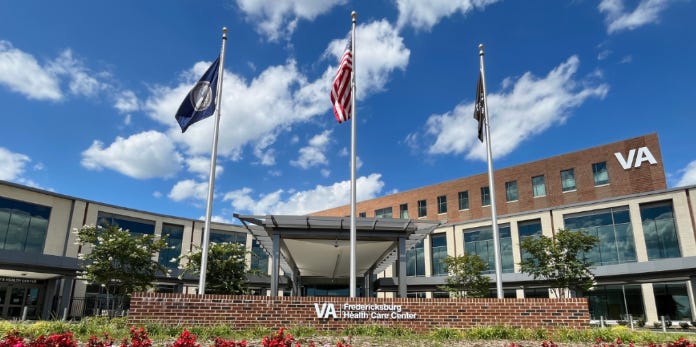
Veterans facing wait times at the Fredericksburg VA Health Care Center can instead seek care from a community provider, but that option can be problematic, area veterans said this week.
Rep. Eugene Vindman and Sen. Tim Kaine heard stories of canceled appointments and lack of coordination between the VA and community providers during a roundtable discussion Monday at the Howell Branch Library in Fredericksburg.
The local center is “a state-of-the art facility,” said Vindman, a Democrat representing the 7th Congressional district. “The feedback that I’ve gotten is that providers are great. The problem is getting in to see a provider.”
And when those wait times get too long, finding a doctor outside the VA system can be fraught with peril.
“The care you receive in the community may be excellent,” said Michael Dunlap, a 23-year Marine Corps veteran, “but the feedback doesn’t get back to the VA. If you get an MRI out in the community, the VA doesn’t get the MRI. They get a text recap. Same thing with treatments. Most doctors don’t turn around and give a full, detailed report back to the VA with all the records.”
Private-sector doctors lack experience to deal with veteran-specific problems, said Ashley Carothers, an eight-year Air Force veteran.
Carothers served in Iraq and suffers from health problems due to being stationed near a toxic burn pit. A doctor outside the VA system might merely treat her symptoms, but a VA physician who is more experienced with the fallout of burn-pit exposure would dig deeper, she said.
The VA doctor “can connect the dots,” she said.
Community care is an important option because of wait times at the center can prevent people from getting appointment right away, which brought up another longstanding complaint: Although the facility provides outstanding care, veterans say it simply doesn’t have enough staff.
Vindman said the center would be fully staffed at 933 employees. It opened last year at one-third staffing and is currently around 580 employees.
“To me, that is completely unacceptable,” he said.
Kaine said he found it “particularly galling” to have attended the center’s grand opening to see its great facilities, then hear complaints that patients can’t get in the door.
The VA has defended its staffing levels, and maintains that it is ramping up as demand increases. Besides the nearly 600 employees, another 80 are in various stages of coming onboard, according to VA spokesman Quinn Slaven.
The center has served more than 22,000 veterans and completed more than 214,000 appointments, surpassing first-year targets, according to VA officials.
Kaine said congress could provide some solutions. Salary caps on some VA positions means that people have better options if they seek a job at a private hospital. Also, staffing cuts implemented by DOGE targeted probationary employees. That can make the VA far less attractive to job-seekers.
“Providers at the VA have a two-year probationary period, not one year,” Kaine said. “If you’re looking to get a job and the VA wants to fire people and I’ll be on probation for two years, why would I go out on that limb?”
The Trump administration has cut thousands of VA positions, but says the cuts do not impact medical care. Kaine said he can’t understand how the VA can cut positions while committing to staffing up centers like the one in Fredericksburg.
“I just don’t see how this works,” he said. “It’s a math problem.”
After the roundtable, Vindman and Kaine said they planned to meet with leaders later in the day at the Fredericksburg health center to address concerns. There was no immediate feedback from that meeting.
Asked what the veterans would like to share with the health care center leaders, Marine Corps veteran Dunlap replied, “One thing, they’re doing a good job. They’re working hard. Two, get more people and retain them.”
Vindman released a follow-up statement about the listening session:
Yesterday’s meeting with leadership at the Fredericksburg VA Health Care Center was productive and laid the groundwork for continued collaboration between the Department of Veterans Affairs and my office.
I shared what I heard directly from local veterans at a roundtable earlier that day about staffing, access to care, and communication, and we discussed concrete steps the VA and my office can take together to address these challenges.
I appreciate VA leadership coming to the table and acknowledging that too many veterans are still facing unreasonable wait times and delays. I feel confident that we will keep fighting, together, to make sure this facility is fully equipped to serve every veteran who depends on it. My office will continue to share updates on the tangible steps we take as a result of yesterday’s conversations.”

The problem at the FXBG VA Clinic as well as other clinics has been going on for a while now. It has only become important because midterm elections are a little over two months away. I had an issue with the VA, I contacted Vindman's office for assistance. His office passed the buck back to the VA. It took me 3 months to get the issue resolved through hard work and persistence. These two chuckleheads are doing this to get votes and nothing else. They could care less about us veterans. They have their gold plated congressional healthcare.
I wish I’d been able to attend the round table. I too have had numerous frustrations with coordination and communication between Community Care and civilian medical providers. The communication and coordination problems I’ve experienced exist both to and from each entity. My VA primary care physician is great but beyond her there’s almost always something that causes a problem. Very frustrating that there is insufficient staff at the new facility. It’s hard enough to find doctors in this area outside of the VA.