By Michael Aubrecht, ADVANCE CONTRIBUTOR
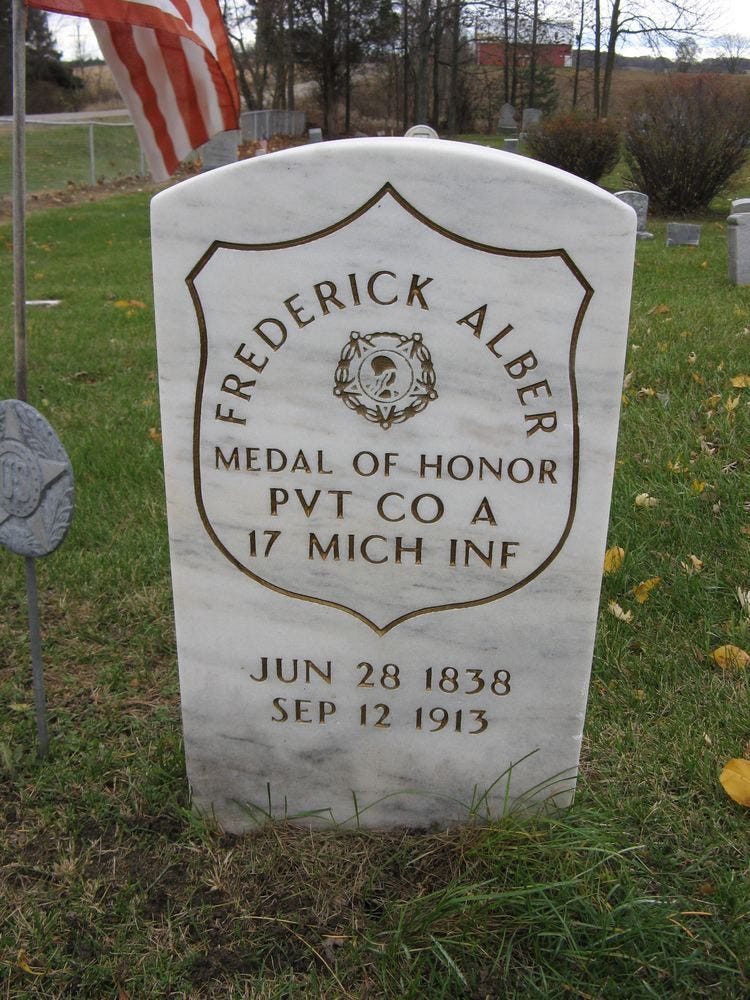
“Bravely rescued Lt. Charles H. Todd of his regiment who had been captured by a party of Confederates by shooting down one, knocking over another with the butt of his musket, and taking them both prisoners.”
That’s what the Congressional Medal of Honor citation read when former Union Private Frederick Alber finally received his.
Probably in the mail.
32 years after he earned it—on May 12, 1864 during the Civil War Battle of Spotsylvania.
Considered to be the most prestigious decoration for members of America’s armed forces, the Congressional Medal of Honor is given to those soldiers who distinguish themselves, “above and beyond the call of duty while engaged in an action against an enemy of the United States.”
The citation, initially christened the “U.S. Army Medal of Honor,” was first authorized by a joint resolution of Congress on July 12, 1862 in the middle of the Civil War. 1,522 military men who participated in that conflict received the commendation. To date, over 3,000 men and one woman have been awarded the medal, many posthumously.
One recipient with ties to the local area was Private Frederick Alber, who was awarded his Medal of Honor for valor in action. Alber was a German immigrant and member of Company A of the 17th Michigan Volunteer Infantry. He was recognized for saving an officer on May 12, 1864 during the Battle of Spotsylvania.
Alber’s moment of gallantry came during one of the most grueling engagements of the Civil War. Immediately following the bloody stalemate at The Wilderness, the Battle of Spotsylvania erupted and lasted from May 8 through May 2, 1864. The desperate and ferocious encounter, at sites with names like “The Bloody Angle,” resulted in more than 30,000 casualties.
Also referred to as “Spotsylvania Courthouse,” the battle is considered to be part of General Ulysses S. Grant’s Overland Campaign, and pitted the brash commander’s Army of the Potomac against General Robert E. Lee’s Army of Northern Virginia. Lee’s troops had been tremendously successful in defending the Old Dominion in previous years, but were terribly lacking in supplies and starting to show their diminishing numbers.
It seems fitting that Frederick Alber became a soldier, as he had had to protect his own family at a very early age. After his parents emigrated from Germany to the United States in 1847, they settled on a farm in Lodi Township in Michigan. The Albers appeared to be living out the American Dream until, in July 1849, the family was dealt a terrible blow when both of Alber’s parents and a brother contracted cholera and died shortly after. As a result, Alber was left with the responsibility of caring for his brother and sister. They remained on the family farm and worked the land as their parents had intended.
Frederick Alber was 24 on July 2, 1862 when he enlisted in the 17th Michigan Infantry, and went off to fight for the Union. His regiment participated in at least nine major engagements, including the battles of Antietam, Fredericksburg, Vicksburg, Cold Harbor and Petersburg.
The 17th Volunteers earned the nickname the “Stonewall Regiment” following their inaugural fight on South Mountain in Maryland. Not to be confused with their adversary’s equally regarded “Stonewall Brigade,” which was commanded by General Thomas J. Jackson, the Federal “Stonewallers” boasted eight Medal of Honor recipients.
In rescuing his superior at Spotsylvania, Alber stood out in the minds of those who had witnessed his courage. The story of his bravery circulated, and on February 21, 1865, Major General John G. Parke formally recommended him for the Medal of Honor.
As Parke wrote, “In addition to his undaunted bravery, exhibited in the Wilderness, [Alber] rescued, at Spottsylvania [sic], May 12 (1864), Liet. (Charles) Todd, of the 17th, who was in the hands of a party of rebels, shooting down one, knocking over another with the butt of his musket and taking the captors of Lieut. Todd as prisoners, conducted them both to the rear.”
The resulting award wasn’t issued until July 30, 1896, 32 years after the Battle of Spotsylvania. Most historians today believe that the medal was simply mailed to Alber, as there is no mention of it in the local papers. There was no ceremony, no formal presentation, and no celebration. As the recipient has no surviving likeness on record, it seems understandable that the event was devoid of public fanfare.
Later that year Alber’s first wife died. Over the course of the next six years, all of his siblings passed away, leaving him as the sole family immigrant in America. In December 1904, Alber remarried, but due to his advanced years, the rapidly aging German was forced to sell the farm. In 1913 he passed away at the age of 75.
In November 1999, Oregon Township in Michigan dedicated a new headstone to honor the veteran in the local cemetery. At the unveiling ceremony, a chaplain from the Sons of Union Veterans stated, “It seems well we should leave Comrade Frederick Alber to rest in honor where over him will bend the arching sky, as it did in great love when he pitched his tent, or lay down weary and footsore, by the way or on the battlefield for an hour’s sleep.”
***
Michael Aubrecht is a historian, author, documentarian, and lecturer. You can find out more about his work, including his new book project on Virginia Loyalists During the Revolutionary War, at his website The Naked Historian.