

By Adele Uphaus
MANAGING EDITOR AND CORRESPONDENT
Email Adele

On Friday, August 1832, the Staunton Spectator published a short article titled “Munificent Endowment.”
“The Editor … congratulates his fellow citizens upon the impulse which the Female Charity School of that town is about to receive, from a magnificent bequest,” the article states. “‘Miss Sophia Carter, of Prince William County, who died a few days since, has left it a legacy consisting of Bank Stock and lands, of the value of about $20,000.’”
This “magnificent” gift from Carter helped Fredericksburg’s Female Charity School, which had been established in the early 1800s, to construct in 1835 the building that still stands at 1119 Caroline Street.

Sophia Carter was the 12th daughter and 16th child of Robert “Councilor” Carter and his wife Frances.
Robert Carter’s father and grandfather amassed huge land holdings in today’s Westmoreland, Loudoun, Prince William, and Fairfax counties, according to an article published by Loudoun Now, which Carter inherited, along with hundreds of enslaved people who worked plantations established on some of this land. But over time, his own attitudes towards slavery changed, and in 1791, he filed a Deed of Gift in Northumberland County which emancipated more than 500 of his enslaved workers.
According to the Nomini Hall Slave Legacy Project, which is an effort to document the people Carter emancipated and connect their descendants, this was “the largest manumission of slaves by a single individual prior to the American Civil War and the largest number ever manumitted by an individual in the U.S.”
Sophia Carter, who never married, inherited her portion of her father’s estate when she was 25, according to the Historic Fredericksburg Foundation. Her $20,000 bequest to the Female Charity School is equivalent to about $737,000 in today’s purchasing power.
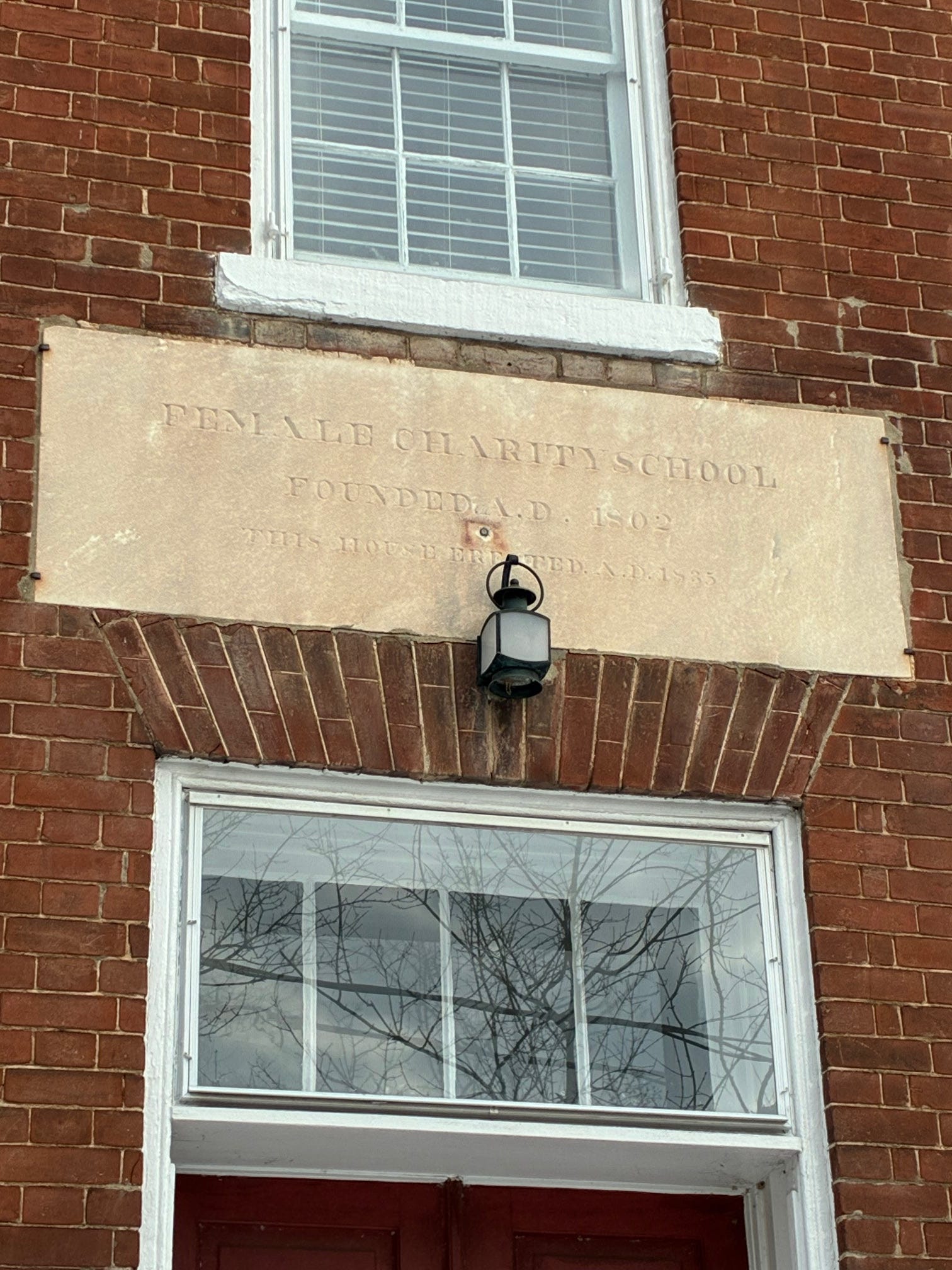
The school provided a home and education for “indigent” girls from infancy through age 17, at which time they were placed to work in private homes as “helpers,” according to research prepared by Margaret Lynn for HFFI’s marker program.
The school’s curriculum stressed “the rudiments of an English education and principles of Christian religion.” It was in operation through 1930, and according to a Free Lance-Star article from that year, the resident girls were “familiar objects about the city.”
“Dressed in their prim and neat uniforms, they could be seen each Sunday morning walking en masse to Sunday School at St. George’s Church,” the article states.
In 1860, 18 girls lived at the school, cared for by governesses Elizabeth and Mary Vass, according to a history of the school compiled by St. George’s.
In 1862, according to an account published in the Free Lance-Star, the 12 girls living at the school were removed to the country for safety during the Battle of Fredericksburg— “We children experienced a great delight when the Female Charity School arrived, 12 girls to play with us, but this was only a two-day treat,” Lizzie Rennolds recalled.
In 1910, according to an article published in the Daily Star, a Mrs. Carry Carneal petitioned to have her 7-year-old daughter admitted to the school because her husband was “serving time in jail for disorderly conduct.”
“The little girl will be accepted,” the article states.
In John Goolrick’s 1922 history of Fredericksburg, he reports just eight “happy maidens” housed there.
When the school closed, the building was sold to a group of four fraternal societies to be used as meeting space, but the return on investments made by the school’s governing board continued to be used to house and educate city children. In 1941, for example, the Female Charity School assisted three families with monthly expenses for their female children, and paid for boarding care for four other girls in the care of the city’s Welfare Department.
In 1948, the Female Charity School contributed $1,225, which paid for foster care for five children in the city, according to a Free Lance-Star article.
St. George’s vestry minutes from 1973 report that “a regular monthly contribution was made [by the Charity School board] to the Department of Public Welfare and Social Service.” At the time, Mrs. Alis Bailey “supervised the disbursement of funds for child care, dental work, food, clothing, school expenses and other needs. They estimated $2,000 is awarded yearly from returns of investments.”
There is still an active Female Charity School Endowment Fund with the Community Foundation of the Rappahannock Region. The fund provides “for the housing and education of boys and girls in need.”
In 1984, the Female Charity School Partnership sold 1119 Caroline Street to attorney A. Blanton Massey.





Local Obituaries
To view local obituaries or to send a note to family and loved ones, please visit the link that follows.

Support Award-winning, Locally Focused Journalism

The FXBG Advance cuts through the talking points to deliver both incisive and informative news about the issues, people, and organizations that daily affect your life. And we do it in a multi-partisan format that has no equal in this region. Over the past year, our reporting was:
First to break the story of Stafford Board of Supervisors dismissing a citizen library board member for “misconduct,” without informing the citizen or explaining what the person allegedly did wrong.
First to explain falling water levels in the Rappahannock Canal.
First to detail controversial traffic numbers submitted by Stafford staff on the Buc-ee’s project
Our media group also offers the most-extensive election coverage in the region and regular columnists like:
And our newsroom is led by the most-experienced and most-awarded journalists in the region — Adele Uphaus (Managing Editor and multiple VPA award-winner) and Martin Davis (Editor-in-Chief, 2022 Opinion Writer of the Year in Virginia and more than 25 years reporting from around the country and the world).
For just $8 a month, you can help support top-flight journalism that puts people over policies.
Your contributions 100% support our journalists.
Help us as we continue to grow!


This article is published under Creative Commons license CC BY-NC-ND. It can be distributed for noncommercial purposes and must include the following: “Published with permission by FXBG Advance.”