
Bruce Saller, ADVANCE CONTRIBUTOR
The proliferation of data centers in Virginia has forced our utilities to import a growing amount of electricity at higher prices resulting in large increases in our electricity rates. Per Dominion’s 2025 Integrated Resource Plan, they are currently short about 5 billion watts of generation, and need to add 5 million watts of generating capability every year for the next 10 years. That is the equivalent of adding a Lake Anna reactor every other year. We can lower our imports by increasing supply and reducing demand.
There are several options to increase our supply of electricity: nuclear, natural gas, wind and solar. (Geothermal is not viable in Virginia.)
NUCLEAR
There are two categories of nuclear reactors: large legacy reactors like Lake Anna, and new Advanced Reactors.
Legacy nuclear reactors provide reliable clean energy, but they have the highest lifetime cost. (Georgia Power just completed two legacy reactors in 2024, but they took 15 years to build and cost $36 billion.) They need to be shut down two months for refueling every 18–24 months, and the used fuel needs to be stored for thousands of years. There is still no national fuel repository, so utilities are currently storing all used fuel on-site. Dominion has no plans to build another legacy reactor but has refurbished all their existing legacy reactors to extend their life by twenty years.
All the Advance Reactors are still in development, with the first units projected to be available in 2033. They are projected to cost less than traditional reactors, but are expected to have a lifetime cost of $.11 per kilowatt hour. Dominion plans to install six Small Modular Reactors (324 million watts each) at North Anna, with the first unit going operational in 2040.
NATURAL GAS
There are two types of Natural Gas generators—simple cycle and combined cycle. Both types have a gas turbine that drives a generator to produce electricity. The combined cycle system captures the excess heat and uses it to drive a steam turbine, which also drives the generator. Simple cycle systems are between 20–35 percent efficient, while combined cycle system efficiencies can approach 60 percent. The Department of Energy found that a simple cycle system (38 percent efficient) cost $720 per thousand watts, and a combined cycle system (59 percent efficient) cost $1100 per thousand watts. Utilities generally purchase single cycle systems for peak usage (~1000 hours of use a year), and combined cycle systems for higher usage. Since peak systems are used so infrequently, they have the highest lifetime cost of $.17 per kilowatt hour, with combined cycle systems costing $.08 per kilowatt hour. Dominion plans to install 1446 million watts of combined-cycle systems in 2033, 2034, 2037 and 2038, and 882 million watts of simple cycle systems in 2032, 2035 and 2036.
WIND
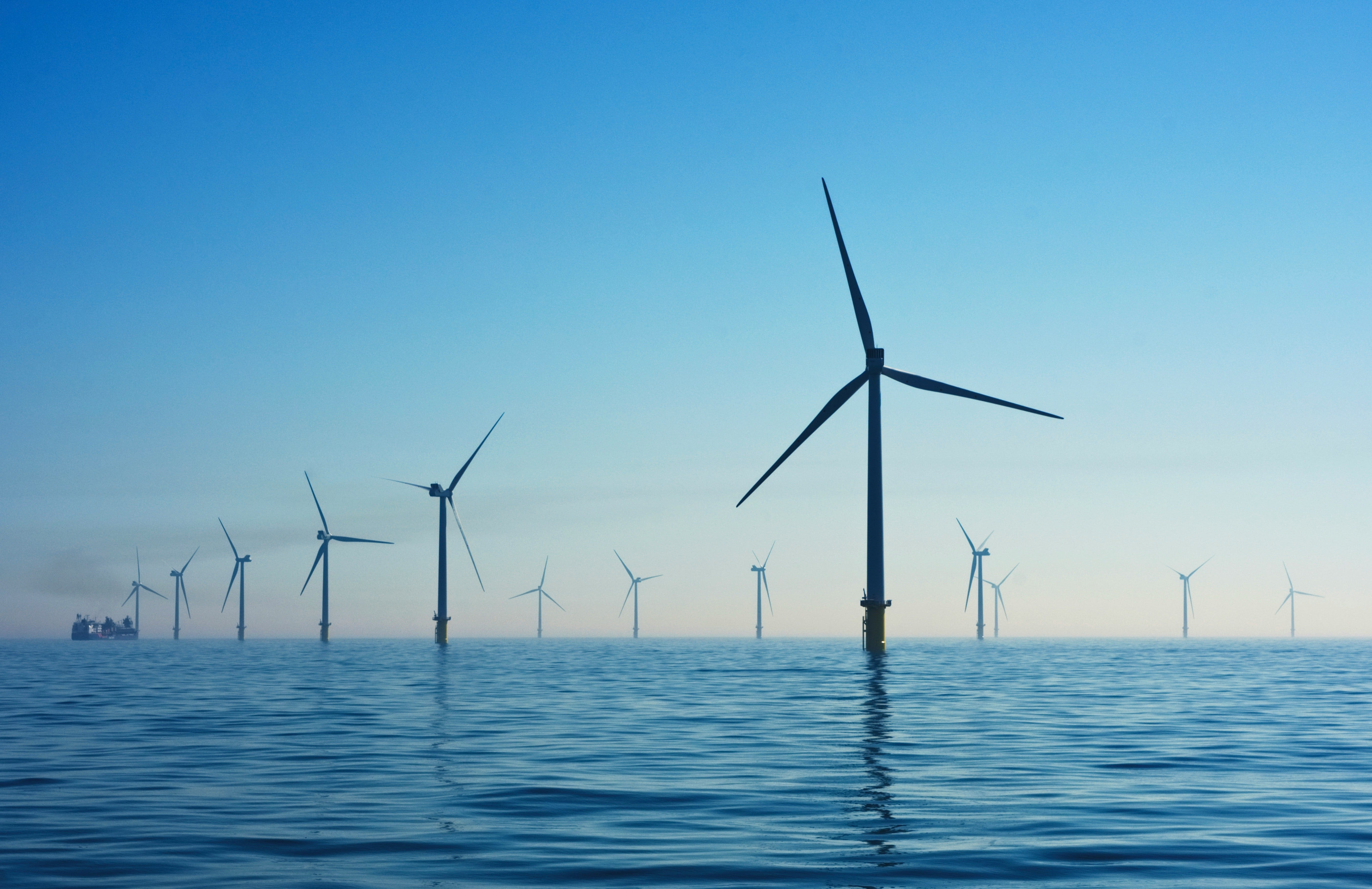
There are two types of wind systems—onshore and offshore. Onshore wind turbines produce 3-6 million watts, while Dominion’s offshore turbines are each producing 14.7 million watts. Wind produces most of its energy in the winter, so it needs to be supplemented with storage and other energy sources. Onshore wind has the lowest lifetime cost at $.06 per kilowatt hour, while offshore wind has one of the highest at $.12 per kilowatt hour. Dominion is currently installing 2.6 billion watts of offshore wind turbines, and should complete the installation next year. They plan on installing 60 million watts of onshore wind turbines in 2032, and offshore wind turbines of 800 million watts in 2034 and 2600 million watts in 2039.
SOLAR
Solar panel efficiency continues to improve, while the cost continues to decline. Panels are now 22–23 percent efficient, and cost about $.30 per watt. Solar produces most of its energy in the summer, so it needs to be supplemented with storage and other energy sources. Solar also has the lowest lifetime cost at $.06 per kilowatt hour. Dominion plans to install around 450 million watts of solar every year from 2026-2039.
For 2026 and 2027, the amount of imported energy should remain stable due to the installation of offshore wind turbines and planned solar projects. Dominion only plans to add solar from 2028-2032. Since the average solar system in Virginia produces 20.2 percent of its capacity over the year, this will only add the equivalent of 91 million watts of generation a year. So, the amount of imported electricity will grow again from 2028 until 2032. (Unless we reduce our electrical demand, which is my next article.)
(Cost data from Energy Department: https://www.eia.gov/outlooks/aeo/electricity_generation/)
***
Bruce Saller is a retired systems engineer with degrees in electrical engineering and computer science.

Excellent. Very informative..
Great info! Would be interested in seeing your thoughts on rooftop solar on schools / municipal buildings / businesses / data centers as well as insights into small turbines and their efficiency / potential.