
By Ranjit Singh
ADVANCE ENVIRONMENTAL COLUMNIST
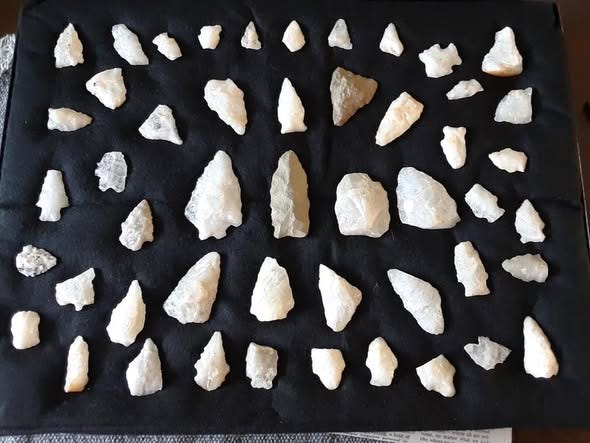
I grew up on a family farm alongside Potomac Creek in Virginia. Our farm’s rich soil holds millennia of Native American history. As a boy, I regularly found “arrowheads” along the muddy creek banks and adjacent fields (more on those quotation marks later). Without the internet for entertainment, some days I even had a rule that I couldn’t go home until I’d found at least one. Over time my eyes got better at finding them. Now, I have hundreds sleeping in softly-cushioned boxes.
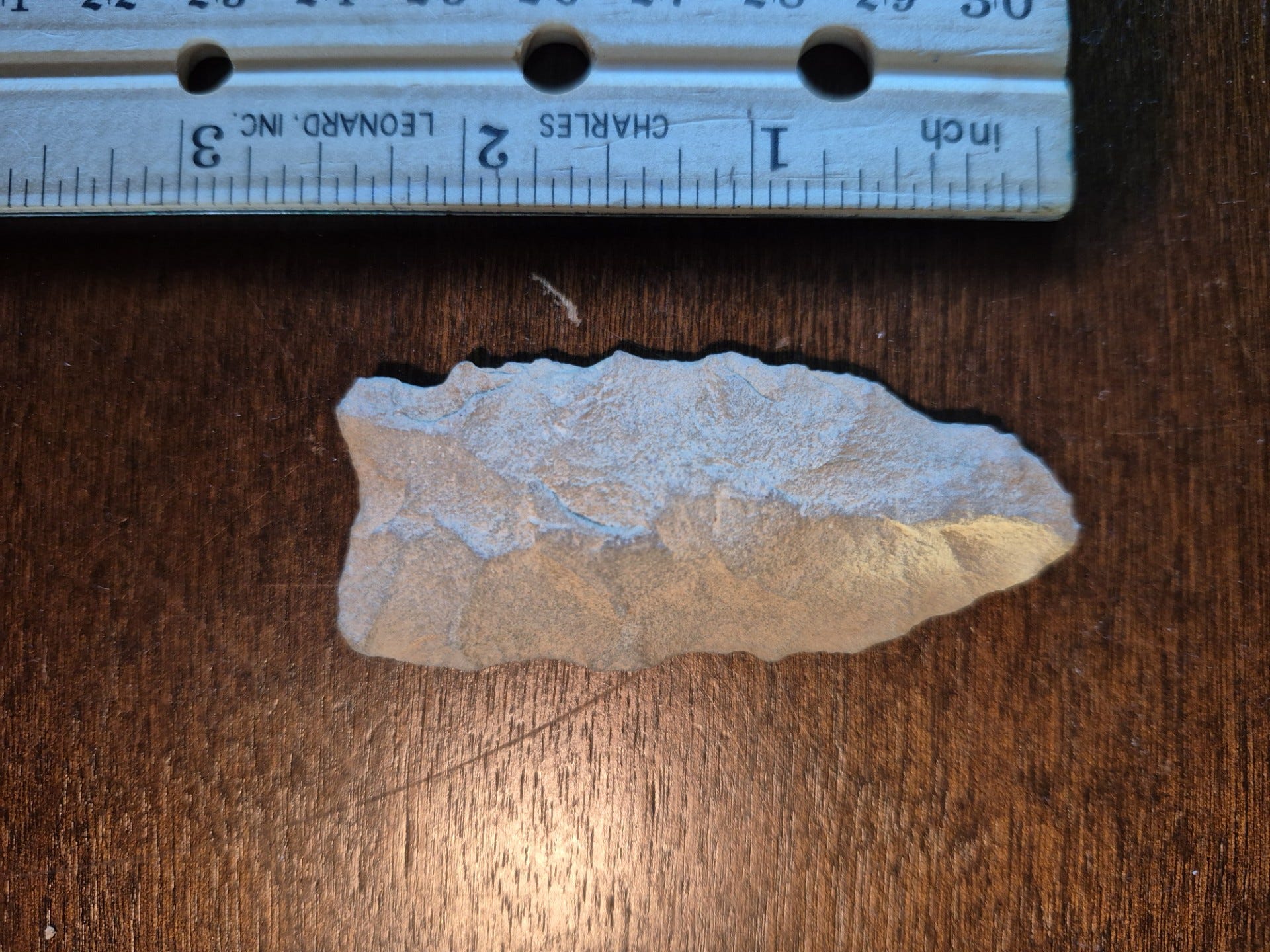
The photograph above is a box from my collection. Sadly, some arrowheads are broken; time takes its toll, and the modern plow is both a crude archeological tool as well as a careless destroyer of antiquities. Here’s one up close:
I still find arrowheads today. Birders win by looking up, but my life-long habit of looking down brings its own rewards. Arrowheads are a tangible and addictive way to learn history. They also connect us to those who called this land home long before us. When I joined Facebook years ago and began posting picture of my finds, the “How do you find them?” question started rolling in.
So, here’s my starter guide. It includes common sense rules that will not only save you from wasting many hours, but could keep you from legal trouble.
Rule 1. Know the law, and be ethical.
I’m no lawyer, but use common sense.
You shouldn’t look for arrowheads on private property without explicit permission. Not only is that stealing, but here in Virginia you are putting yourself in danger from dogs and landowners. Both bite when angry. (We do have hidden meth labs, you know.) Even if you get permission, it’s nice to offer the landowner first choice of anything you find. They may even let you come back.
Also, should you find anything in an official park (local, state, federal), leave it where it is and tell the officials. That’s the law in most places. In my experience, they’ll often let you keep it. But you never know if you’ve found something of real archeological value, either in terms of the location or the artifact itself. So, do an internet search of the relevant laws of the place you’re in and follow them. It’s your responsibility.
In that vein, never dig for specimens. Yes, there are private businesses, called “pay digs,” that let you dig up artifacts for a fee. They seem to be concentrated in Texas. Some even use bulldozers. That’s unethical, in my view. Cashing in on Indigenous People’s history is tasteless, and digging harms the landscape. Leave no trace, as they say. Everything I’ve ever found has been exposed on the surface.
And NEVER, EVER go looking on a known archeological site. You are interfering with the work of the professionals who add to our knowledge of human history. If you come across something you suspect might be a Native American village site or campground, tell somebody. Email an archeologist at the local university, for example. Leave it to the experts.
That said, I do read local histories to learn where native villages once stood. That’s educational and provides useful information when considering Rule 3 below.
Rule 2. Know what you’re looking for.
This is a real challenge, especially at first. Some helpful facts: To begin with, calling them “arrowheads” is misleading.
In Virginia at least, actual bow-and-arrow technology dates back only to the latter parts of the Woodland period, which lasted from about 1200 BCE up to European contact 1600s CE. Yet, Indigenous peoples lived here for many millennia before that. Some scholars estimate up to 20,000 years before today. Even conservative estimates say 12,000 years, at a minimum.
This means that most of the stone artifacts I find aren’t actual arrowheads. They’re knives, grinders, drills, spearheads, ammo for atlatls (a thrower device common before archery), or something else. It’s more accurate to refer to them as “points.” But it’s easy and common to call them all “arrowheads,” so that’s what I’ll do here.
Take a good look at the examples in the picture I posted of the box from my personal collection. You’ll see arrowheads come in many shapes.
In part, this is because forms changed over time. Over centuries, elders passed, cultures shifted, and people learned to make things differently. This is also because these artifacts had different functions—as knives, scrapers, spears, etc. Each function necessitated a different form. And even the size of the animals the native peoples hunted changed over time. After the megafauna disappeared, for example, carrying around a mastodon-size spear probably looked silly, like bringing a howitzer to a rabbit hunt.
But many of the arrowheads in my collection have been altered, too. And that’s not just the fault of modern plows.
Take a look at the two artifacts below, which I found separately. Note the distinct curves along their top left edges. What’s going on here? The explanation is that their respective owners resharpened these blades to keep them useful.
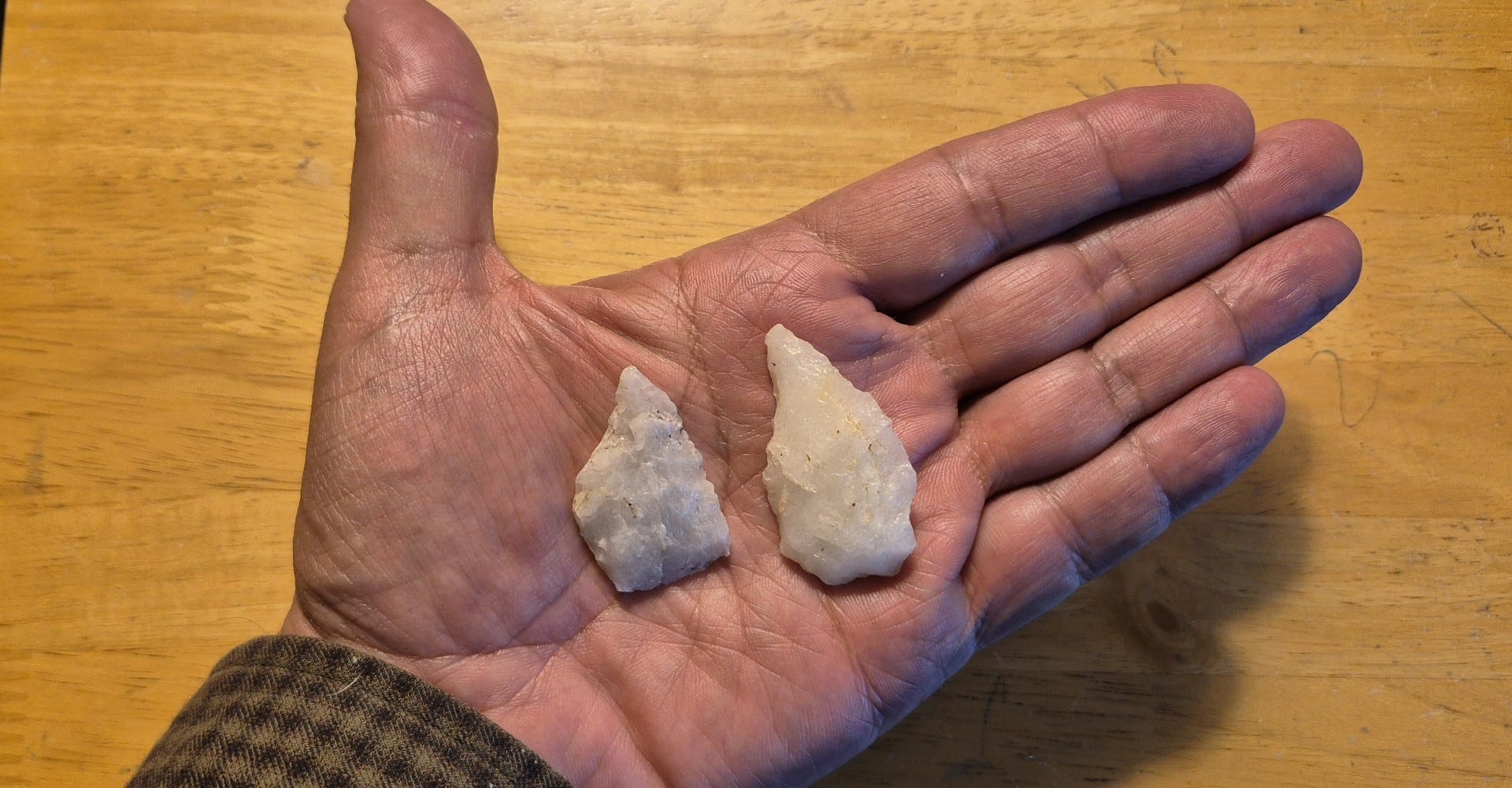
Reader, check your pulse: If you don’t find that incredibly cool, go back to your previously scheduled, incurious life.
Indigenous people had to keep their tools in proper working condition, just like smart chefs and hunters do today. Their lives depended on it. It took effort to make a good blade out of hard rock—why toss it away when it goes dull? Reuse!
More evocatively...
The arrowheads you find will usually look different from each other, especially if they’re from different time periods. There’s no one shape or style to look for. And their condition will differ.
The material used may also vary, although there are consistencies within regions. This is because, barring trade, Native Americans usually relied on the rock types they could access most readily.
Out West, that might be glassy, black obsidian. Here on Potomac Creek, that usually means quartz or quartzite. This is fortunate, because white is easier to spot on the ground. But chert and other rock types are found here, too. Once you realize how hard these rocks are, you’ll appreciate the skill required to turn them into intricate tools with refined edges.
So, familiarize yourself with the common shapes and stones. I suggest looking at examples posted by social media groups that are interested in arrowheads from your area.
You’re looking for something that has an edge or point AND shows signs of human work.
The latter part is key: without it, chances are you’re holding a “geo-fact” made by Mother Nature, not an artifact made by people.
It’s maddening how often nature creates something resembling human-made work!
I guarantee that the first hundred objects you pick up will be geo-facts. Don’t get too frustrated. The patience of Job is a virtue here.
You’re also likely to come across an arrowhead that’s not just broken or altered, but lying on its side, or in a position where the original shape isn’t obvious. Some of my proudest moments are when I identify a partially buried artifact, with only a small bit poking out of the ground. Or even under water. Without a good sense of what I’m looking for, I would have missed it.
Finally, as you can see from my collection, most arrowheads are small, ranging from an inch or so to maybe three or four (unless you come across something unusual).
This is important knowledge, because it leads us to the Rule 3.
Rule 3: Know where to look.
Theoretically, you can find an arrowhead almost anywhere. Stuff travels. Items get lost or haphazardly moved around. I’ve found arrowheads in unexpected places, like cities. But you want to increase your chances, so follow these principles.
First, stones of similar size tend to associate with each other.
Why? Because natural forces like wind, gravity, and water like to group similarly-sized things together. This means that you are less likely to find a 2-inch arrowhead on a beach that holds only very fine sand (unless it plopped down from an overhanging cliff face). Ideally, you want a field, hillside, or beach littered with stones that are roughly the size of what you’re looking for.
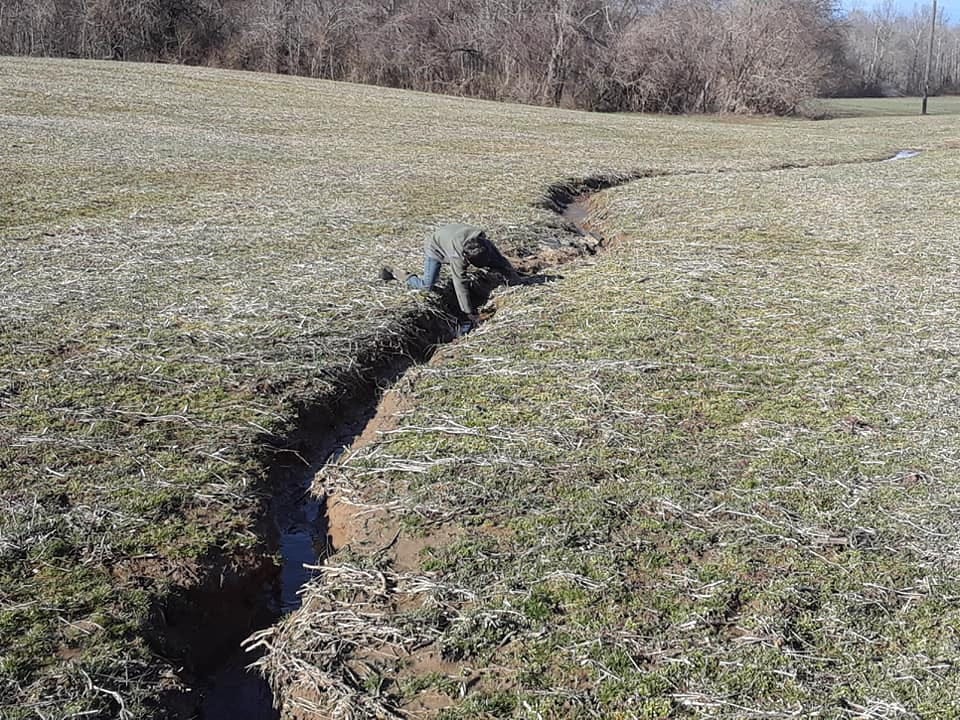
Second, although arrowheads may be almost anywhere, fields and water are the best places to look. That’s where erosion works fast, especially after storms have passed. I love searching such places after a heavy rain. A freshly plowed field can be great —but make sure you have permission.
On that note, here’s another fun fact. Stones rise up in places where the ground freezes. That’s because each stone has a small pocket of air under it, where water collects. When the water turns to ice, it expands, lifting the stone up. Enough freeze cycles and eventually the stone pops up onto the surface. This phenomenon is known as “frost heave.”
It’s probably why New England farmers are so ornery; they have to keep clearing their fields of rocks each spring.
And that’s why I walk the same fields each year. New arrowheads keep popping up! What a generous world we live in.
Rule 4: Think like a native
This rule is a lot of fun.
Travel back in time for a minute. Imagine yourself an Indigenous person utterly dependent on your surroundings for everything you need to survive.
Where would you spend most of your time?
Almost always, the answer is near fresh water. You and the animals you hunt need it every day. So, you build your village, fish, hunt for game, and generally hang out there. Even when you run off into the woods to flirt with someone from another tribe, you leave your family and kids there. Access to water is key to your life.
That’s the best place to start looking for arrowheads. The fields I walked as a boy are in a broad valley with creeks and streams that lead to a river. No surprise I found so many.
Of course, topography changes over time; a river’s banks have almost certainly shifted—often dramatically—in the last thousand years or so.
But downhill is downhill. Lowlands fill with water that attracts game and hunters. Since humans arrived, Potomac Creek has likely always been someone’s home. (Except when it was under the sea—but that’s a boon for the fossil hunters.)
Even hilltops near water can be worth checking. In summer, native peoples usually camped by the river. But in winter, when the cold air settles low, they often built their villages up high where the warming sun hits first. So, look up there. And remember that whatever tools they used up high are now washing downhill into creek beds and gullies. Check there, too.
So while there are other places to look, start with water. And I don’t mean modern, human-built reservoirs or lakes, unless you can find the natural feeder creeks that flow into them. Maybe check a good topo map for clues. A kayak is a great way to gain access to otherwise hard-to-reach shorelines.
Here’s another very useful hint: If you’re patient and observant, you may come across evidence of tool-making.
For this, it really helps to know how stone implements like arrowheads are made. You start with a larger stone, which you then “knap” or chip away at to produce the finished product. This laborious process inevitably produces hundreds of flakes.
Come across these flakes and you’re in business.
In your investigations, you are far more likely to find a concentration of flakes (once you can identify them) than an arrowhead, because there are so many more flakes. And once you do, you can be sure you’re in the right place. Native Americans were making and using tools right here.
Now, your chances of finding something nice is pretty good. This reminds me of a happy story.
There’s a trail near my office that I sometimes visit for a quick break. Years ago, I noticed that the high ground at one bend in the trail, right next to a river, was littered with flakes eroding out from the soil. So, I kept my eyes open every time I walked there.
Sure enough, one fine day I discovered one of the prettiest arrowheads I’ve ever seen. It lay in the open, eroding out of a slope, right where hundreds of people walk and jog every day. Here it is:
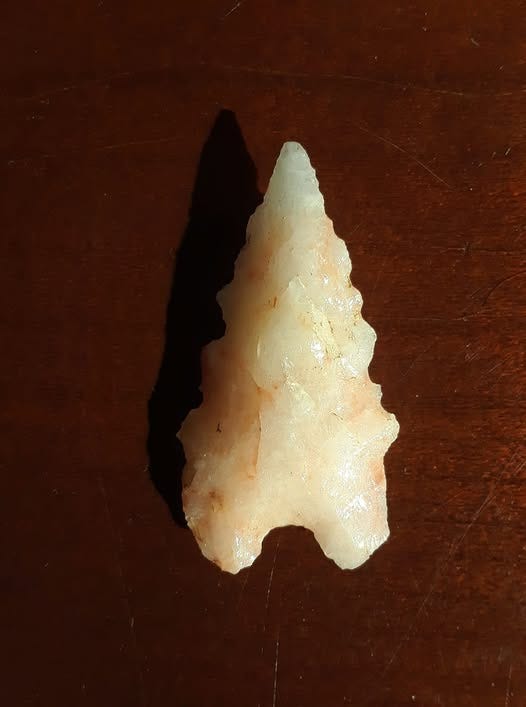
Look at those serrated edges, cut into an object only one inch long. What extraordinary craftsmanship! That day, I felt as though I’d found the Ark of the Covenant.
Chris Egghart, an expert on Native American stone tools who writes books on the subject, looked at photos of my collection and identified this one as a LeCroy bifurcate, dating from the early to mid-Archaic period (about 6500 BCE. For perspective, the Great Pyramid in Egypt was built around 2600 BCE. What I’d found was about four millennia older.
Up yours, King Tut!
See how addictive this can be?
I sent pictures of that point and others to the local museum, noting where they were found and offering to donate them. The nice lady there said thanks, but that they already have more of such items than they know what to do with.
Rule 5: Have fun, grab a flippin’ stick, and give thanks.
Of course, there’s plenty more to say about finding arrowheads. But don’t forget it’s supposed to be fun. Take a kid along.
I get skunked most days, meaning I fail to find anything worth keeping. But it’s still a day spent outdoors in nature, exploring beautiful places. Birds sing, flowers bloom, and critters scurry about. And I can get so focused on what’s immediately in front of me that I’ve unwittingly come close to stepping on many a snake.
It’s also helpful to find a thin but sturdy flippin’ stick, about 45 inches long. If you’re anywhere near my age, you don’t want to bend down to check every promising stone. You need something to flip it over with. My favorite sticks are the de-barked ones left behind by beavers.
Finally, there’s an important ritual I always observe whenever I find something. I raise the artifact skyward and give thanks to the person who left it there.
Maybe they lost the arrowhead by accident. Maybe they killed someone with it. Maybe they were kind, and maybe they were some type of prehistoric jerk. Who knows? But almost certainly I’m the first person to touch it since they did, however many millennia ago. So, I feel somehow connected to that person, and grateful for their long ago presence.
I hope future peoples will grant me such benefit of a doubt.
Bonus finds
Logically, looking for arrowheads will lead you to find sundry other objects we humans have tossed aside. They can be interesting unto themselves. I found a bunch of V-shaped stones in a river and thought they might be weights for a fish net. Since then, I’ve concluded they’re some sort of alien spaceship.
Less mysteriously, that sort of crap appears at a rate of 50 to each arrowhead. A bit creepy, if you ask me. But one morning several years ago, I found—and nearly lost—something I truly value today.
Walking a river bank after a good rain, I spotted a very nice, complete arrowhead. I was happy as a plum. I gave appropriate thanks.
Then, I spotted this unusual object lying among the pebbles.
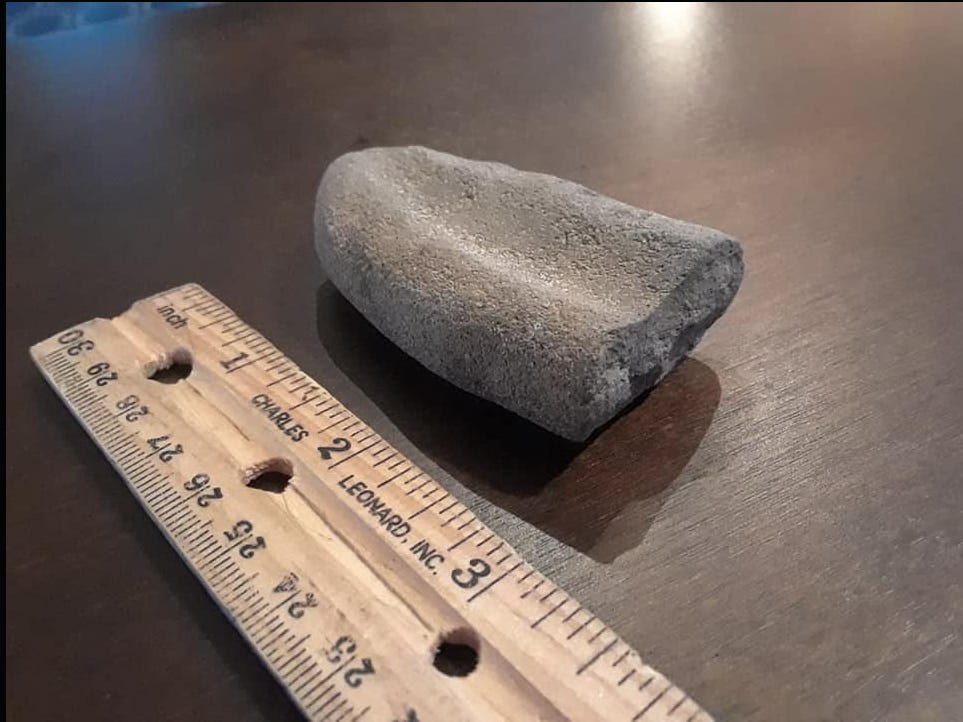
At first, I thought it was modern. It felt like rough masonry, with smooth grooves worn into each side. I figured it was a piece of a defunct bridge or dam, or maybe a collapsed upstream house. Definitely nineteenth or twentieth century. So, I tossed it back on the ground. Maybe you geologists would like to chime in?
Half an hour later, I returned to pick it up. I still didn’t know what it was, but I just couldn’t leave it behind. Something about the way it fit in my hand—I know that’s a maddening cliché among arrowhead hunters, but sometimes it’s valid.
The gods smiled on me.
Lying in bed late that night, I happened to be reading The Powhatan Indians of Virginia: Their Traditional Culture, by noted Virginia anthropologist Helen Rountree. Figure 14 on page 66 held a black and white photo of Native American artifacts housed in a local university collection.
An object at center-bottom was exactly what I’d picked up that morning and almost left behind for trash! The book called it “a stone crusher with indentations on both sides.” What I’d found was a stone miller.
What are the odds I’d learn the truth that very night? I was so relieved I hadn’t tossed it out. My wife, lying next to me, was measurably less excited.) And, as usual, I offered it to the local museum, which declined without looking at it.
One final discovery
I LOVE finding Indian pottery. Given its use in food making and storage, there’s something warm, familiar, and intimate about it.
Our local Native pottery was made by pinching clay; they didn’t have pottery wheels. The potter then usually pressed fabric or cords onto the vessel, creating distinctive patterns. Apart from decoration, I’m guessing the patterns probably made it a bit easier to grasp the finished pot, too.
The Native pot sherds I find are always very small (about the size of a microchip), scattered, and barely worth keeping even if you know what they are. I only recognized the tiny sherd pictured below because it showed the imprinted cloth pattern. I found it deep in the marshes of Potomac Creek behind our farm, washed up alone by a fast-flowing stream.
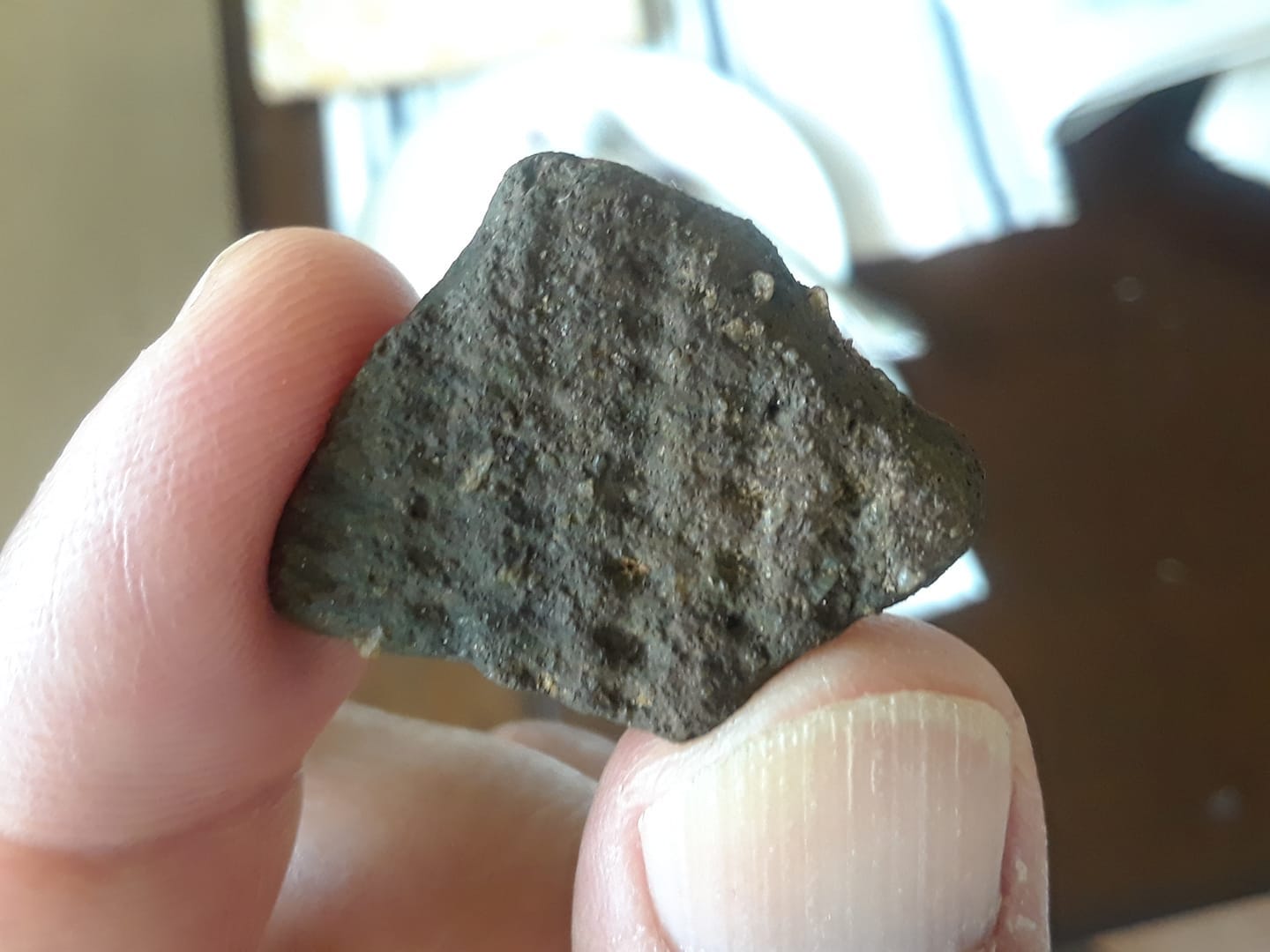
Look at the miniscule quartz minerals embedded within the clay. This is “temper” added for strength. Delicate, strong, and lovely.
My gratitude to whomever made it. You are long gone and unknown to me. But by your works, you’re still here, in the present. With me.
***
Ranjit Singh teaches in the Department of Political Science and International Affairs at the University of Mary Washington. He’s also an active environmentalist. His “No Lines in Nature” Substack, where this essay originally appeared, blends history, science, and philosophy to explore our relationship with the natural world world. You can find it HERE.