
Bruce Saller, ADVANCE CONTRIBUTOR
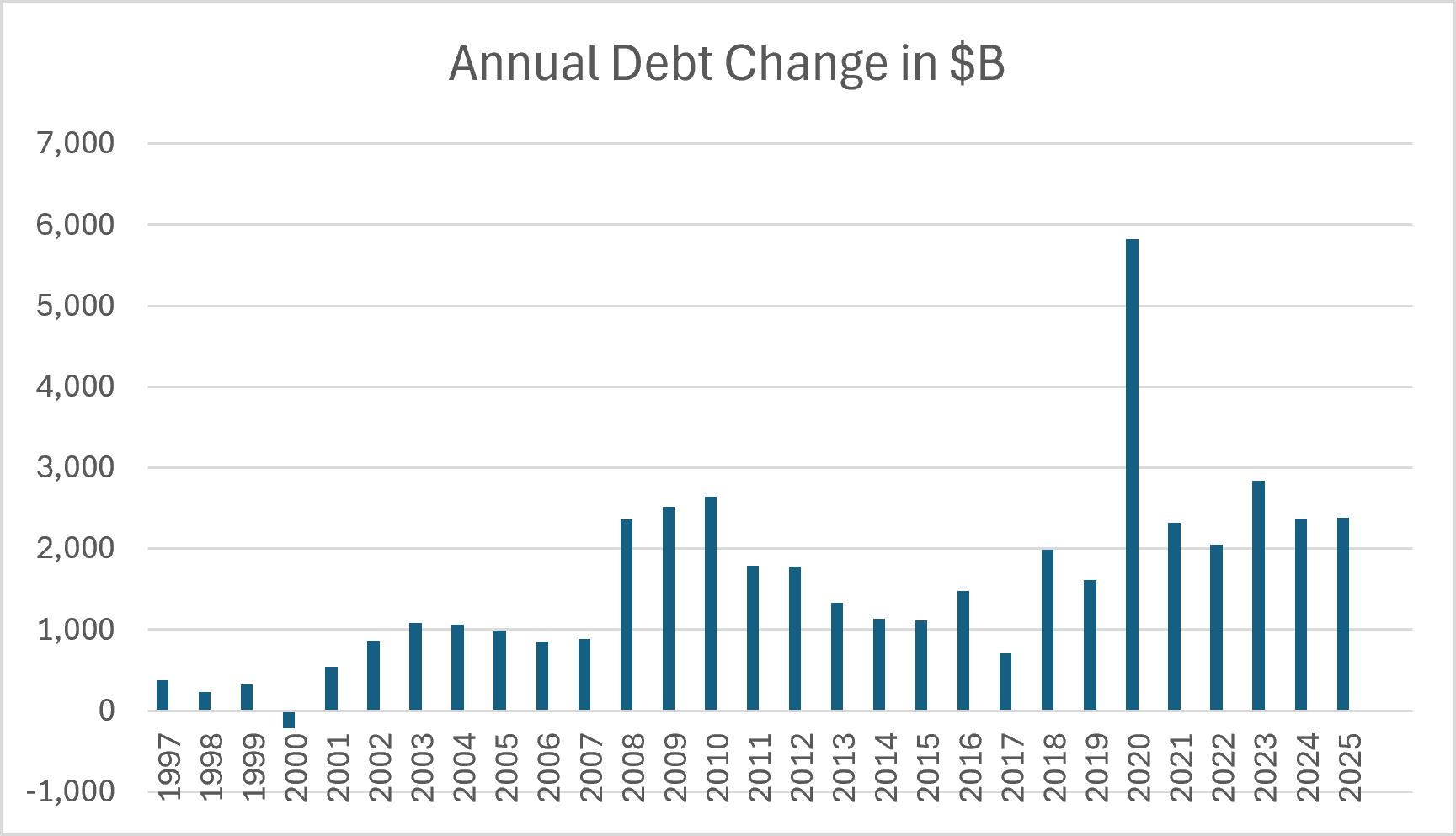
The federal debt reached $40 trillion dollars on 8/18/26. It previously reached $38 trillion on 10/21/25 and $39 trillion on 3/16/26. The debt was “only” $5.5 trillion in 1997, so why has it increased so much? The chart above shows the annual addition to—and in the year 2000, subtraction from—the debt since 1997 in current dollars.
The debt has only decreased the one year, 2000, in recent history. That was accomplished by a combination of tax increases and reduced spending.
Tax cuts in 2001, spending on Medicare drug coverage, and the wars in Afghanistan and Iraq, led to trillion-dollar debt increases each of the next several years.
The housing bubble burst in 2008 led to a financial crisis and recession, resulting in massive spending to bail out banks.
Additional spending on healthcare began in 2013, but spending in following years was reduced due to a budget agreement.
Tax cuts and increased defense spending in 2018 reversed the decline.
The Covid-19 pandemic caused massive spending in 2020 and subsequent years.
Additional spending on infrastructure and green energy started in 2022, but spending restraint in 2024-2025 reduced the annual increase.
Additional tax cuts, increased defense spending and rising interest rates in 2026 will cause the annual debt to rise again.
To date, the 2026 annual debt increase is $500 billion higher than 2025.
So, how can we start to reverse this trend? The first issue is to understand which income and spending affects the debt. When politicians start talking about the debt, they first focus on entitlement spending. But most entitlement spending does NOT affect the amount of debt. It does impact the annual deficit/surplus because of how Congress has defined income and expenditures.
Here’s how it works: The government reported a surplus of more than $500 billion in 2000, but the debt only decreased by around $200 billion. The difference was due to including the income and expenses of trust funds in the deficit/surplus calculation. The surplus/deficit of certain trust funds does not affect the total debt, only the split between the public and government held debt. This is true for trust funds that have a separate funding stream and enough income and assets to cover their expenses (e.g. Social Security Trust Funds, Medicare Hospital Insurance Trust Fund). For example, if a Social Security fund had a $100B surplus, that trust fund would purchase $100B of government bonds, shifting $100B of public debt to government debt, but not changing the total debt.
The government does not produce a report that shows the income and spending affecting the debt. I have created one (my best estimate) for Fiscal Year 2025 based on the government’s 2025 financial report (in billions):

This shows the magnitude of the problem, and how difficult it is going to be to reduce the debt increases. I don’t see how we can substantially reduce it without increases in revenue and decreases in spending. Other major problems that need to be addressed are the viability of the Social Security and Medicare Trust Funds, which are projected to deplete their reserves within a decade.
All of these problems become more difficult to solve as we delay making the hard decisions. The last time the government addressed some of these issues was in the mid-1980s when the Democrats and Republicans jointly raised Social Security and Medicare taxes, and increased the full retirement age for Social Security. Those changes added decades to the viability of those programs. We need to have Congress create bi-partisan commissions to develop recommendations for these issues, and voters need to push their representatives to agree to the changes before the rising debt causes another financial crisis.
Data Sources
Debt: https://fiscaldata.treasury.gov/datasets/debt-to-the-penny/debt-to-the-penny
Annual inflation: https://www.investopedia.com/inflation-rate-by-year-7253832
Medicaid: https://usafacts.org/answers/how-much-does-medicaid-cost-in-the-us/country/united-states/
Medicare: https://www.cms.gov/oact/tr/2026
***
Bruce Saller is a retired systems engineer with degrees in electrical engineering and computer science.

Good article. My brother often says "Post-war America is always pre-war America." America is in a perpetual state of war. War is all that any citizen under thirty has ever known. This sad condition not only leads the country into deeper debt. It reveals how utterly bereft we are of leadership willing and able to engage in diplomacy and a true estimation of what constitutes an actual threat to our national security. Currently, we resemble a conglomerate of self-interested corporations and billionaires with a vast, taxpayer-funded military at their disposal. As our prestige abroad continues to plummet, our leverage does, too, and the temptation to simply try to bomb our way out of predicaments only increases. Nothing will change until the leadership does.
At this point, I think of anyone who says that the budget problem is difficult to solve is just a billionaire apologist. These problems would be immensely easy to solve if we weren't living in a kleptocracy.
Raise the tax rates on the wealthy and corporations; problem solved. Remove the social security tax cap; problem solved. Those who say "this problem is complicated" have succumbed to the oligarchs propaganda: It's easy! We obviously need to raise revenue. Look at any macroeconomic chart since 1980 and the problem be comes glaringly obvious: The US political class has completely succumbed to the oligarchs. That is the real problem.
**Of course our nation should demand that the DoD pass an audit before giving them another dime, but that's a topic worth its own article.