
By Steve Rabson, GUEST COLUMNIST
In May 1974, shortly after moving to Boston, I made my first of many visits to Fredericksburg where my mother was a psychology professor at Mary Washington College, now the University of Mary Washington. In those days, I associated southern accents, like what I heard in Fredericksburg, with the South’s history of slavery and Jim Crow.
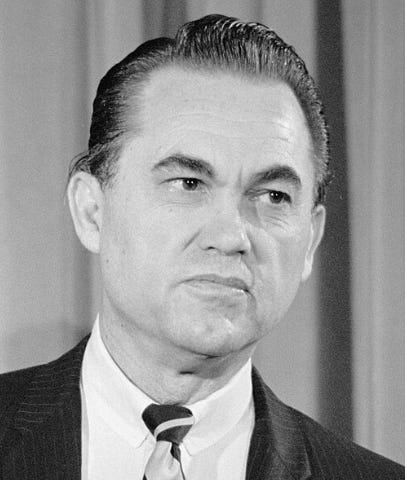
When I returned to Boston that June, television news was broadcasting scenes of riots there with angry white residents hurling stones and eggs at school buses. This was the Boston “Busing Crisis,” a violent backlash to court-ordered desegregation of the city’s schools. Two years later, Alabama governor George Wallace came to Boston to campaign for president in the 1976 Massachusetts primary election. Notorious as a rabid segregationist, Wallace claimed to have moderated his views on race after a 1972 assassination attempt left him in a wheelchair. But in Boston he railed against the court order as a “social experiment” engineered by “pointy headed federal bureaucrats too busy busing little children.”
Wallace received 123,112 votes, 16.73 percent of the total, good enough to place third among 14 candidates in this deep-blue state—and first in what I had previously assumed was ultra-liberal Boston, ahead of Hubert Humphrey, Henry “Scoop” Jackson, Morris Udall, and Jimmy Carter, the eventual Democratic nominee for president.
At the time, I was studying Japanese dialects as a graduate student in the Department of East Asian Languages at Harvard, and my visit to Fredericksburg sparked my interest in speech patterns here. I learned the difference between the “deep” southern accent spoken by Wallace, which is characterized by sharp, clipped consonants and elongated vowels stretching words into extra syllables—such as cat into “ceh-at”—and the Central Virginia accent, which according to linguists is a softer blending of southern intonation with Appalachian, Mid-Atlantic and Tidewater elements.
I interviewed a native speaker in Fredericksburg at the 2400 Diner on Princess Anne Street who offered the following examples:
Wash—warsh
water—warter
kindergarten—kundygarden
by—bah
bye—bah
about—aboht
try—trah
on —own
probably—prob-lee
I—ah
my—mah
then—thay-en
time—tah-eem
type—tye-eep
Carolina—kya-ro-LAH-na
pin and pen—both pronounced “pin”
In my courses at Harvard I learned that Japan also has regional accents. However, they are discouraged by the Ministry of Education which seeks to enforce the Tokyo “standard” in the schools, and by the media which seeks a nationwide audience for its commercials.
Wherever I’ve lived in the U.S.—Boston, New York, Rhode Island, Michigan, Chicago, California, and Virginia—I’ve noticed that, as in Japan, TV and radio announcers ignore the local accents and speak in what is thought to be “standard” English, but which in fact is the regional dialect of American English spoken in the upper Midwest, at one time the nation’s industrial heartland.
Another difference in speech I noticed between Boston and Fredericksburg was the way store clerks greeted customers here. In New England customers were usually left alone to find what they wanted to purchase or, at most, asked, “May I help you?” “May I help you?” of course, can sound like pressure to buy something and leave the store, depending on the clerk’s tone of voice.
In Fredericksburg and the surrounding area, on the other hand, clerks greeted me enthusiastically as if I were an old friend: “Hello, how are you?”
This never sounded insincere to me, or like an effort to cajole me into buying something. I also noticed that when I passed strangers on Fredericksburg streets, that they would also say “Hello” or “Good morning” with a friendly smile. In New England, such behavior would generally be considered abnormal, or even intrusive.
I began to think that “southern hospitality” was more than just a myth or a stereotype, although I wondered if most white people here would greet me in similar fashion if I were Black.
I’ve also noticed, having lived in several parts of the country, that many people who move from one region to another try to conform or assimilate their speech to the region where they relocate to avoid being labeled as outsiders or “transplants.”
Others, however, take pride in their regional accents. I’ve met long-time residents of Fredericksburg, originally from New York and Massachusetts, who steadfastly maintained their regional accents—even exaggerating them—as important expressions of their personal identity.
Since moving to Fredericksburg in 2011, I’ve come to enjoy hearing the local accent, and no longer associate southern dialects automatically with the region’s troubled legacy, especially after living in Boston with its own deeply problematic racial history.
***
Dr. Steve Rabson is a retired professor emeritus of the Department of East Asian Studies at Brown University, and currently an adjunct instructor in the Department of Modern Languages and Literatures at the University of Mary Washington.

100 percent ... a great analisis.
Welcome back, Kotter.
Robert and Cathy
(Rowser Fish Fry...)