
By Michael Aubrecht
ADVANCE CONTRIBUTOR
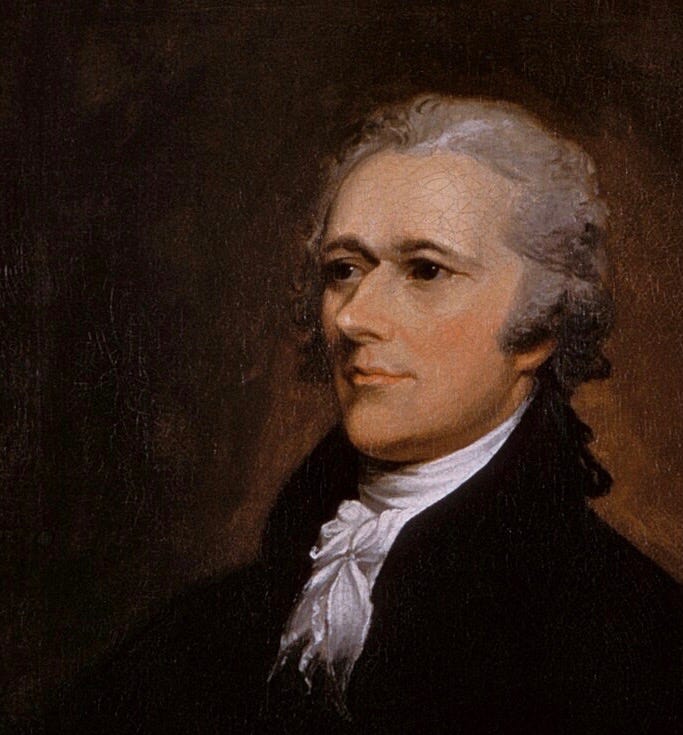
Perhaps no other American icon has had more speculation raised (and ignored) about his sexual preference than Alexander Hamilton. This controversial Founding Father left behind an abundance of questions after dying a premature death following an ill-fated duel with political rival Aaron Burr. His is a story that begs reexamination. Of course, all historical analysis is subject to speculation, but what we’ve come to learn about the life and writings of Alexander Hamilton has revealed an interesting argument for his being gay.
Hamilton was a complex man of many talents. Soldier, economist, political philosopher, constitutional lawyer, secretary of the Treasury, leader of the Federalist Party, and founder of the U.S. Mint were just a few of the titles he held. Hamilton’s climb toward political popularity was forged during his exquisite service during the American Revolutionary War. Initially acting as an artillery officer, he later became the senior aide-de-camp to General George Washington. Hamilton again served his commander-and-chief in 1794 during the Whiskey Rebellion tax-revolt, acting as the president’s closest military confidant. Three years later, he was unanimously named as Washington’s successor as commander of a new American army, mobilizing in preparation for a potential war with France. Fortunately, the need for such a force was negated thanks to the stubborn diplomacy of President John Adams.
It was while serving on Washington’s staff that Hamilton met John Laurens, the man about whom his relationship has become the subject of much fascination. Laurens was a successful soldier and statesman from South Carolina who gained approval by the Continental Congress in 1779 to recruit a regiment of 3,000 enslaved men by promising them freedom in return for fighting.
Despite being married to a woman named Martha Manning, Laurens arrived in the colonies as a bachelor after leaving her behind in London. He joined the Continental Army, and following the Battle of Brandywine was made an aide-de-camp to Washington with the rank of lieutenant colonel. He also served with the Prussian-born Baron von Steuben—also said to be gay—doing reconnaissance at the outset of the Battle of Monmouth.
While on campaign, Laurens became close friends with his fellow aides the Marquis de Lafayette and Alexander Hamilton. His connection with Hamilton would eventually lead to speculation that the two were in a closeted gay—or at the very least an intimate homosocial--relationship. Adding to the complexity of their bond was Hamilton’s reputation as an adulterer. In 1791 he admitted participating in a scandalous affair with the wife of James Reynolds, a notorious swindler who later tried to blackmail Hamilton. In an effort to limit the political fallout, Hamilton published a full confession, shocking both his family and supporters by not merely admitting his guilt, but also by inexplicably writing about the affair in a surprising level of detail. The public’s reaction damaged Hamilton’s standing for the rest of his life. That event, however, took place years after the untimely death of John Laurens in 1782.
According to historian Jonathan Katz, who specializes in human sexuality, the primary source about the Hamilton-Laurens relationship is a series of intimate letters that Hamilton wrote shortly after Laurens left Washington’s staff to return to his home state of South Carolina. Laurens’ goal was to persuade the state’s legislature to recruit African Americans, who were flocking to fight the Continentals as British Loyalists.
Hamilton’s first letter to Laurens was penned in April of 1779:
Cold in my professions—warm in my friendships— I wish, my Dear Laurens, it were in my power, by actions rather than words, to convince you that I love you. I shall only tell you that ‘till you bade us Adieu, I hardly knew the value you had taught my heart to set upon you. Indeed, my friend, it was not well done. You know the opinion I entertain of mankind, and how much it is my desire to preserve myself free from particular attachments, and to keep my happiness independent of the caprice of others. You should not have taken advantage of my sensibility, to steal into my affections without my consent. But as you have done it, and as we are generally indulgent to those we love, I shall not scruple to pardon the fraud you have committed, on one condition; that for my sake, if not for your own, you will always continue to merit the partiality, which you have so artfully instilled into me….
And Now my Dear as we are upon the subject of wife, I empower and command you to get me one in Carolina. Such a wife as I want will, I know, be difficult to be found, but if you succeed, it will be the stronger proof of your zeal and dexterity….
If you should not readily meet with a lady that you think answers my description you can only advertise in the public papers and doubtless you will hear of many… who will be glad to become candidates for such a prize as I am. To excite their emulation, it will be necessary for you to give an account of the lover—his size, make, quality of mind and body, achievements, expectations, fortune, &c. In drawing my picture, you will no doubt be civil to your friend; mind you do justice to the length of my nose and don’t forget, that I [Several words here have been mutilated in the manuscript. Some scholars theorize that Hamilton was referring to his “manhood”].
After reviewing what I have written, I am ready to ask myself what could have put it into my head to hazard this Jeu de follie. Do I want a wife? No—I have plagues enough without desiring to add to the number that greatest of all; and if I were silly enough to do it, I should take care how I employ a proxy. Did I mean to show my wit? If I did, I am sure I have missed my aim. Did I only intend to [frisk]? In this I have succeeded, but I have done more. I have gratified my feelings, by lengthening out the only kind of intercourse now in my power with my friend. Adieu
Yours. A Hamilton
On September 11, 1779, Hamilton wrote a second letter in which he referred to himself as a jealous lover:
I acknowledge but one letter from you, since you left us, of the 14th of July which just arrived in time to appease a violent conflict between my friendship and my pride. I have written you five or six letters since you left Philadelphia and I should have written you more had you made proper return. But like a jealous lover, when I thought you slighted my caresses, my affection was alarmed and my vanity piqued. I had almost resolved to lavish no more of them upon you and to reject you as an inconstant and an ungrateful [—]. But you have now disarmed my resentment and by a single mark of attention made up the quarrel. You must at least allow me a large stock of good nature….
Have you not heard that I am on the point of becoming a benedict? I confess my sins. I am guilty. Next fall completes my doom. I give up my liberty to Miss Schuyler. She is a good hearted girl who I am sure will never play the termagant; though not a genius she has good sense enough to be agreeable, and though not a beauty, she has fine black eyes – is rather handsome and has every other requisite of the exterior to make a lover happy. And believe me, I am lover in earnest, though I do not speak of the perfections of my Mistress in the enthusiasm of Chivalry.
Is it true that you are confined to Pennsylvania? Cannot you pay us a visit? If you can, hasten to give us a pleasure which we shall relish with the sensibility of the sincerest friendship.
Adieu God bless you…. A Hamilton
The lads all sympathize with you and send you the assurances of their love.
One year later, on September 16, 1780, Hamilton penned a third letters to Laurens that appears to put his affections for the recipient to be above those for his current female mistress:
That you can speak only of your private affairs shall be no excuse for your not writing frequently. Remember that you write to your friends, and that friends have the same interests, pains, pleasures, sympathies; and that all men love egotism.
In spite of Schylers black eyes, I have still a part for the public and another for you; so your impatience to have me married is misplaced; a strange cure by the way, as if after matrimony I was to be less devoted that I am now. Let me tell you, that I intend to restore the empire of Hymen and that Cupid is to be his prime Minister. I wish you were at liberty to transgress the bounds of Pennsylvania. I would invite you after the fall to Albany to be witness to the final consummation. My Mistress is a good girl, and already loves you because I have told her you are a clever fellow and my friend; but mind, she loves you a l’americaine not a la françoise.
Adieu, be happy, and let friendship between us be more than a name. A Hamilton
The General & all the lads send you their love.
There are no other suggestive Hamilton-Laurens letters. Two years later. Laurens was killed during a skirmish, prompting a distraught and grieving Hamilton to state, “I feel the deepest affliction at the news we have just received of the loss of our dear and inestimable friend Laurens. His career of virtue is at an end…. I feel the loss of a friend I truly and most tenderly loved, and one of a very small number.”
In an essay titled “The Hamilton-Laurens Relationship,” historian Bob Arneback wrote that the “extant letters” were expressions of Hamilton’s “homoerotic bravado with Laurens.” They may not be definitive, Arneback concluded, “But it is quite enough to allow us to label Hamilton as a man with a wide appetite for pleasures that comfortably included homosexuality.”
Whatever the nature of Hamilton’s relationship with Laurens, there is distinct proof that he enjoyed the company of women. In addition to his affair with Maria Reynolds, Hamilton later married Elizabeth Schuyler, mentioned in one of the letters to Laurens, and fathered eight children with her. Schuyler survived Hamilton by 50 years, until 1854, and spent much of her life working to help widows and orphans. After Hamilton’s death, she co-founded New York’s first private orphanage, the New York Orphan Asylum Society.
Most historians who ascribe to the Gay-Hamilton Theory, believe that Elizabeth was unaware of her husband attraction to men.
Alexander Hamilton joined John Laurens in the great beyond on July 12, 1804. Both a celebrated war hero and detested politician, he left behind a legacy that continues to divide critics today. From his dissenting posture as an ardent Federalist to his disruptions as a member of John Adams’ cabinet, Hamilton didn’t enjoy the same blanket-adoration as his contemporaries—until he was “rehabilitated” by Lin-Manual Miranda’s Tony-, Grammy-, and Pulitzer-award-winning musical.
John Laurens is with him there, too.
***
Michael Aubrecht is the author of Thomas Jefferson and the Virginia Statute for Religious Freedom: Faith & Liberty in Fredericksburg and The Letters of Robert Morris: Founding Father and Revolutionary Financier. You can learn more at Michael’s blog.
Michael Aubrecht begins his writing for the Advance with a bang.