
By Ranjit Singh, ADVANCE ENVIRONMENTAL COLUMNIST
Dirt is mostly minerals—minute specks of rocky dust, empty of life. If you grab a handful from the ground, it falls away easily, slipping through your fingers. If it clumps in your hand, however, it isn’t dirt: It’s soil.
Soil is life. It is a living ecosystem, full of organic matter like microorganisms and fungi as well as water and air. Soil’s many ingredients also include bits of old life capable of sustaining new life.
Wherever our species has lived, the underlying soil is likely to hold traces of dead humans, too. Our DNA, like that of woolly mammoths and cave bears, may persist for hundreds of thousands of years, depending on conditions. This means that even here on warm, wet Potomac Creek, we literally walk and grow flowers in the loam of past peoples: of natives and immigrants, of masters and the enslaved, and of the Indigenous peoples who have persisted here for millennia.
Not surprisingly, many Stafford residents are emotionally attached to the rich soil of our county. This is especially so among older people. They know their forebears weren’t just “children” of the soil; they are the soil.
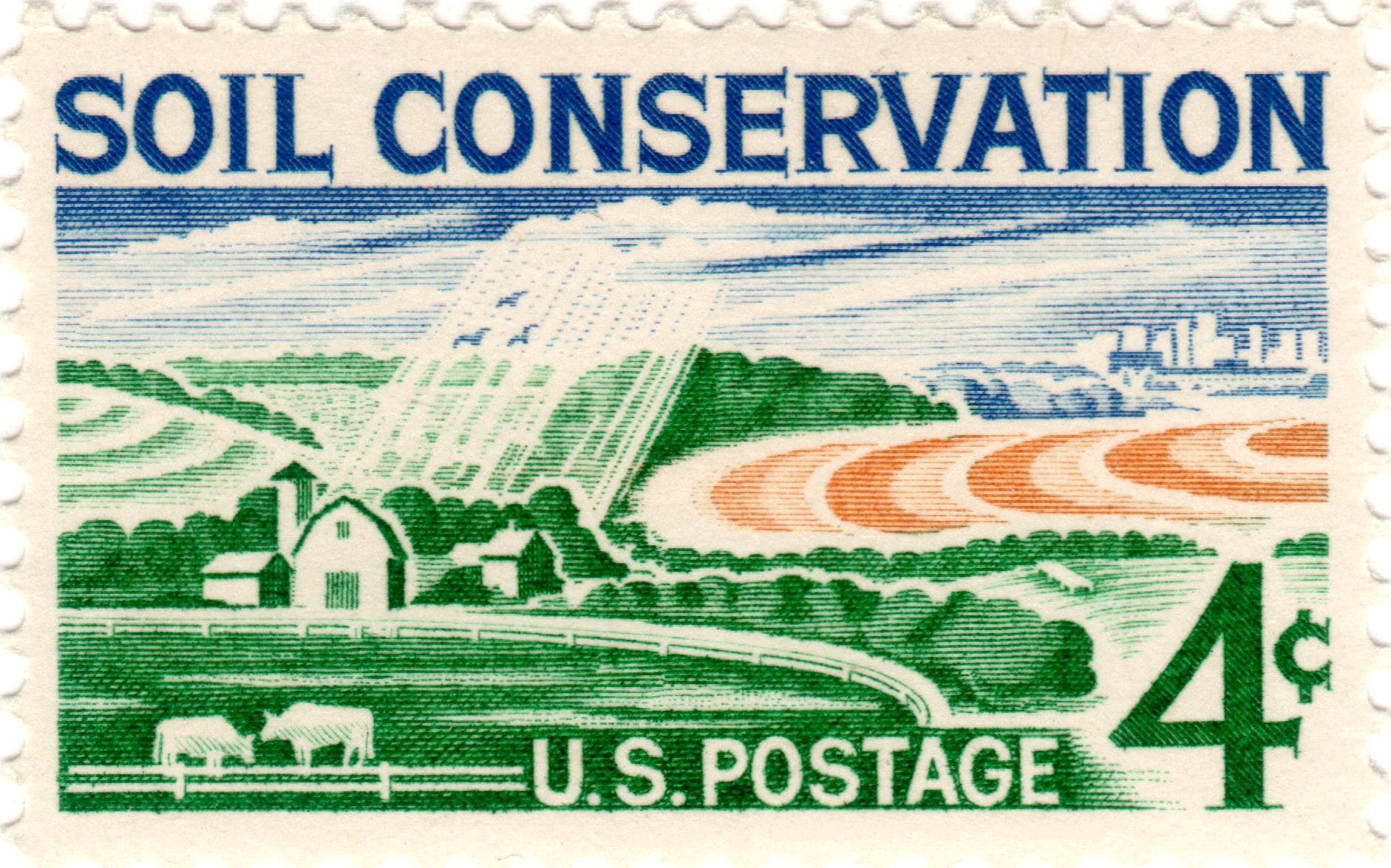
You don’t know what you’ve got ‘til it’s gone. 1959 stamp marking 25 years of soil conservation, prompted by the catastrophic Dust Bowl.
So dirt—lifeless, moonlike—warrants little interest. But in soil, the fables and narratives of those who came before us commingle with those living now. Soil is intrinsically valuable. And what we do with it says a lot about who we are.
Which is to say there is a morality to soil.
I draw this distinction for a reason.
In a recent No Lines in Nature article titled The New Battle for Potomac Creek, my friend Jeff Eastland argued against a proposed data center to be built in Stafford County, along the creek that runs past our family farm. Jeff pointed out that, among other problems, the thrumming, polluting center would be built atop a family cemetery. The plot belongs to the Seddon family. It is believed that this historically significant graveyard, dating to the 1700s, holds the remains of both slave owners and the enslaved. Such mixed cemeteries are rare in the South. An archeological review is now under way.
If the Potomac Creek data center is approved, a court may decide that the human remains have to be relocated. That idea doesn’t sit well with some local people. In fact, some current descendants of those interred in the cemetery, both Black and white, find it outright objectionable.
Take the words of 94-year-old Dorothy Jackson. Jackson, who is African American, has spent years researching the history of her ancestors. Some were enslaved and are thought to be buried in the Seddon lot. She does not want to see their remains dug up and moved away.
“We should not disturb the dead,” Jackson told a local news crew. “I don’t think it’s right to dig up the remains of people who were slaves.” She continues:
“Money isn’t everything. Let’s look in our hearts. It’s wrong to dig up dead people. We don’t need the money that bad.”
The data center campus proposed for Potomac Creek is 99 acres. Building a large data center requires clear-cutting every tree, removing the soil, and stripping the earth down to bare clay. Then, as Jon Gorey of the non-profit Lincoln Institute of Land Policy notes, such data centers cover the land “with impermeable steel, concrete, and paved surfaces,” rendering it no longer available for farmland, nature, or housing.
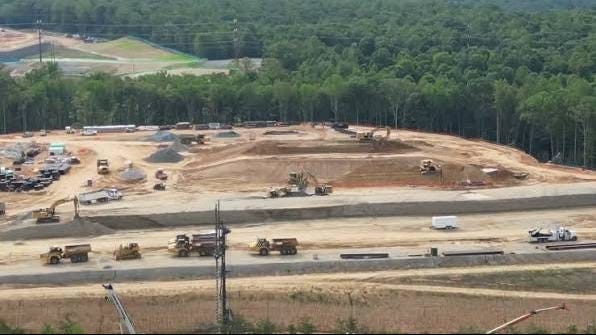
In other words, once the data center is built, that’s it for the land. Soil-less, it becomes inhospitable to life.
The environmental death wrought by data centers brings to mind the coal mining industry’s large-scale mountain top removal practices, which to date have leveled more than 500 mountains and utterly destroyed 2,000-plus streams in Appalachia.
Legally, the companies involved in mountaintop removal are supposed to “reclaim” the land after they’re done mining it. Yet enforcement is weak and inconsistent at best, and they seldom do. Often, the mining companies prefer to walk away, claiming bankruptcy once the profits have been realized. And when they do what they’re legally obligated to do, they spray the now-flat and usually toxic area with inorganic rocks and grass seed. None of this “reclamation” is capable of restoring the rich life taken away. The environmental damage is permanent.
I won’t argue that Stafford County data centers are equivalent to mountaintop removal. Almost nothing compares with that kind of total war against nature. The destruction involved is biblical in scale.
But where those new data centers are built, the ecological damage will indeed be permanent. The nourishing soil will be gone forever. And no one should trust a corporation that says otherwise, or promises to fix things after these cutting-edge centers become obsolete (often estimated to be within 3-10 years).
Headquartered elsewhere, data center developers are outsiders with every incentive to mislead local elected officials and hide inconvenient truths from the public. Their only short-term goal is to gain the necessary approvals to start making money. After that, nothing is guaranteed, whatever promises have been made.
Decades of mountaintop removal in Tennessee, Virginia, West Virginia, and other parts of Central Appalachia provide all the evidence we need of that. Throughout the energy industry, when promises are kept, it’s usually after acrimonious lawsuits. Just look at the coal ash clean-up problems throughout North Carolina and Virginia. Of course, data centers are massive energy consumers, not energy providers. But let’s not expect the IT and digital infrastructure industry (and the billionaires behind it) to act like angels, either.
That’s not cynicism. It’s simply what happens over and over. For that matter, the promised massive revenues data center developers are dangling before our local officials should be viewed with profound skepticism, too. More than one such official has explained to me that the money on offer would revolutionize local school budgets overnight. I could only think, “Who, years from now, is going to hold them to those promises? If it sounds too good to be true…” The record suggests that much of the revenue will have to be fought for.
And then, there are some who may well say “It’s only dirt.”
Here is where the morality kicks in. No—it’s soil. It is life itself.
It is life to the migratory birds like the red-eyed vireo and scarlet tanager, which for millennia have flown all the way from Amazonia each spring to raise their next generations in our protective forests. It is life to the eels, herring, and shad that swim from the Atlantic Ocean to spawn in our increasingly polluted creeks and rivers. And to the disappearing box turtles that require ten years to mature and reproduce, and are every day losing the wooded habitat they need to survive.

Maybe those arguments won’t move everyone to value the soil beneath our feet.
But say “It’s only dirt” to 94-year-old Dorothy Jackson. She can explain it to you quite succinctly:
Money isn’t everything.
***
Ranjit Singh teaches in the Department of Political Science and International Affairs at the University of Mary Washington. He’s also an active environmentalist. His “No Lines in Nature” Substack blends history, science, and philosophy to explore our relationship with the natural world world. You can find it HERE. And you can find an earlier version of this essay HERE.

“A nation that destroys its soils destroys itself,” - Franklin D Roosevelt, 1937.