By David S. Kerr, SPECIAL TO THE ADVANCE

When I was a student in Scotland 45 years ago, I went to a church near where I lived in Edinburgh. It was called Hope Park/Buccleuch Methodist Church and was located on George IV Bridge Street in the center of the city. It was a beautiful old Victorian church, that from the street looked plain, but inside was magnificent. To be honest, I think I decided to go that particular church because it was the closest to where I lived, and being all of 20 I wanted to sleep in as late as possible on Sundays.
But it was a good choice. The minister, the Rev. McPherson, was friendly, and in spite of his seemingly advanced age (at that time I thought someone in their late 50s was extremely old), had an excellent ability to connect with young people.
He wore his clerical collar as a man of God should, but it did fit a little tightly. He had consumed, as he frequently admitted, more than his fair share of cookies and pastries. However, the one thing I couldn’t have imagined, at least in the mind of a 20-year old, was that this happy, jovial, and wonderfully empathetic Scottish minister had once been a soldier. Even more than that, an undisputed hero.
In Britain, the Sunday nearest the 11th of November—Armistice Day in the United Kingdom, our Veteran’s Day—is for many churches “Remembrance Sunday.” Church services close to Armistice Day are often focused on remembering not only those who died in defense of the nation’s freedom, but also on living veterans. It’s also not uncommon for veterans to wear their service medals to church.
It was on a Remembrance Sunday after church when talking to the Rev. McPherson while he was delighting in a cup of tea and a very large chocolate croissant, that I asked him about the medal he was wearing. The idea of this somewhat hefty, good-natured man being a soldier surprised me.
The reverend didn’t have what the armed services call a “military bearing,” and that’s why I wasn’t prepared for his answer.
He smiled at my somewhat brash question, fingered the medal for a moment—it was on a ribbon around his neck—and then quietly said, “This is the Victoria Cross, David.” I don’t quite recall what I said after that. Perhaps not much, because though my knowledge of British medals for valor might have been limited, I knew what the Victoria Cross was. It’s much like our Congressional Medal of Honor, and is given only for the most remarkable deeds of heroism. And just like our Medal of Honor, many of those who receive it, do so posthumously.
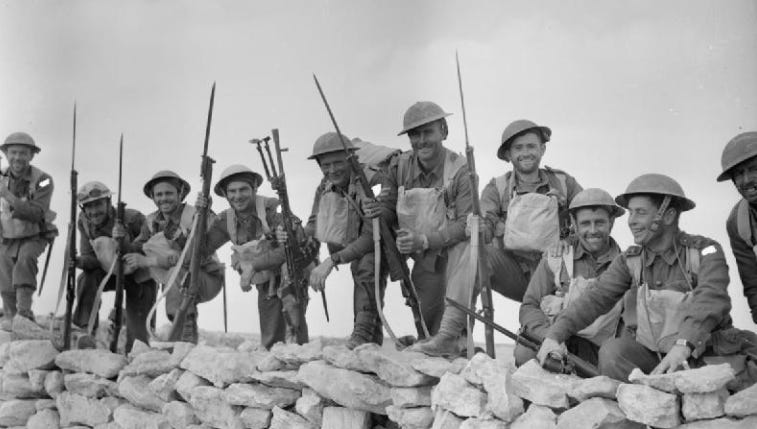
I found out later that McPherson received his medal for his heroism in North Africa in 1941. I don’t know the precise details, but I was also told later that it involved his leading an action that cleared a German position. One that had been raking British troops with machine gun fire.
I don’t know if he was wounded, but he probably was. And like many veterans—particularly the British, who tend to be more reserved about such things—he didn’t talk about it much. But he did wear his medal that one Sunday, and it changed my view of what a veteran was ever after. Namely, that those who serve their country, whether doing heroic deeds or just the often-unglamorous things that need doing during wartime and peacetime, can be anybody.
Appearances, as they were in this case, are deceiving. A veteran can be an old man in a nursing home. Your child’s teacher. Perhaps a granddad, a father, mother, uncle, brother, or a sister. Your mechanic, a bank manager, a coworker, and the list goes on. I have veterans in my classes at Virginia Commonwealth University who are still under 25.
But they all have one thing in common, and it’s that for some period of their life they served their country in the armed forces. They will often say—and it’s a common quote among veterans; my father used to frame his service this way— that they were just doing their jobs. Fair enough. But whether they choose to frame their service in these words or not, they were protecting us, our freedom, and our way of our life. This Veterans Day, and indeed every day, they deserve our thanks.
***
David Kerr is a Stafford County resident. He taught for nine years as an adjunct professor of political science at Virginia Commonwealth University. He has worked for various federal agencies as well as on Capitol Hill. David also served on the Stafford County School Board. He lives with his wife, two horses and three cats. He is also a Navy veteran.