By Paul Cymrot, ADVANCE CONTRIBUTOR
Humans are the only animals that have to constantly balance to keep from falling down. Our feet are small, soft, and non-prehensile. By the standards of everything else that runs or walks or slithers or swims, we are untenably precarious. Cats and chimps and crocodiles maintain four points of contact with the ground, and a tail too, for something more than mere balance. Ants and beetles, six legs and two antennae. Spiders more. Fish and dolphins are immersed and don’t know the meaning of “falling over” (although they can get swept up in strong currents—literal ones, not metaphorical ones, which is another danger humans endure alone). Birds, our only two-footed brethren, have feet that lock into a gripping position when they are perched or asleep. Their feet are as much as a third of their height when birds are walking, and most have toes that point in both directions. It’s true that we humans can see further towards the horizon than most other animals, standing erect as we do, but is what we’re seeing so important? And what good does it do if we keep losing our balance?
***
Our four families have shared an early summer beach house for nearly 20 years. We were just babies back when we started. My wife and I had the first kid, then year by year, the others did too, until the first place was too small, and we had to splurge for the big house next door. Now it, too, is full, with someone invariably ending up on a hallway couch and a lizard in a plastic terrarium.
From its broad oceanfront porch, we tread our own private footpath over the dune to the beach. Is this the front porch or the rear? We’ve debated for years. From here, are we looking forwards or backwards? We carry tents and chairs and buckets and Frisbees back and forth in a practiced routine. We have a spreadsheet older than the kids with a detailed list of everything we need to bring, all the tangibles for the week. Coffee filters, a sharp knife, puzzles.
For the other 51 weeks of the year, we all live in the same town but rarely see each other, instead co-habiting an endless text thread where we share videos of houses falling into the ocean, hurricanes breaching the dunes, and shark attacks in proximity to our beach. On travel day, we set our phones to show our locations, and watch the four dots representing our minivans roll southward and oceanward. The dots start in a cluster in our home town, spread out along the highway, then re-cluster once we get here. The beach is always right where we left, everything is as it was.
Until this year.
This year our oldest child is off on a cross country road trip and college-bound in the fall. Her absence, this vacancy, is not on the spreadsheet, but the car and the house are filled with it.
Her trip had been plotted out on a large paper map on the living room coffee table for months, and is the culmination of a full year of wishful thinking and hopeful, resilient, planning. The first version included four classmates. One dropped out because her parents couldn’t stomach the idea of four inexperienced drivers covering 7,500 miles in an unsupervised month. Another dropped when she tore her ACL and had to get surgery. When the third lost her father to cancer, it looked as though the trip might not launch. But launch it did, just 36 hours after graduation. All smiles and tears. It is already the furthest and longest she’s been away, and a harbinger of things to come.
***
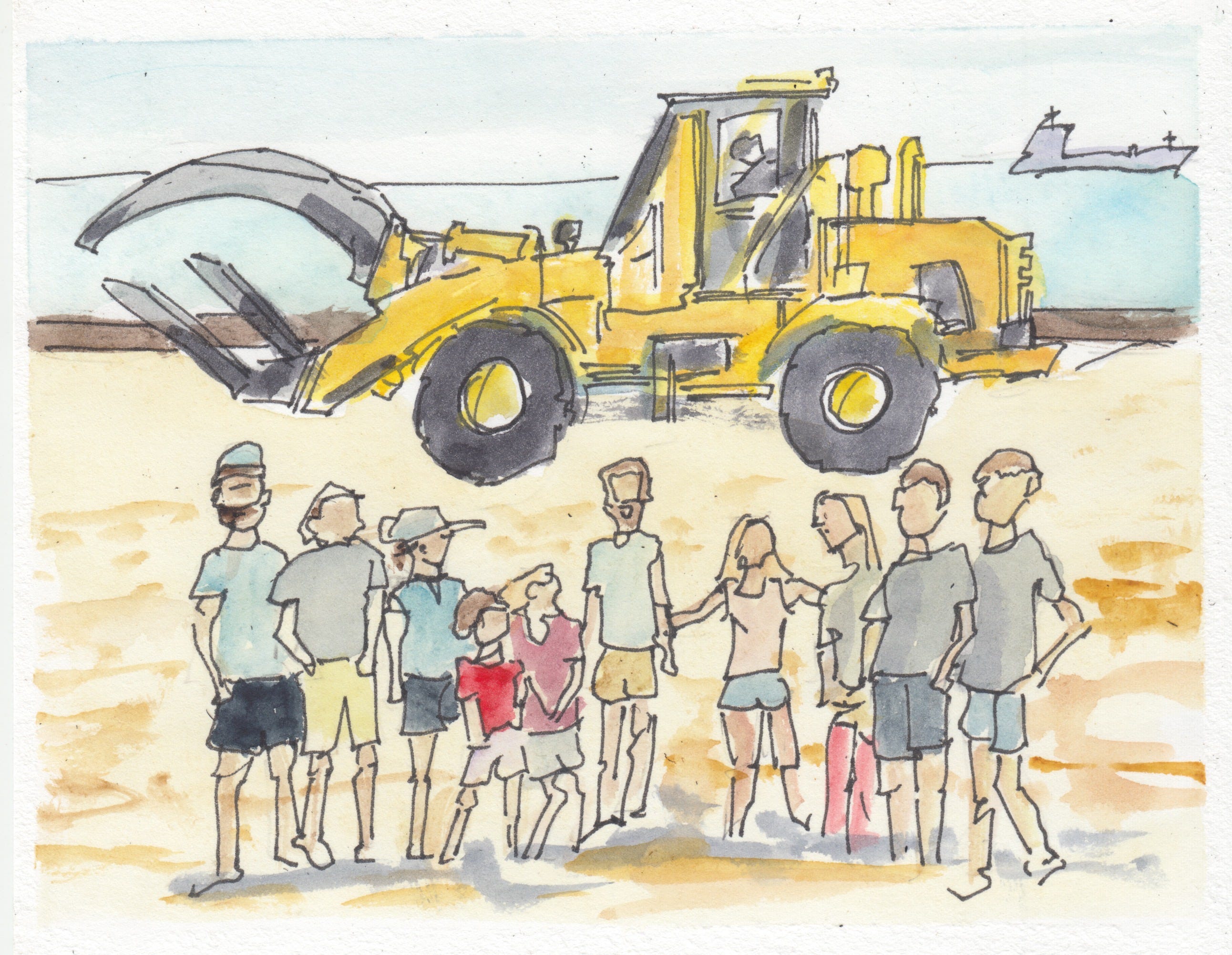
Check in at the beach house is 4 p.m., but we all make good time and find an unlocked window to climb through at 3. As much as we prefer to unload the car before any vacationing begins, it’s impossible not to hurry over the dune to the beach as soon as we arrive. This year, though, instead of whispering surf and smooth sand, we are greeted by four bulldozers, two pipe haulers, two floodlights on collapsible towers, a portable office on skids, three diesel tanks, a port-a-john, and a quarter mile of rusty pipe laid between our house and the ocean. Another quarter mile of pipe goes straight out from the beach to an offshore dredge. The break in the dunes where we access the beach, our private path, is blocked with a strand of yellow caution tape hung between two stakes pounded into the sand all askance.
As we survey the scene, the pipe, large enough to crawl through, small enough to leap over, gurgles and shakes and trembles and belches a slurry of dark sand and water out onto the beach. The bulldozers, beeping in endless reverse, shovel it this way and that. When they move their piles of sand too close to the surf, the sharp frothing edge of each wave carves off swaths and swallows them back into the water.
A woman with a neon orange safety vest and hardhat hurries over and tells upon us that the caution tape is a boundary not to be crossed. The good news, she says, is that since they work overnight, it won’t be too many days until they’re done. She calls it “Beach Rejuvenation.” They are adding a hundred feet of width to the eroding beach. Putting it back where it once was. Filling a vacancy.
We unpack the minivans, deposit bags in rooms and hallways, make a grocery list. What else is there to do? Someone clears off the dining table and pours out a puzzle. I’m not a puzzle person, but I’m in the minority here. I’m not even sure how everyone else decides what’s a good puzzle and what is not. Another longstanding debate we have every year is whether the jigsaw puzzle box should remain in view, with the final picture there for all to see, or whether we should work from just the pieces. The living room is full of overcast summer light, the kind that makes pillars and buttresses of dust motes visible when the room is still. Luckily, the dune blocks the view of the construction on the beach, but the beeping sounds infiltrate. Why do the bulldozers spend so much time going backwards?
There’s a reshuffling of sleeping spaces this year.
Since our daughter drove off, one thing I’ve noticed is that we still eat meals. We still wash the dishes. Some of the things that should seem different are the same. Some that should be the same are different.
The “Find My’” app is pre-installed in my phone and has been mostly an afterthought all these years. I use it on travel days, once or twice a year. But since our daughter drove off last month, it remains active and I remain attentive to it at all hours. Great Smoky Mountains. Crossing the Mississippi. The Choctaw Nation. Cadillac Ranch. We roughed out a dozen rules for the road. Stay off the highways as much as possible. Don’t drive after dark. Don’t camp where there’s no help in sight. Check in with us often. Bandelier, Mesa Verde, Zion. All, coincidentally, places where the “Find My” feature does not seem to work. Further and further west. Many nights, instead of a reassuring blue dot, it has shown only the message “cannot be found” beside her name. Or it will show some place where she recently was.
Before I go to sleep, I check the blue dot. Somewhere north of Taos, beside a reservoir.
***
Now that I’m in my 50s, a new time of day is emerging. I don’t know its name. It comes regularly and in the dark. I find myself no longer asleep, but not as awake as I think I am. This place, or time, feels expansive but not peaceful. I don’t know what summons me there. At first I thought it might be because I needed to go to the bathroom, and often I do. But that doesn’t explain it, or locate it, or make it disappear. Is it a dream-space? I’ve read about those in other people’s stories. But that phrase doesn’t mean anything to me. It is dark and featureless, never a remembered room or green. It is grounded and gravitational, not merely a non-space. It could be most any place, but unrecognizable in the dark. I recognize myself there, the dot of consciousness that I identify as me. I am free to explore thoughts and memories, though I usually haven’t, as yet. Mostly when I am there it is with a sense of vague unease. There are no reference points. I can make myself aware of the position that my actual body is in, separate from this place. I can take inventory. Where are my people? Where am I? Sometimes I linger there much longer than feels fruitful, or am stuck, neither awake nor asleep, not resting and not—what is the opposite of resting?—Alert? Processing? Acting?
I assume that other people have already been there, because everywhere else I’ve been, other people preceded me. Other people saw it fresher, saw it better, saw it more deliberately. If there ever were an Age of Discovery, a real one, not a colonial euro-centric one, surely it was eons ago.
I have no discoveries to my name. More often than not, I walk on paths. It’s enough to process my own experience without considering that I might be creating a record for all of time, or a path for someone else to follow. Sometimes, some rare fleeting times, I’ll realize that what I’m seeing is a unique convergence of creatures, light, geography and attention, arranged in some new and nameless constellation. Gone as quickly as it appears. The signature of wind on water. The presumption of non-discovery accompanies me in the dream space; that’s part of how I know it’s me. But what if I’m wrong?
My younger daughter says that I’m barely at the beach house, that I’m off birding all the time. But what she doesn’t understand is that I only go birding when everyone else is accounted for. If everyone is sleeping, I might sneak out. Or if everyone is happily working on the puzzle, or reading in a book. My freedom to slip away depends on everyone else being contentedly fixed in place.
***
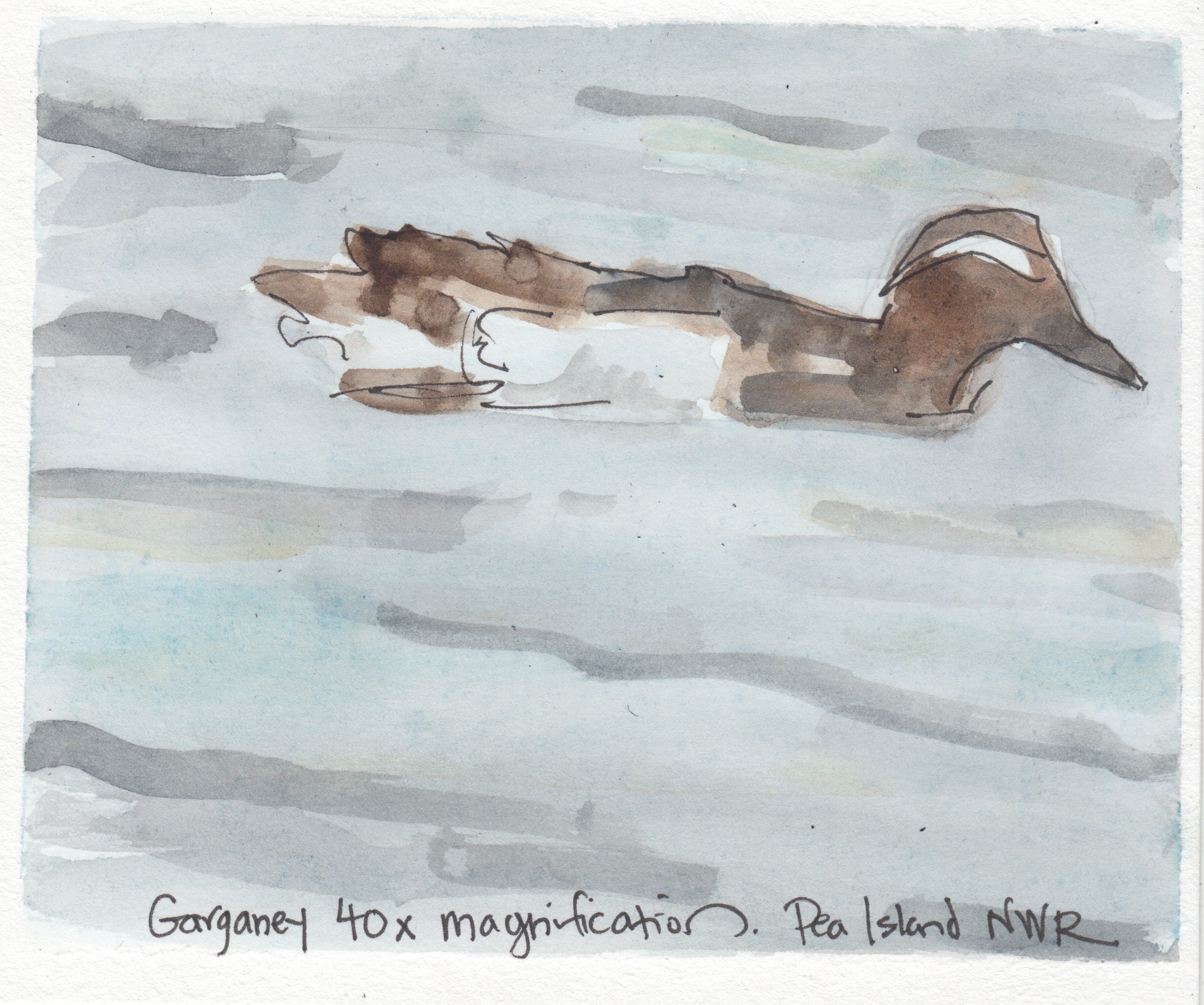
Another phone app I have—the handy eBird app—knows where I am and notifies me if there are birds nearby that I haven’t seen before. Shortly after arriving at the beach, my phone chirps to tell me there’s Garganey in the vicinity. A Garganey is a small duck that spends its winters in sub-Saharan Africa and sub-Himalayan India and its summers on shallow, freshwater, ponds all across Asia and western Europe. Within that range, a goodly part of the globe when you consider it, they are relatively common. In North Carolina, they are not.
In the spring of 1957, a group of birders reported a Garganey on a pond 40 miles further south of our beach house. There was no question that it was a Garganey, but there was debate about whether it was a wild bird or an escaped pet. The sighting was recorded, but there was an asterisk beside it, as there are beside all unsettled things.
According to the field guide, the males are easily identifiable by a white crescent moon that curves along above each eye and down the sides of their chocolate colored heads and necks. In this summer plumage, their sides and wings are a silvery blend of white speckles and black streaks, like the sunlight bending on the calm water where they live their lives. Its wingspan is about twice as big as the shadow puppet you make by linking your thumbs and flapping your fingers. Just a little thing, as most birds are. It doesn’t do any good to scale them against familiar things, since they are untouchable.
The reports on eBird say the Garganey is at Pea Island National Wildlife Refuge. The north side of the South Pond. Or the south side of the North Pond. Either way, it’s only a short drive.
I head to the refuge headquarters first in the hopes that the staff there will know exactly where it the Garganey might be. It’s busy there. I listen to the volunteer at the information desk tell a family about black bears at nearby Alligator River. I listen to him recommend a shrimp shack to a sunburned couple. He has no idea at all about the Garganey. I think he thinks it’s a shell. He tells me that the shelling will be good on the ocean-side beaches following a super tide later this week. He tells the next group in line that the restrooms are out of service. Everyone is looking for something different.
There’s a long grassy causeway between the two ponds, north and south, with good views into both of them. With binoculars and telescope, I venture out alone. A brisk wind blows the mosquitoes off and scratches dynamic swirling lines onto the surface of the water. There are plenty of herons. Geese. Black backed stilts, which are thin and active waders, with long red legs and bills. I don’t see any ducks. Also, I don’t see any birders. Sometimes the trick to finding what you’re looking for is to find the other people looking for it, too.
The Pea Island ponds stretch further than I can see, although I can see some geographical features beyond them. Even from the observation tower, the edges of the ponds are implied by the presence of things on the other side. Tiny islands of brown grasses throughout offer nesting spots and hiding spots and shade.
After a couple hours, I pack up and head back to the house.
***
We have group photos from every year that we’ve done this together. All of us in a row, then a double row. Some years we stand in family groups and some years we’re all scrambled up. In these photographs, we’re all fixed in place. Whatever chaos went into getting the pose right is mostly forgotten. I can remember setting up the camera and seeing everyone looking at it. And I can remember pushing the shutter button and running into place, looking at the camera, and waiting.
The Beach Rejuvenation does indeed go on all night and all day and all night again. The “new” sand is really old sand, vacuumed up from the bottom of the ocean into the hold of a dredging ship, then brought to the far end of the rusty pipe out at sea. Huge pumps force it through underwater pipes to the beach, then through exposed pipes to wherever the bulldozers are waiting. It comes from the underwater shoals that have been causing shipwrecks for as long as there have been ships. It has never been exposed to the sun before. It might be full of pirate treasure or perfect shells. But from the safe side of the yellow caution tape, all we can know for sure is that it’s full of tire tracks.
The Outer Banks is more than 200 miles long, low dunes, scrubby trees, fragile houses, and sand. The winds and the tides have rearranged them for all of time. We’ve created fixed points by building houses and roads. And it’s only in relation to these fixed points that we have come to see the constant change. It’s nothing to the seagulls and sanderlings who inhabit these edges where sand and sea come together, irrespective of where the collision takes place. But we’ve called in the Federal Emergency Management Association so their various construction companies can move up and down the beach year after year, putting sand back where it was, protecting the houses, trying to make reality match what we think it ought to be. Or what we remember it as being.
One night, while the dredge ship is refilling and the bulldozers are refueling, we sneak down past the caution tape and can hear the surf and see the stars. None of us are astronomers or experts in the common night sky. Disconnected dots that we connect in our minds with animals and stories. A swan, a serpent, a scorpion. Identifying the constellations brings only a semi-satisfaction. That curve over there is Scorpio, we tell the kids. That little cluster is called the Pleidies. It’s made up of 7 stars. Or really 1,000 stars, but only 7 that you can see. Or 12 stars with binoculars. Or 9 stars if you don’t look straight at it. It’s the shoulder of the bull constellation. We tell them these things the same way we might gesture at a shelf of books we haven’t read or don’t remember, in the hopes that they’ll be more interested than we were when someone showed us.
It’s surprisingly hard to show them the few things we do remember, up there. They can’t follow the direction of a pointing finger all the way up into deep space, so we resort to words. “Do you see that one bright bluish star all alone? Go to the left of it until you see the three together. From there, come just just a bit. Connect all those. Can you see a bull? Can you see a scorpion rising up out of the sea?”
The lines last as long as it takes to describe them, then are gone.
I’ve always thought it was curious that the Big Dipper was part of a bear constellation for cultures that never met to share their stories.
***
Sometimes late at night, after checking my older daughter’s location on the app, I take some pleasure in seeing that she’s somewhere that I have been. Inspiration Point, The Narrows. If I have the energy and can escape the pull of social media, I will open the book of my own memory. I know I’ve been to Monument Valley, but what do I really remember? Who was I with? What did I eat? When was it? Where did I spend the night? Why was I there at all? It’s not until I try to revive the memory that I realize that the pages of that book are mostly blank. Only the label on the spine is clear. Grant Canyon Visit.
Is that a symptom of age as well? Does everyone in their 50’s carry a memory library with brightly labeled volumes, blank inside? Do even all my own memories need to be re-visited and stories re-told in order to keep from being sloughed back into the sea?
The spider has eight legs, but my points-of-contact analogy doesn’t work because most of them hoist themselves up off the ground instead of standing firm. They spin a web to support themselves, picking anchor points that they think are secure, criss-crossing silk strands, and then inhabiting the shape they make.
On the fourth morning, the caution tape is gone. The pipe is still there, but the machinery has moved down the beach. They’ve built a sand ramp for us so we can go over the pipe, down to the water. The new sand stretches so far from the house that our feet burn when we cross it. It takes several trips to get the tents and the chairs and the cooler and the towels and the rest of the ‘beach gear’ spreadsheet items across the scalding sand. The new sand is softer than the old. It’s hard to walk on. We liked the idea of new sand. We also like the idea that it is just old sand churned back up and made new. But it’s hard to walk on. Scalding hot, even in the morning.
Nevertheless, midday finds us all set up on the beach, just like we’ve always done. The water is cold, like we remember, but that doesn’t stop the kids from wading out to where the waves break. This year it only comes up to the waist, though. They used to have to hop and paddle to stay about the surface. Have they grown that much? Or is it not as deep as it used to be? A strong wave still tumbles them all into happy heaps, though.
The whole idea of having to maintain balance might sound ludicrous to anything not human.
At mealtimes, the table still feels full. We don’t leave a spot empty for our absent girl. She is both there and not there. There is a language commonly used for grief that I seek to avoid. I want to make sure I reserve that for real loss and irrevocable change. It’s just that she’s far from where she usually is.
Overnight, some part of me wakes up long before my body does. It knows my eyes are closed and where I am and who I am. There is nothing to see in this place. No landscape and no color and no words, though I feel certain that I would have the ability to discern them if there were.
I feel that I could wake all the way up, but for some reason I don’t. I am the blinking dot of a cursor on a blank screen.
Full sleep feels out of reach, from this place. I can’t go back to it.
One time when I was the age my daughter is now, I wanted to see how far into the day I could get without opening my eyes. It took many tries over many days to teach myself to wake up and turn off the alarm clock without opening them. Once I’d accomplished that, it was not so difficult to get out of bed, get to the shower, and dress. I didn’t keep a daily journal of how far I got as I practiced, because I assumed I’d remember forever. I had a big empty brain with lots of space in it. I do remember the frustrating feeling of having my eyes snap open on their own, ruining my experiment by the instinct to orient, realizing I’d have to wait until the next day to try again. It was annoying, but there were an endless number of days still ahead, then. I’d find my way downstairs, eat my breakfast, talk with my bewildered or bemused parents. On the most successful and final day of the project, I made it all the way out the front door, down the front steps, and to the corner of the block. I opened my eyes intentionally then, in order to cross the street.
***
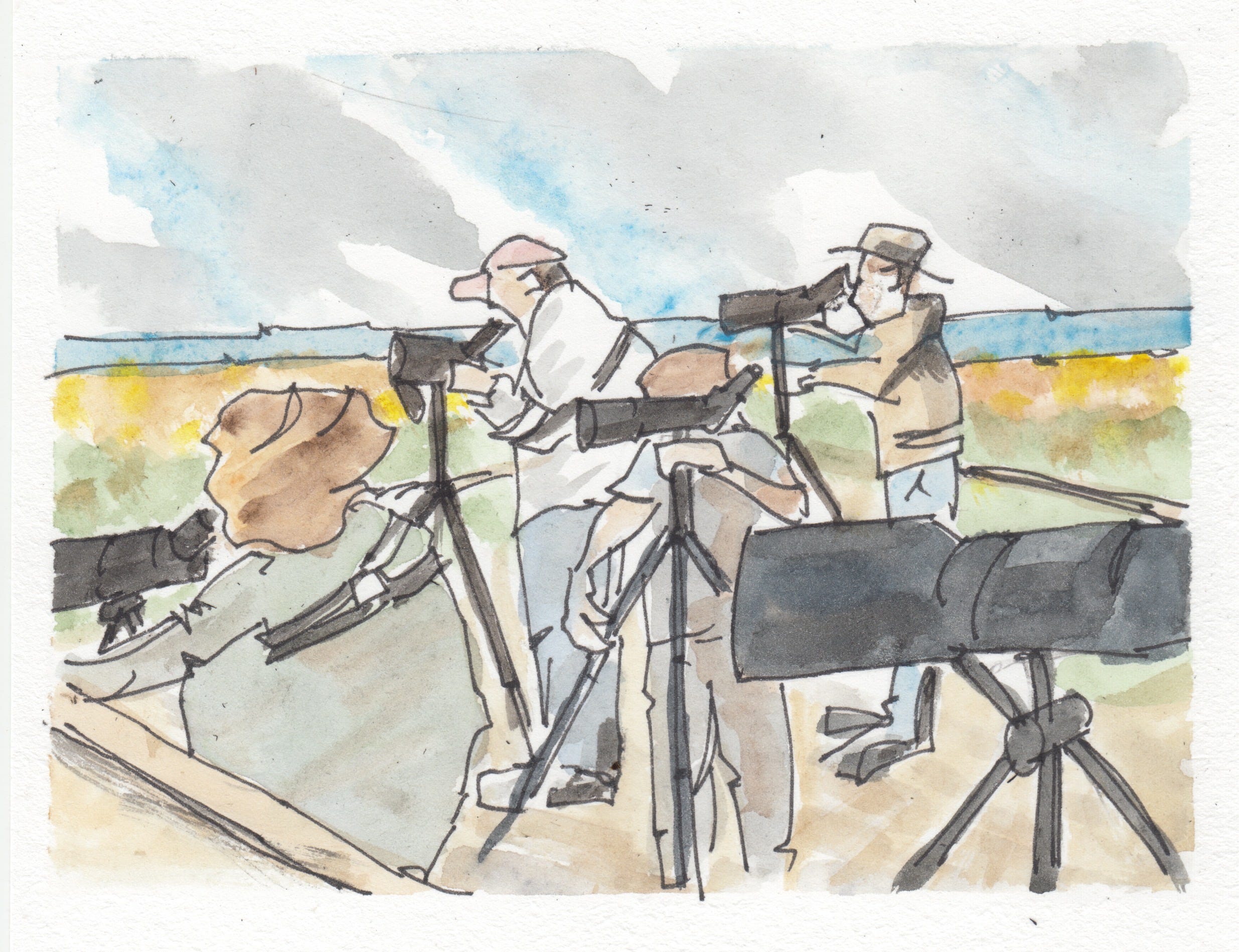
Just at dawn, I bypass the refuge visitor center and drive further south for another viewpoint where the Garganey might be. At the southern end of Pea Island, the oceanside dune is encroaching on the road. The northbound lane has to swerve around it. The ocean has broken through the dunes below the refuge ponds, creating a new, shallow, connection between the ocean and the sound. There is a viewing platform on the southbound side of the road near this point. I can see from a considerable distance away that there are half a dozen birders already there, half a dozen telescopes on tripods. I pull over onto the low sandy shoulder and get my telescope out of the back.
I’ve been birding for most of my life, keeping a serious list for half that time. I’ve never seen a Garganey before. This is only the second sighting in North Carolina. I climb the dune with telescope balanced on my shoulder, the same shoulder that is sore from carrying the heavy beach tent yesterday. There is no room on the viewing platform itself, so I set up the tripod on the sand beside it. The other birders tell me that it’s still there, without my asking. One of them invites me over to her scope. “I’m on it,” she says. “Come look here first, just in case.”
With my naked eye, it’s too far away to see. Through the scope, I can make out two small ducks. One of them is a blue winged teal, with a white crescent between its bill and its eye. They’re common here in winter, quite rare in summer. But in this moment, I’m only interested in it for scale and comparison. The other duck, the Garganey, dabbles beside it, its own white crescent clear above the eye like a helmet. Or as clear as such a thing can be from half a mile, through the heat shimmer of early morning. Having seen it through the scope, I can make it out with naked eye now. I thank her and set up my own scope. I pick it out again.
It is unremarkable in so many ways. It is also thrilling. The pond spreads out for a hundred acres around it. The wind off the ocean skates across the surface of the water leaving arcs and dimples which in turn catch and reflect light. The Garganey is feeding on whatever is floating on the surface, whatever the wind is laying down or the current stirring up from below. Does it know that it’s 5,000 miles from where it should be?
It’s 2,000 miles as the crow flies from the Outer Banks to the Grand Canyon, the westernmost point on our daughter’s road trip. There was cell reception on the rim, but she went backcountry, over the edge, to a campsite halfway down to the river.
I remember being at the Grand Canyon when I was her age and reading the signs telling me how deep it was, how long it was, and how old it was. I remember standing at an overlook and trying to put things into some meaningful scale. I remember thinking that being at the Grand Canyon was something I’d remember my whole life. An anchor point. But I don’t remember where I parked the car or what I had for breakfast.
I remember some point in childhood—it must have been very early—when dot-to-dot activity books were a big part of my life. Not to brag, but I was very good at them. I took special pride in completing one flawlessly, going from dot to dot with deliberate care, and never assuming I knew where the next one was and mistakenly drawing a line where a line wasn’t supposed to be. I also remember the point where it began to bother me that it was too easy to tell what the finished picture was going to be. If I could already see that the dots were going to form a bear, why bother drawing the lines? I started experimenting with connecting the dots differently, in order to form a picture that wasn’t the “right” one. Eventually I switched from activity books to dot graph paper and connected those dots to draw whatever I wanted. Then I realized I could do that same thing, basically, on blank paper, and everything was suddenly, entirely, different.
While the Garganey dabbles for food, another car pulls off the highway behind mine. A woman with a floppy tan hat partially holding back her gray hair, with green pants tucked into her socks, leaves the driver’s door open and the motor running and she scrambles up the dune to us.
The woman with the nearest telescope tells her not to worry, it’s still there. Come look. Bucket Hat gets to the scope still out of breath. She says she’s been on the road for 7 hours. Her hands are shaking. While she gets a good first look, I scan the rest of the pond. The presence of the Garganey changes everything else. A flock of Canada Geese nearby. Little Terns keening overhead. A brown pelican and double crested cormorant fly over. Still scanning with the scope, across to a grassy cove where two greater yellowlegs, a semi-palmated plover and a semi-palmated sandpiper stand on bare mud. I plot them all in my mind, their locations in relation to each other and to me. Connect the dots. What shape do they make?
As the minutes pass, a conversation burbles up. How far have people come? Has anyone got a good photo? What else are people seeing? Who remembers the flamingo showed up here after the hurricane? We are birding not just in space but in time.
While I’m scanning, a deer emerges from the tall grasses and steps into the pond, a hundred yards away. The water covers its hooves but little more. It walks cautiously at first. Then casually. It crosses in front of the geese, the water never reaching its knees. It crosses in front of the distant Garganey. Until that moment, the silver streaked water had seemed as deep as it was broad, a water-filled Grand Canyon in my mind, the Garganey and all waterborne things pleasingly inaccessible. We all, more or less, look away while it passes. A few minutes later, things are back as they were, the presumption of depth restored.
***
Back at the beach house, everyone wants to know if I saw it. There are breakfast dishes in the sink. Evidence of fried eggs on toasted bagels, avocado peels, salsa jars. The puzzle is more than halfway done, and the perspective has shifted. Now the image is perfectly clear, and it’s just a matter of putting in the final pieces for sharp focus and completion.
The dot on “Find My” shows me that our daughter is back up out of the Canyon. It’s still an awfully long way away, but at least it’s there in real time.
This is the day that we take the group photo. All but one of us. In addition to the group photos, I always take individual close-ups of everyone. Contrasty black and white portraits so up-close that chins and hairlines get cropped out. A week of sun and wind makes laugh lines distinct, cheeks blotchy. A week of close contact makes expressions frank. When we get prints made, the group photo goes up on the fridge. The individual portraits get shuffled and scattered, dealt out on the tabletop like a puzzle to be arranged and rearranged in different patterns.
I text all the photos out west that evening, but get no reply.
To the north, home.
To the south, a Garganey on a shallow pond.
To the east, beach rejuvenation.
To the west, my girl.
Overhead, stars in the shapes of lost stories.
Below, shifting sands.
***
Paul Cymrot is the owner of Riverby Books in Fredericksburg, Virginia.