
By Michael O’Keefe, ADVANCE CONTRIBUTOR
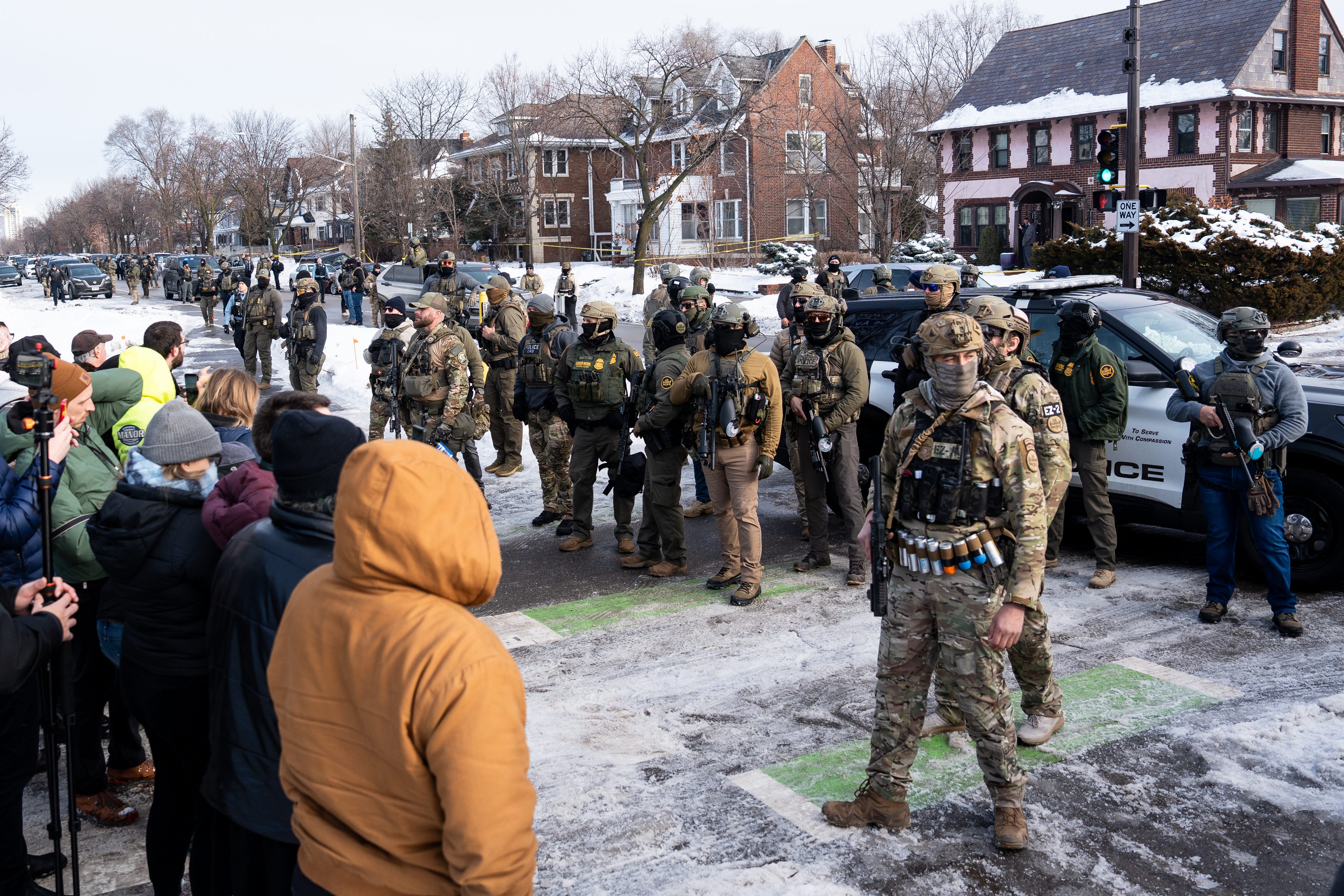
As a former police officer and attorney, I wrote this essay not long after two United States citizens—Renee Nicole Good and Alex Pretti—were shot and killed in Minneapolis by federal law enforcement agents during domestic law enforcement operations in the United States. Initially, the feds denied any wrongdoing and cast blame on the victims. They also implied, or said outright, that the federal actors involved had enhanced powers beyond those of civilian police officers. None of these claims were true. Videotape evidence laid bare the factual lies. And our Constitution, Bill of Rights, and case law guide and empower statutes, codes, and policies that govern ALL domestic law enforcement conduct, including conduct involving the use of force.
Just this past week, two more people were stopped and killed by ICE agents, both under disputed and controversial circumstances, one in Houston, and one in Maine.
I was and remain angry that the marauding task force of feds from DHS, ICE, Customs, DOJ, Border Patrol, and who knows what other federal law enforcement agencies have evaded personal accountability by wearing masks and placing electrical tape over their name plates and badge numbers. I’m also angry at the politicians and political appointees who encourage and cheer on the task force. Collectively, they almost make me feel ashamed to have worn the badge.
My emotional response to my anger—my cop’s response—involved writing about my first solo patrol tour of duty in a Fairfax County police car, which you can read below. Law enforcement, while challenging, is an honorable profession. Most of the cops I know pay homage to that profession by honoring the rule of law. Many, including me, also honor an unwritten cop code infused into them by their mentors and squad mates.
My logical response—my lawyer’s response—involved taking a closer look at case law and policies related to use of force. One of the first documents I examined was “The National Consensus Policy and Discussion Paper on Use of Force,” which provides a Model Use of Force Policy for United States law enforcement organizations. Eleven national law enforcement groups, including the Association of State Criminal Investigative Agencies, Commission on Accreditation for Law Enforcement Agencies, Fraternal Order of Police, Federal Law Enforcement Officers Association, International Association of Chiefs of Police, Hispanic American Police Command Officers Association, International Association of Directors of Law Enforcement Standards and Training, National Association of Police Organizations, National Association of Women Law Enforcement Executives, and National Tactical Officers Association are signatory to and recognize these documents as the best thinking and practices on Use of Force issues. These organizations have long represented the best and brightest minds in law enforcement.
The Model Use of Force Policy contains several relevant points related to the recent fatal shootings by federal task force agents.
Language in the model establishes that officer conduct must be “objectively reasonable” versus “subjectively reasonable,” mirroring the standard established in the controlling use of force case decided by the United States Supreme Court in Graham v. Connor, 490 U.S. 389 (1989). This represents a higher standard of conduct.
The Model Use of Force Policy also states that officers shall not discharge firearms at a moving vehicle unless all other means of defense have been exhausted, including moving out of the path of the vehicle. The model requires officers to use the minimal necessary force.
The model also says that officers have an affirmative duty to intervene when another officer is violating an arrestee’s Constitutional rights and/or the use of force policy. They also have an affirmative duty to render medical aid, which is not met just by calling for an ambulance. There also is a de-escalation training requirement and a de-escalation action requirement section in the model policy.
You might be astonished by the content of the Department of Justice’s own Justice Manual, Title 1-16.000-Department of Justice Policy on Use of Force. All the points discussed in the National Consensus Policy and Discussion Paper on Use of Force model policy, highlighted in my previous paragraphs, were adopted and in full force by DOJ. The same is true of the DHS, ICE, Customs, and Border Patrol use of force policies.
I offer up the following essay to provide insight into the unpredictable nature of law enforcement and how cops react to difficult circumstances. Good cops know the risks of the job. They even know that they will sustain injuries throughout their careers and, yet, they still strive to use the minimal necessary force required to keep the peace and make arrests. They control their tempers and exercise patience in furtherance of those goals. Good cops do not look for reasons to injure or kill human beings. They do just the opposite.
There is no such thing as a license to kill.
***
A late-July muggy Saturday on my squad’s first of seven consecutive 4-to-12 shifts was also my first shift going solo in a Fairfax County Police Department scout car. A few days earlier, I had graduated from the academy, one of four guys log-jammed in a statistical dead-heat at the top of the class. The others were college graduates, but not me. I had spent my college years on the Metropolitan Police Department in D.C. acquiring a blue-collar education.
Seated in Scout 65 just out of roll call that first solo night, I tested my lights and siren. Next, I flipped the hidden toggle-switch that deactivated the magnetic lock anchoring the shotgun strapped behind my calves along the front bench seat. After emptying and reloading it to make certain that the chamber was clear and the breech full, I locked it down and headed for my patrol area.
I had seen a lot of action on the D.C. Police, working solo in high-crime sectors on a foot beat initially and then in a scout car. That experience taught me that being a good cop was all about looking for trouble and making good decisions when you find it; and, even more importantly, making good decisions when trouble finds you.
I kept my windows down the way I’d been trained to do, sweating under my bullet proof vest in the stifling hot air. The sun had just set, and the last light of day was lingering in the western sky as I patrolled along Elmwood Drive in a working-class neighborhood called Burgundy Village. The houses were nearly identical three-bedroom one-and-a-half bath ramblers on concrete slabs with carports. Yards were about an eighth of an acre and surrounded by chain-link fences.
It was a 25-mph road, and I was pacing a jacked-up Camaro with a roll bar that was going twice that speed. Radio mic in hand, I was waiting for a break in the radio traffic before lighting up my overheads and calling in a traffic stop. But sudden curb-side peripheral motion and a woman’s desperate cry for help grabbed my attention, causing me to pull over.
The passenger side of my windshield exploded in chaos as a buck-naked burly man slammed down a woman’s face, instantly extinguishing her eerie scream. Her head bounced, leaving behind a mask of blood, strands of long auburn hair on the shatterproof glass. It was obvious that she was unconscious as he dragged her inert and three-quarters-naked body by her hair through the front gate and across the lawn into a darkened carport.
Immediately, I gave the dispatcher my ten-twenty and a concise summary of the trouble that had found me. Good cops always know their exact location, another D.C. Police lesson learned. I also noted that I was going in, hesitating just long enough to activate my overhead lights to make it easier for back-up units to find me, and to hear my sergeant’s voice over the radio ordering me to wait for back-up. Sorry Sarge, I thought but didn’t say. The whole point of being a cop is helping people.
Despite ducking evasively as I entered the carport, I was jolted by a stunning shot just above my left eye. I wasn’t sure what hit me, but I knew right away that I was concussed, and from the warm liquid blurring the vision in my left eye that my eyebrow was split. I had been in fight-for-my-life situations previously, which helped me skip the WTF reaction stage. My training officer on the D.C. Police had walked a lot of point in Vietnam, and he’d taught me a few tricks for amping up my adrenaline and immediately engaging what was supposed to be my most valuable weapon—my brain. The last thing I did before bailing out of my scout car was slap my face and initiate a running observational conversation with myself. I spoke aloud the details of what I was seeing to help me anticipate what might come next—which was the man who’d dragged off the injured women, now coming after me.
I burrowed my head into his chest as I drove him up the three interior carport stairs and tackled him onto the kitchen floor. The flurry of punches he continued to throw my way gained little effect. I kept my right hand on my gun, guessing that he would go for it, which he did. I had been working on my left arm to develop better power and control—pushups and pullups—and I soon understood that my training was paying off. He let out pained grunts and began to sag as I landed punch after punch to the right side of his face.
Ours was a primitive and brutal waltz. We bathed in each other’s sweat and blood. His breath was hideous. We both struggled to maintain the initial ardor of our first blows, while we upped the volume on the machine-gunned curse words and spittle. For me, time stood still, which was okay because I knew that time and in-route backup were on my side. He had gained a major advantage by landing that stunning first blow, but because he failed to land another one, slowly the advantage turned my way.
I learned later from the dispatcher’s log that it took 13 minutes for the first backup unit to arrive, and probably a few more minutes to find us. That was a significant difference between policing in a city and a suburb. I never had to fight a 15-minute-long round in D.C. Regardless, I had the guy in handcuffs by the time the cavalry arrived. The cop code requires that if you ride solo you handle your own shit.
The woman turned out to be the guy’s wife. She managed to survive his booze and PCP-fueled insanity with a concussion, broken nose and jaw, plus several lost and damaged teeth. When I saw her lying about five feet away from us a few seconds after I cuffed the guy, I thought she was dead. She was naked from mid-torso down, wearing just the ripped remains of a sundress around her neck and shoulders. I was surprised and happy when I felt her beating pulse via her carotid artery.
I asked the dispatcher to send a rescue squad when I radioed that I was ten-four (okay) and ten-fifteen (prisoner in custody). A bunch of other cop units keyed their mics to break squelch, their way of celebrating that I had taken care of business.
I later found out the guy I’d fought—built like a linebacker, with a beer gut—had been a laborer for a roofing company. He’d been laid off a few months earlier, and the electricity had been cut off at their house for non-payment. There was an eviction notice on the front door.
After the cavalry arrived the night of the incident, and after I processed my prisoner and took him to the county jail, I drove myself to the ER. I was right about the concussion and needing eyebrow stitches. I also had a dislocated right thumb, courtesy of the side battle for control of my gun. And I had a bunch of nasty looking scratches on my face, neck, and arms. The ER doc told me not to drive for 24 hours, and to take three days off work.
I drove back to the station a few minutes before midnight, arriving just in time for my sergeant to write me up for disobeying his order to await back-up. My punishment was to work my next two days off without pay.
My squad mates were waiting in the locker room to razz me and slap me on the back, and THAT mattered to me. It hadn’t been the first shift I’d expected. Trouble had found me and I’d made the right calls. But I didn’t duck fast enough turning the corner into that carport and I paid for that. Still, when I hit my pillow that night, I felt good because I had done my job, and I had honored the cop code.
When I saw the couple a month later in court, they apologized. Neither claimed any recollection of that night. The wife hadn’t pressed charges against her husband, and she asked me to ask the judge to be lenient. The guy hadn’t made bail, so he was in jail clothes and escorted by a bailiff. Both of us still sported faint remnants of black eyes, but the stitch line in my eyebrow was invisible.
The guy pled guilty and was sentenced to time served, which seemed fair to me We all walked together to the parking lot. There was no animus between us.
Two years later, the same couple waved to me as I was passing their home in my scout car, indicating that I should pull over. This time, the woman had an infant in her arms. The man smiled self-consciously when he told me he’d been attending AA meetings and was 18 months sober. He also told me with pride in his voice that he’d been hired on as an apprentice sheet metal worker, and that his wife was working part time as a medical transcriptionist. They looked happy and they looked healthy, and they thanked me.
***
Michael O’Keefe spent his early adult years working for the Metropolitan Police Department in Washington, D.C. and the Fairfax County Police Department. On-duty injuries sent him to college and law school. He practiced law locally and is now retired. He notes that two of the other three graduates at the top of his police academy class also became lawyers, including Randy H., who may be the best construction law attorney in Georgia. The third, Tom M., rose through the ranks and served as chief in Fairfax County and Montgomery County, Maryland. Tom M. recently retired as chief of the U.S. Capitol Police, where he successfully reformed his department and fought tirelessly for good cops everywhere against the addled thinkers who claim January 6th was a peaceful protest.

As a retired Virginia prosecutor for over 30 years I worked with Mike when he has an ass't county attorney in Spotsy. His opinion piece is spot on in terms of law enforcement law. & procedure. It is obvious from documented news accounts that poorly trained ICE officers have in violation of the 4th Amendment illegally stopped motor vehicles on at least 3 occasions in the past year and then shot & killed the drivers in MN, TX and now ME - always claiming against eyewitnesses & video accounts that the victim's had aimed their vehicles against an ICE officer. Then on each occasion DHS refuses to cooperate with state & local police investigations & covers up ICE's unlawful & deadly acts. If ICE's vehicle stop tactics are as lawful as claimed, then why refuse to cooperate in such homicide investigations? And if ICE is really targeting criminal aliens, then why were the 3 victims in the above incidents a US citizen and mother & 2 admitted non-targets of ICE - none with any criminal past?
Thank you Mike for sharing this story.
I hope that we can all agree that we want our law enforcement personnel to use only necessary force.
Beating a person held down by multiple people is a tactic that should be unacceptable to all of us.
It is still unclear to me why we are so focused on removing immigrants.
An AI generated search of benefits provided by immigrants indicates that immigrants are helpful to the US (regardless of document status).
“Immigration acts as a net positive for U.S. public finance, generating billions more in tax revenues than immigrants consume in government benefits. According to comprehensive, updated modeling from the Cato Institute, immigrants generated $14.5 trillion in cumulative fiscal savings for federal, state, and local governments over a 30-year period. Without these continuous tax contributions, the U.S. national debt would have skyrocketed to an estimated 205% of GDP.”-