
by Eric Bonds and Ranjit Singh, ADVANCE CONTRIBUTORS
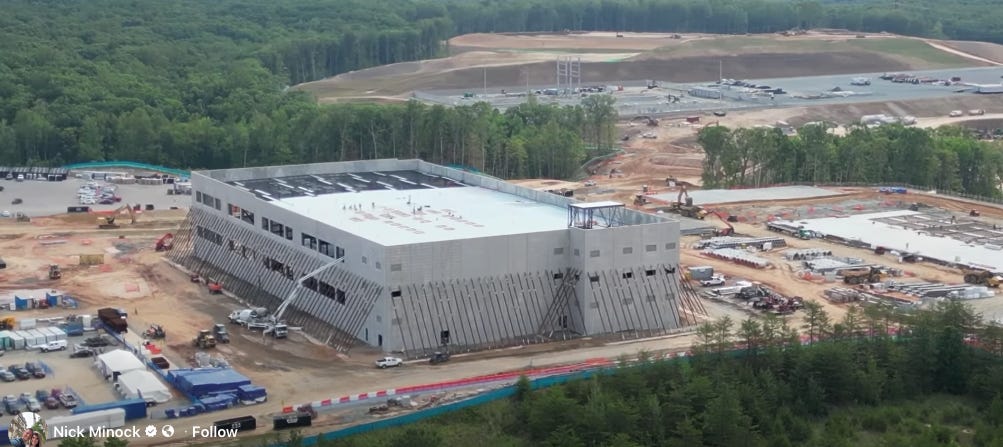
[EDITOR’S NOTE: Columnist Ranjit Singh will be moderating a “Data Centers in Our Region” forum 6:30-8 Thursday night in the Central Rappahannock Regional Library, at 1201 Caroline Street in Fredericksburg. Speakers will include Tim Cywinski with the Virginia Sierra Club, Elena Schlossberg, director of the Coalition to Protect Prince William County, and Virginia State Delegate Josh Cole.]
***
Social change happens in strange ways. Ideas can seem implausible—or even downright impossible—at one point in time. But then something shifts, and those same ideas begin to seem like realistic goals, maybe even like common sense.
We seem to be in the midst of one such transition. Here in Virginia—the data center capital of the world—an increasing number of elected officials and ordinary folks are thinking that enough is enough: It’s time for a moratorium on new data center development.
The proliferation of hyperscale data centers has brought Americans from disparate backgrounds together in a common cause. Democrats and Republicans alike share a disdain for data centers, with majorities in both parties saying they would oppose data center development in their area, according to a recent Gallup poll. This makes a data center moratorium, which seemed unthinkable a year ago, suddenly a winning political issue.
There are plenty of reasons why people from both the right and the left oppose further data center development. Folks from all walks of life are bothered by the industrialization of rural landscapes and residential neighborhoods, increased air pollution from massive diesel generators, and the huge amounts of water needed to cool some types of hyperscale data center systems.
Even putting these significant environmental and quality-of-life issues aside, a data center moratorium is needed due to the simple fact that we do not have enough electrical capacity to power them all.
Dominion says that it is contracted for 53.8 gigawatts of total electricity in its Virginia territory. This is more than twice the amount of energy consumed during the region’s demand peak during the cold snap we had this past winter, which was just shy of 25 gigawatts. This doubling of power demand, the JLARC study tells us, is almost entirely due to the data center industry.
As a frame of reference, both plants at the North Anna Nuclear Station have a combined capacity of less than two gigawatts. The newly approved natural gas plant in Chesterfield will have a capacity of about one gigawatt. The Spotsylvania Solar Project, which is the largest solar farm on the East Coast with arrays on 3,500 acres, has a far smaller capacity than a gas plant, and that’s when the sun is shining on a summer day.
In other words, Dominion would have to build the equivalent of 14 new North Anna Nuclear Generating Stations or 29 new conventionally-sized natural gas plants just to meet the energy demand for which it is already contracted. All of this would require hundreds of miles of transmission lines across private land, something that has already sparked its own opposition.
Taking all this into account, a moratorium is not some “pie-in-the-sky” hippy dream. Quite the opposite: What is out-of-touch and unreasonable is the notion that we can forever build more energy-hungry data centers.
While momentum is building towards a moratorium, the path towards achieving one remains unclear.
Earlier this month, Republican state senator Glen Sturtevant called on Governor Spanberger to support an immediate data center moratorium. Senate President Louise Lucas, a Democrat, came close to endorsing the call, saying “Senator Sturtevant is right that the status quo cannot continue… A statewide moratorium is a serious proposal that deserves serious consideration.”
Governor Spanberger recently dismissed the idea, but did add that, “some localities may create a moratorium; that is a local choice.”
Because Virginia is a Dillon rule state, meaning that the powers of local governments are severely circumscribed unless specifically authorized by state government, it is not entirely clear if localities have the ability to formally enact a moratorium and pause consideration of new data center proposals.
The Spotsylvania County Board of Supervisors, for instance, just passed a resolution supporting Senator Sturtevant’s call for a moratorium, but did not itself pass a local moratorium within its own borders.
Other local governments in Virginia aren’t waiting for state government to act. The City of Chesapeake, for instance, voted at the end of July to pause consideration of all new data center applications for eight months. Councilors want to give the city time to evaluate its zoning rules and strengthen regulations.
Earlier this summer, the City of Suffolk enacted a similar data center development pause. Leaders in Loudoun County are now considering doing the same.
Communities in our region can follow the lead of cities in the Hampton Roads to create temporary pauses in order to take time to reassess zoning regulations for data centers, further increase setbacks, or better still–using the authority provided in Virginia state law–prohibit this type of land use within their borders.
In the meantime, citizens can continue speaking out against the many individual data center proposals that will soon be put before planning boards and elected officials in our region. So keep attending local forums, contacting your elected officials, and making your voice heard.
It is making a difference. We can feel the ground shifting, but we can’t let up now.
One day, the fever dream of unending data center development will subside. The communities that enacted moratoriums and worked to prohibit additional data center development, beyond that already approved, will be glad that they did.
***
Eric Bonds is a professor of Sociology at the University of Mary Washington where he studies climate change and environmental inequality in Virginia. Ranjit Singh teaches in the Department of Political Science and International Affairs at the University of Mary Washington. A version of this essay was first published in No Lines in Nature, his Substack, which blends history, science, and philosophy to explore our relationship with the natural world world.

Flyer: Community Forum #3 DATA CENTERS IN OUR REGION: https://apis.mail.yahoo.com/ws/v3/mailboxes/@.id==VjN-o3Xz22E-6MvakqKnO0iXIkjpSYBJxbVrH7kt-MUVmHiO_fCpsVkV9lQWGF56WRHyBmBxuc2UTjmHlmQVvjcwMQ/messages/@.id==AALzXeZAifjWxn1LEZXq3F3y7vv/content/parts/@.id==2/thumbnail?appid=YMailNorrin
The Dillon Rule is a hurdle not an impenetrable wall. And there is a foolproof work-around that already exists; but it takes participation, engagement and effort.
You simply let your local elected officials know that, via zoning powers already within their delegated powers, they must deny any and all data centers for valid reasons that already have been proven to exist, OR you personally will vote them out of office.
Don’t be fooled by the “we can’t do anything because of the Dillon Rule” alibi.That’s a boldface lie.