
By Hugh Lessig
ADVANCE MILITARY CORRESPONDENT
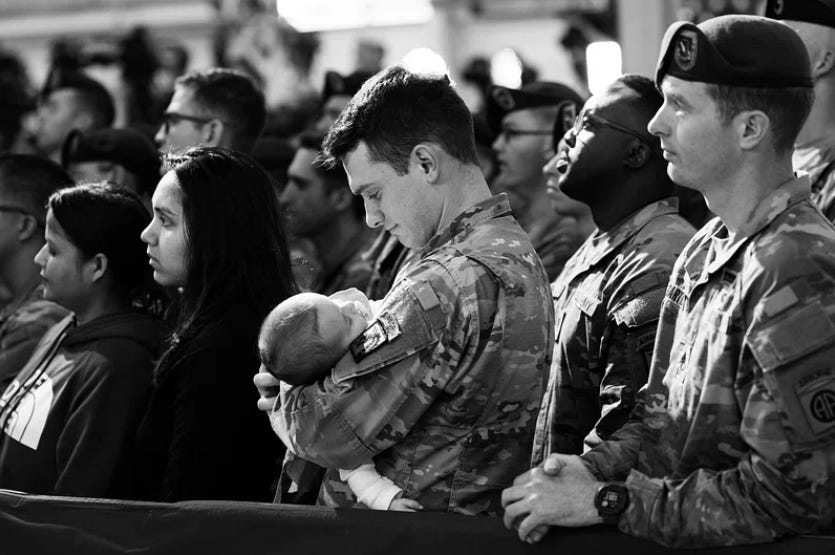
The meeting lasted 14 hours and featured plenty of debate, but Rep. Eugene Vindman said he had a good feeling before walking in the door—especially about the prospects of more money for military families, a great many of whom live in the Fredericksburg area.
It happened last week when the House Armed Services Committee considered the National Defense Authorization Act. This is a critical piece of legislation that helps funnel millions of dollars in defense spending to the sprawling 7th Congressional District, which includes Fredericksburg and the counties of Spotsylvania, Stafford, Caroline and King George.
Up for consideration: pay raises for active-duty military, funds for defense construction projects, money for high-tech weaponry, and initiatives that benefit defense contractors and military families.
All in all, it was a high-stakes meeting for constituents and for Vindman, a Democrat who with 51 percent of the vote in 2024 won the seat vacated by now Gov. Abigail Spanberger.
The Defense Authorization Act is not the defense budget. It dictates—or authorizes—how billions of defense dollars can be used, and sets spending ceilings, but it doesn’t actually allocate the money. That comes in the Defense Appropriations Act, which comes out of a different set of committees.
To further complicate things, the Senate passes its own version of the Defense Authorization Act, and the House-Senate differences have to be ironed out before the Act can be passed into law. So, we have a way to go.
That said, the National Defense Authorization Act is a big deal.
Vindman praised his staff for its advance work before the meeting began.
“I learned from my time in the military, and also on the National Security Council, that the hard work is done ahead of time,” he said. When you walk into the meeting, it should be just to secure agreements, signatures and things like that. That’s exactly how we worked this [Defense Authorization Act] cycle.”
The 7th District is home to Marine Corps Base Quantico, Fort A.P. Hill and Naval Support Facility Dahlgren along with thousands of active-duty service members. The Defense Authorization Act would put more money in their pockets with a series of pay raises: 3.6 percent for all service members, 7 percent for noncommissioned officers and junior enlisted, 6 percent for service members who rank E-6 to O-3, and 5 percent for O-4s and above.
“A lot of the work I did was focused on the basics” like those pay raises, Vindman said.
Modern warfare was another priority.
Last year’s focus was on unmanned systems. This year, the House authorized $15 million toward fiber-optic drones, which employ a thin, fiber-optic cable tethering the drone to the operator, rather than relying on wireless or radio frequencies. Fiber-optic drones have been effective in Ukraine and the Middle East, so we’ll see where this goes.
Another interesting initiative Vindman hopes to see passed is a pilot program using AI-powered “digital twins” to virtually replicate critical infrastructures. It’s like having a digital sandbox to look at base operations and figure out how to improve resilience against attacks. You figure it out on the digital twin, then take that data into the real world.
Down in Tidewater, Newport News Shipbuilding has used digital twins to model aircraft carrier components, testing them on the screen before bringing the work pier side.
A number of other items being considered in the Defense Authorization Act came from conversations Vindman had with constituents. That includes authorizing a report on how the Defense Department can provide better support for families going through major life changes.
You can read Vindman’s news release about the other things he felt good about.
Not that Vindman got everything he wanted.
He’s not a fan of the proposed Trump-class battleship, a nuclear-powered vessel that would include an array of advanced weaponry, not all of which has been battle-tested. Vindman sees it as the poor use of resources.
The Navy estimates the first ship would cost $17 billion. The Congressional Budget Office put is closer to $20 billion. That’s a few billion more than a Ford-Class nuclear-powered aircraft carrier.
Supporters say it would sharpen the Navy’s competitive edge. Vindman wonders if Republicans would support it so strongly if they called it the Obama-class battleship.
“Don’t take this to the prediction market,” he said, “but I suspect in two and a half years this thing will quietly go away after we’ve spent a billion-plus dollars in the design phase. It’s just not smart.”
A major point of contention in the House Armed Services Committee meeting, Vindman said, was the debate over base names.
In 2023, a congressional commission recommended changing the name of southern military bases named for former Confederate leaders. Fort A.P. Hill, for example, became Fort Walker in honor of Mary Walker, a Civil War surgeon and Medal of Honor recipient.
Under President Trump, the names were changed back to the original, but supposedly honoring former members of the military with the same last names as the old Confederate generals. Reverting to back to Fort A.P. Hill required some linguistic gymnastics. Trump announced that he was re-renaming the fort after three Medal of Honor recipients: Pvt. Bruce Anderson, 1st Sgt. Robert A. Pinn and Lt. Col. Edward Hill.
Or A.P. Hill, for short.
The House Armed Services Committee amendment to revert back to the non-Confederate names passed by a narrow margin. Vindman said it represented some of the most passionate debate of the day.
“It is a sensitive item,” he said. “I understand folks who have a concern about history and heritage, but there are so many examples of great Americans who were not traitors. That’s the point I made.”
Looking ahead, the target date for passage of the Defense Authorization Act is Oct. 1, the start of the new federal fiscal year. Between now and then, the House and Senate must approve their own versions of the bill and iron out the differences.
Meanwhile, we hope to get another perspective on this issue after Aug. 4. That’s when Republicans hold a primary to decide who will oppose Vindman in November. Three candidates are running: Philip Harding, Doug Ollivant and Ricky Smithers.
We’re looking forward to reaching out to the winner for a second look at military- and defense-related issues.
***
Do you have an idea for a military- or defense-themed story? Send an email to hlessig@yahoo.com.