
Bruce Saller, ADVANCE CONTRIBUTOR
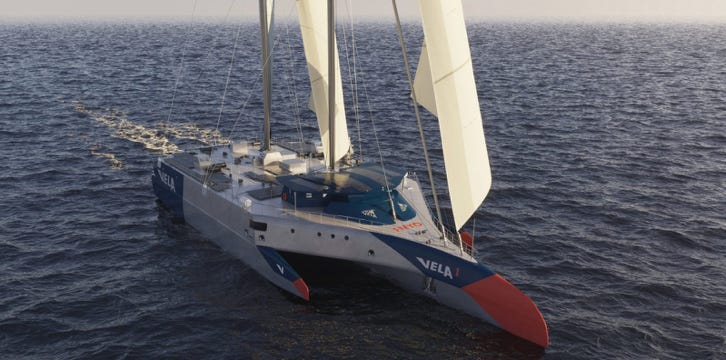
The global transport company Dalsey, Hillblom, and Lynn (DHL) has signed a contract with the French company Vela to produce large sailboats to transport cargo between Europe and the US. The 220-foot-long trimarans (three hulls) will be able to carry 600 European Union pallets weighing up to 458 tons.
The ships are expected to travel at 16 miles per hour with an estimated crossing time of about two weeks. (The typical container ship takes nine days to make the trip). The initial route will be between Caen-Ouistreham, France, and New Haven, Connecticut, with service starting in early 2027.
Vela plans to have five ships operational by 2030, allowing for weekly shipments. The ships will have solar panels and batteries to provide electricity, and are expected to reduce greenhouse gas emissions by more than 90 percent compared to traditional shipment methods.
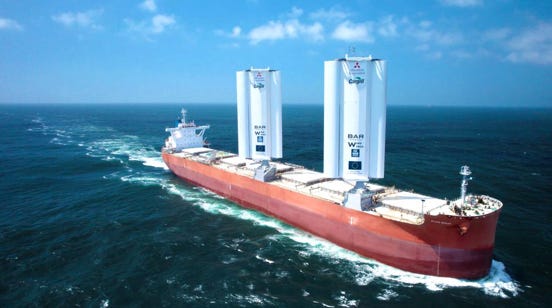
Meanwhile, the European Union has also developed a wind-powered system which supplements the traditional oil-powered cargo ship. The WindWings project adds wing sails, up to 123 feet high, to the ship’s cargo deck. In the test trial, the sails reduced fuel use by 1.76 tons per day per sail. A cargo ship uses between 100-300 tons of fuel per day, depending upon the ship’s size and speed. The sails are expected to reduce fuel usage by 10 percent when installed on existing ships but up to 30 percent when incorporated into a new ship’s design.
These new sailing ships are helping make small reductions in maritime transport emissions until a carbon-free solution is available. A South Korean company, HD Korea Shipbuilding & Offshore Engineering, is already designing a 15,000 TEU-class container ship—capable of carrying 15,000 20-foot containers—powered by a next-generation small nuclear reactor.
The ship is planned to be operational around 2035. Hopefully these new concepts will lead to cheaper and cleaner shipping.
***
Bruce Saller is a retired systems engineer with degrees in electrical engineering and computer science.

I've been reading about these for years. Nice to see they seem to be coming to fruition. Plus, they'll look really cool!
It's been some years, and I'll need to look up the archives for the details. The Chalopede design for legged land vehicles has a counterpart for water vessels. Conceptually, these would include both surface and underwater craft, though, obviously, with some major differences in the overall design.
(A major marine engineering firm had shown some interest in evaluating the cost and construction efficiencies, using their proprietary engineering software, but sadly, the founder passed away unexpectedly, and the idea was shelved. So it goes.)
In a nutshell, the concept is for a double hull, an single sheet inner box to house the crew, cargo, fuel, generators etc, and a modular external hull that is actually the prime mover.
Each module is a linear motor oscillating perpendicular to the direction of motion, with an outer plate, that could (and would) vary in shape from a square to a complex curved surface.
The sum of all the individual motor movements will be a smooth* wave moving fore to aft. The resultant force from the water will act to move the vessel forward. *Actually, the smoothness will be modified by sensors that detect the real-time external wave forces from the sea.
Using large numbers of low noise, low energy linear electric or hydraulic motors, such vessels would impose a much lower cost on marine life, that would be a big step forward in itself. But, apart from being ecologically sensible, constantly matching energies with the motion of the sea means that such vessels are intrinsically more energy efficient, with no wasted energy on churning the water.
When this is combined, for a surface vessel, with energy converted from the air using overhead cylinders or sails, plus all horizontal surfaces layered with solar energy convertors, the dependence on fossil fuels drops.
Superficially, an undersea vessel works the same way, though the energy conversions will change. Losing access to energy from the sun and air will probably raise the overheads to the point that this won't be a viable cargo carrying commercial design, though.