

By Martin Davis
EDITOR-IN-CHIEF
Email Martin
This week, Del. Dan Helmer (D — HD 10) announced that he would be running for Congress in Virginia’s 7th District. Democratic Rep. Euguene Vindman, who currently holds the 7th District seat, is now planning to run in the 1st District.

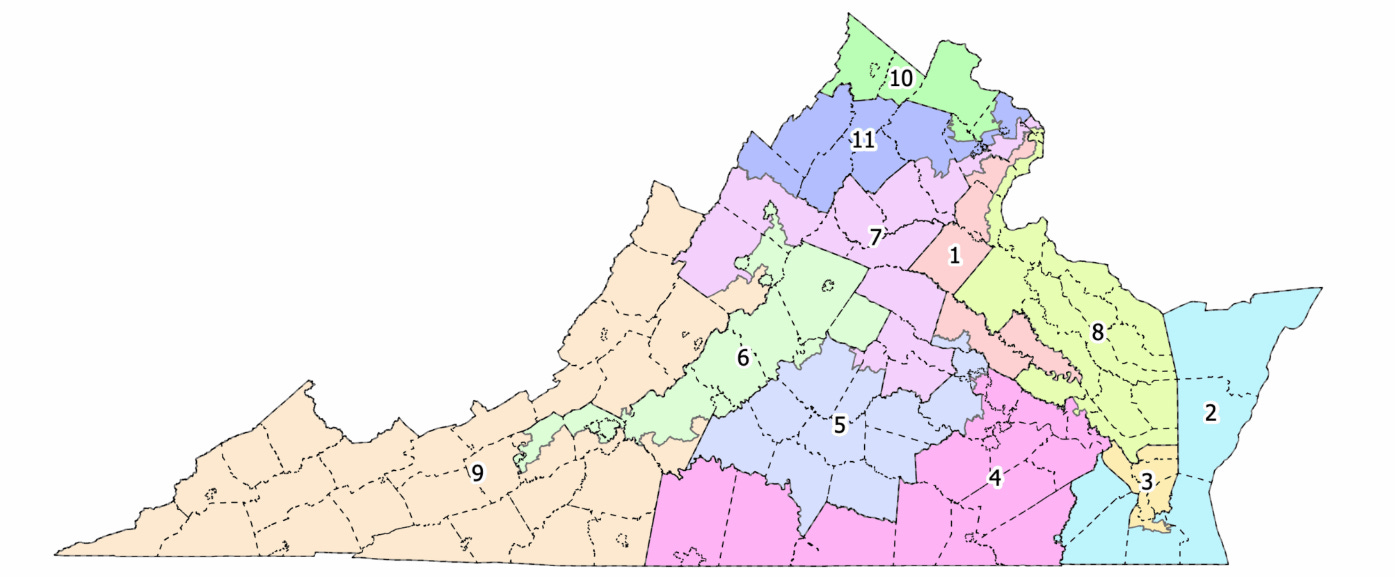
The musical-chairs-type moves are the result of the General Assembly’s mid-cycle redistricting in order to gerrymander Virginia’s congressional districts and ensure more Democrats go to Washington this November.
Redistrictings are typically done following each decennial census, which next occurs in 2030. This year’s move is meant to balance the books because states like Texas are gerrymandering their districts to keep Republicans in control of Congress — a challenging proposition given that President Donald Trump’s poll numbers continue to fall and independent voters are jumping the Republican ship.
All of these moves hinge, however, on Virginians voting on a constitutional amendment on April 21 to allow the General Assembly to redraw the lines. And then the State Supreme Court’s upholding the decision.
Neither is a foregone conclusion.
A recent poll by the Wason Center at Christopher Newport University shows Virginians favor mid-cycle redistricting 51% - 49%. That thin 2-point advantage is well within the poll’s margin of error of +/-4.4%, however, at the 95% level of confidence. In other words — the poll shows the special election a toss-up.
Pass or fail, the amendment is upsetting the primary voting schedule for congressional elections in Virginia and raising several legal challenges.
The result? Headaches for local registrars, challenges for candidates, and local legal tangles.
Shifting the Dates, Opening Legal Challenges
Holding the special election on April 21 requires moving the previously established dates for candidates’ filing documents as well as for the primaries.
In order to qualify for the primary ballots, individuals looking to run for a seat in the House of Representatives were originally required to file their paperwork no later than on April 2. That day, however, is 19 days prior to the special election. Consequently, the filing dates have been moved to May 25.
The primary date will then be moved from June 16 to August 4, according to House Bill 29, which funds the special election.
Whether the constitutional amendment to allow mid-cycle redistricting passes, these dates will hold.
The April 21 date comes with another wrinkle, however. To accommodate early voting requirements, the polls will open to voters on March 6.
But on Thursday evening, the Spotsylvania Board of Supervisors challenged that date, passing a resolution that argues early voting could not occur before April 16 — just five days prior to election day.
The reason rests in how the Board reads Article XII, Section 1 of the Constitution of Virginia.
It states that no proposed amendment to the Constitution “shall be submitted to the voters sooner than 90 days after final passage by the General Assembly.
The bill that triggered the special election was passed on January 16 of this year. Ninety days from that date, then, would be April 16.
In its resolution that passed 6-0 with Supervisor Deborah Frazier abstaining, the Board said that “a legitimate constitutional question exists as to whether authorizing legally binding ballots to be cast prior to April 16, 2026” is to be allowed.
Responding to the decision, Nicole Cole (D - HD66) who represents parts of Spotsylvania, told the Advance via phone that “[t]he State has put forward the special election, and HB 29 funds it. So the actions of jurisdictions not in support of this special election are performative. We want to give the voters in Virginia a change to level the playing field for them to have a voice in federal government.”
Local Election Leaders Face Challenges
Assuming the amendment passes, dates won’t be the only issue. Local registrars face a number of challenges.
One of the first is adding yet another election to the year’s election docket. There will be potentially four elections this year:
The special election to vote on mid-cycle redistricting
The June 16 Republican primary, if necessary
The August 4 congressional primaries
The November general election
“It’s adding a level of complexity to the job I didn’t think I’d see in 2026,” Jessica Atkinson, director of elections for Fredericksburg, told the Advance.
Cost is one concern. “The average election costs between $30,000 and $50,000,” Atkinson said. “That’s extra money” she hasn’t budgeted for. The state is allocating $5 million to offset the costs of holding the August primary, but Atkinson notes that at this point it’s not known how much of that money her locality — or any locality — will actually receive.
Beyond money, however, is the issue of officers of elections. “If we go to August,” Atkinson said, “I may have to find a whole new group of people to train.”
Some election officials have already told Atkinson that an August date would conflict with other plans. This means bringing in more individuals, training them, and getting them ready for election day.
The greatest challenge Atkinson see, however, is voter education.
For the April special election, Atkinson told the Advance that people need to understand they are “not voting on a map, but a referendum that allows the General Assembly to redraw the map.” Already she has had people ask to see a copy of the congressional map the General Assembly has put forward. She has to remind them that “you’re not voting on that. You’ve voting on the referendum.”
That matters because the map produced by the General Assembly is not set in stone. That would not happen unless the amendment is approved. In fact, the maps are currently being tinkered with. “Yesterday,” Atkinson said, “the 2nd and 3rd districts” were adjusted some.
Another challenge is that Fredericksburg is likely to move from the 7th District to the 1st, where it previously was situated. Atkinson said it took a great deal of work to educate voters when the city was moved from the 1st to the 7th. If the referendum is approved, she will again have to make sure that people understand they are in a different district.
“I just spent time telling people they’re in the 7th, not the 1st. Now I have to tell them they’re in the 1st.”
Things are no less complicated in Stafford County.
For Anna Hash, director of elections in Stafford, three concerns are front-of-mind.
“The biggest concern for me,” she said, “is if any of our current precincts are going to be split. If they are, we will have to create additional precincts.”
Like Atkinson, she is also concerned about voter education. “There might be some confusion with the public if [the precincts are] split,” she said, “especially because the vast majority will [likely] be in one district, and just a sliver in the other.”
She also shares Atkinson concern that voters understand the April special election is voting on allowing the General Assembly to redistrict, and not on the map itself.
For Atkinson, the real concern may be simple “voter exhaustion.” “It’s a lot,” she said, to ask voters to vote as many as four times in one year.
Candidates and Two Campaigns
For candidates seeking office, delayed dates for the primary don’t mean that they can take their foot off of the campaign accelerator.
For Republican Doug Ollivant, who lives in Culpeper and will run in the 7th district whether the voters approve mid-cycle redistricting or not, said that he is forced to run his campaign in two geographic regions: the current 7th District, and the proposed new 7th that extends north to Alexandria, west to the West Virginia line, and south to Hanover.
“I have to hedge my bets,” Ollivant told the Advance. “So I have to talk to Fairfax, Louisa, and Rockingham. And that’s the position the legislature has put us in. We have to run two campaigns.”
State Sen. Tara Durant potentially faces the same challenge. She will likely have to run in the 1st Congressional District under the new map, which extends north to Alexandria and south toward Hanover, while also preparing for the possibility that if the amendment fails she will be competing in the current 7th, which tracks north only as far as southern Prince William, west into King George and Caroline, and west toward Greene County.
This story was updated on February 20 at 11:30 a.m. to correct the spelling of Jessica Atkinson’s name. We regret the error.


Local Obituaries
To view local obituaries or to send a note to family and loved ones, please visit the link that follows.

Republicans in other states are playing politics. Now Democrats in Virginia are playing politics. And the voters lose.