By Steve Watkins, ADVANCE EDITOR
From Dead or in Jail: A High School Memoir
I knew I was a disappointment to my dad, and an embarrassment, though he loved me too much to ever say so. My bother Wayne was enough of a regular boy, but I was small and uncoordinated and slow. I whined a lot, and got hurt all the time. I didn’t like getting my hands dirty. I would only wear soft cotton, and had a phobia about buttons. I avoided even saying the word. I couldn’t catch a fly ball. I didn’t like getting tackled in football. I was inept at anything mechanical. I hated working on cars. I was afraid of everything:
Death. The dark. Cemeteries. Quicksand. Calling the movie theater to find out show times, even after they installed the automated answering service. That half-Indian half-alligator that the older scouts told us lived in Lake Okeechobee and would come out at night to drag kids from their tents and drown them in the lake.
When they held the Pinewood Derby in Cub Scouts, Dad had to buy a second balsa-wood kit after I screwed up the first one. He took over from there, carving an exact replica of the Batmobile as seen on TV. It won a gold medal for Most Creative Design, but was the slowest down the racetrack, an engineering failure that Dad pretended didn’t bother him but probably did. When I announced that I was going to build a dragline out of dowels and string and plywood for another Scout competition, he did everything for that, too. The finished project was a working replica of the massive 15,000-ton walking draglines out at the Bone Valley, Florida phosphate mines where Dad worked, with a boom and bucket and pulley and housing and pontoon feet and other moving parts. It must have been obvious who’d done the work, though, because we came home empty-handed from the awards ceremony.
Dad tried to be patient. I know he did. But much of the time, he didn’t know what to do with me—especially when I had night terrors, tip-toed into their bedroom, and stood next to Mom until she woke up and found me. After too many nights when I was little of letting me crawl into bed with them, or Mom leading me to my bedroom and rubbing my back and singing me to sleep, they called the Methodist minister for help. He came over late one night and read from The Bible and said reassuring things. We held hands while he prayed for God to help me through this difficult time, and let Jesus into my heart, etc. Just before he left, he gave me a card with a picture on the front of white, bearded Jesus holding a precious lamb, and John 3:16 on the back: “For God so loved the world, that he gave his only begotten son, that whosoever believeth in him shall not perish, but have everlasting life.”
The card, the idea of an afterlife, eternity—all those scared me, too, but I got the message and quit going into Mom and Dad’s bedroom. Dad could sleep through anything, but Mom suffered from insomnia, and I wasn’t helping things any by standing next to her bed in the dark--breathing, or sniffling, or whatever I’d been doing that kept startling her awake night after night.
Dad must have already been struggling when Wayne and I were teenagers and we moved to North Carolina, though he tried his best not to show it, passing himself off as a stable family man, good husband, involved father, skilled chemical engineer, principal bread-winner, and faithful church leader—all of which he was. He even took up jogging to stay in shape for the annual trail hikes he and Mom led with our church groups, and the mountain backpacking trips he went on with a few mining pals when they could all get away. There were no clues to the breakdown he would have two years later after leaving North Carolina for yet another phosphate-mining job back in Florida. None that us kids were aware of, anyway.
Dad was a stand-up guy who had returned home after college and the army at the end of World War II to help take care of his father through the old man’s final months of alcohol-related dementia. When our first sister died a few days after she was born, and Mom was still in the hospital, dangerously ill herself, Dad, a young father living 500 miles from his closest relatives, arranged for a winter burial in the children and infant section of a cold Florida cemetery—what they used to call Baby Land. It was just him and a minister he’d found in the Yellow Pages who read a short passage of scripture and prayed a small prayer while Dad looked down at a tiny coffin with the body of an infant daughter he would never get to hold while neighbors back in the company-owned mining town where we lived at the time looked after two-year-old me and three-year-old Wayne. Dad quit drinking not long after so he could be a better father, and eventually quit smoking, though it took him years, and an abortive attempt to switch to a pipe, and me when I was little finding him sneaking a cigarette in the barn he’d converted into a workshop. I cried and begged him to quit because they’d said on the news that John Wayne had cancer and might die, and somebody from our church had just died from cancer, and I didn’t want Dad to die, too.
He was a scout leader, a Sunday School teacher, a trail-hike leader, and a church deacon. He took in his brother’s whole family of nine when they lost everything in that car accident out in Colorado—rented them a house, gave them a car, loaned them money they never paid back, helped my uncle get a job. Dad and Mom took in our cousins, and neighbors’ kids, and kids we hardly knew—anybody who needed a safe family for a few weeks, a few months, however long. And when Dad found out his sister’s abusive husband had beat her up yet again, he put us all in the station wagon and drove overnight from Florida to Virginia to make sure she was OK--and to confront her husband to let him know what Dad would do if it ever happened again.
But life had gotten harder for him, in ways he did his best to hide. Getting laid off at yet another mine in Florida, struggling financially, changing jobs again and again, uprooting the family, and now having a problem son he didn’t understand—all of it must have taken a toll. Wayne still knew how to get along with him, how to be the kind of son who could make a dad proud, but I couldn’t keep my mouth shut, and increasingly argued, and complained, and even talked back, especially after the move to North Carolina. It had been one thing when I was an anxious little boy and sometimes erupted. Dad could feel sorry for me then. And protective. The paterfamilias. He could call a minister, carve a Batmobile, build a miniature dragline, send me to Mom.
Now, though, he didn’t know what to do.
And then he ordered us to get a haircut.
Dad had been on Wayne and me about it for weeks, and we’d spent weeks coming up with excuses. It was six months after we moved to North Carolina. We didn’t have to get crew cuts, which Dad himself had given us when we were kids—those and summer Mohawks, which made us the envy of our kid world in Central Florida. But he insisted that we had to do something about how shaggy we’d let ourselves get since the move. Wayne even had sideburns--and the start of a beard.
Finally, one Saturday, Dad ran out of patience and marched us the six blocks from our house on Front Street next to the Neuse River to an old-school barber shop downtown. It had a red and white striped barber pole outside that might have rotated. Why he chose that shop we didn’t know, but it felt like enemy territory from the second we walked in. Old white men sitting in Naugahyde chairs, smoking and reading the newspaper and shooting the shit. Couple of flat-top barbers holding forth while cutting other old men’s wispy hair. Nixon photo and American flag on the wall. Things quieted when we showed up, the old men eyeing us with suspicion and talking low to one another under their breath.
Wayne was first in the chair. “Might as well get it over with,” he muttered before giving the barber detailed instructions: “Keep it kind of long on the back and sides, still touching my ears and a little above my collar. Leave the sideburns. Trim the bangs.”
The barber nodded and smiled, then took up his clippers and buzz cut everywhere but on top before Wayne even had time to look in the mirror. It was a blitzkrieg. Wayne jumped out of the chair, clumps of shorn hair cascading off the black, polyester barber cape, the white-walling already half done. The whole place seemed to erupt. Wayne might have yelled at the barber, or maybe that was just the noise in my head as I fled from the shop and onto the sidewalk and swore that there was no way I was submitting to that butchery, no matter what Dad said.
The worst part was that as pissed off as Wayne was, he didn’t have any choice except to return to the chair and let the barber finish. He was still fuming when he stormed out after me a few minutes later, his longish hair gone, looking instead like all those G.I.s from Fort Bragg who had surrounded us in the Fayetteville colosseum the night Wayne and I and Wayne’s best friend John Hudson drove there to see Three Dog Night in concert.
Dad followed Wayne and me out of the shop, clearly not happy, and for a second I thought he might be on our side—the barber having been such a blatant asshole. But that didn’t happen.
“You’re next,” he said to me. “Don’t keep the man waiting.”
I said I wouldn’t do it.
Dad’s face got red. He stepped closer on the sidewalk and said it again: “In the chair. Now.”
I looked up at him—Dad was several inches taller than me then—and said no again. “Look what that guy did to Wayne,” I said. “There’s no way I’m letting him do that to me, too.”
I didn’t have any sideburns, and only the faintest trace of a mustache—peach fuzz, really—but my hair hung halfway over my ears, and to the collar of my t-shirt, and down to my eyebrows. Wayne and I had been listening over and over to the new Crosby, Stills, Nash, and Young album, Déjà vu, with David Crosby’s “Almost Cut My Hair.” It was our anthem that year.
Also, Susan Eaddy had told me once that she liked my hair long.
I’d never disobeyed Dad, and neither had Wayne. When he gave an order, we said “Yes, Sir” and complied, whether it was picking sandspurs out of the backyard barehanded until our fingers bled as punishment for something, or staying after church every Sunday for an extra half hour collecting orders of service left in the pews and putting away hymnals, or running down the side of the highway a quarter of a mile under the hot sun to retrieve a coke bottle Dad saw me throw from a pickup where I was sitting with some other guys in the truck bed and he was driving, but he decided not to stop right away so he could teach me a lesson.
This was uncharted territory. Dad had given me an ultimatum, and I had dug in. He might have said it one more time—“Go back inside and get in the chair, or else”—or he might have just clenched his jaw and ordered me and Wayne to go straight to the house and wait for him there. He said he needed to pay the barber and would deal with us later.
We made our way slowly back to Front Street, hardly breathing, Wayne incredulous that I had stood up to Dad like that, both of us trying and failing to imagine what possible punishment would be coming down once Dad got home. We were too old for him to spank. It had been years since he whipped us with his belt. Extra chores seemed too tame, though there were sure to be plenty of those regardless. I doubted Dad would put us on restrictions since that seemed too tame as well, and I hardly ever went anywhere anyway.
“He can’t kill us,” I said. “Can he?”
Mom made us tell her what had happened, and from the shocked look she gave us I knew she couldn’t believe it, either. She told us to go to our rooms. “Wait for your father there,” she said. “I’m so disappointed in both of you.”
We trudged up the two flights of stairs to the third floor and continued our speculations, too anxious to do anything else, still unable to think of a punishment harsh enough for what I’d done.
An hour passed, and then another hour, and Dad didn’t come home. We skipped lunch, sure that Mom didn’t want to see us and afraid we might run into Dad walking in the door as soon as we got downstairs. More time passed. We waited and waited until our anxiety slowly faded. Wayne put on some music. I picked up a book. He went into his bedroom to take a nap. He was always taking naps. I went into mine and wrote in my journal. I got bored.
Dad must have showed up at some point, but whenever it was, deep in the afternoon, we were hardly aware of it. He never came upstairs. Never spoke to us about what had happened. Never said a word to me about any of it, then or later. He was mostly silent at dinner. Mom was the one who said grace. Wayne and I cleared the dishes and cleaned up the kitchen. Mom and Dad went up to their second-floor bedroom and shut the door. Wayne might have gone to John Hudson’s house, or he might have had a date with his girlfriend Dotty. I retreated once again to my bedroom and climbed out on the roof and watched the lights of cars a mile away on the Neuse River bridge, crossing in and out of town. I wished Dad would turn back into himself and punish me the way he always had in the past—I didn’t even care how. But I knew it wasn’t going to happen. Everything had changed, though it would take me a long time to understand how.
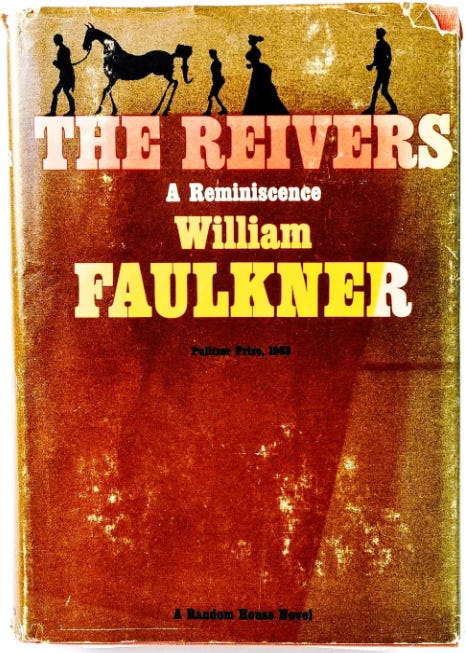
I would remember the moment, and that feeling, years later when I read William Faulkner’s novel The Reivers, published a month before he died, and when I saw the movie version starring Steve McQueen as the reprobate farmhand Boon Hogganbeck. When Boon and 11-year-old Lucius return home from their misadventures, Lucius expects to be whipped with a razor strop by his angry father as punishment for lying and running off. Lucius’s grandfather interrupts, though, and says there won’t be any punishment this time—at least not with the razor strop.
Lucius, the narrator, doesn’t understand how life is supposed to go on—how his parents can forgive and how he can forget--unless he’s punished. He begs his grandfather. “Do anything,” he pleads, “just so it’s something.”
I was crying hard, bawling, standing (no: kneeling; I was that tall now) between my grandfather’s knees, one of his hands at the small of my back, the other at the back of my head holding my face down against his stiff collar and shirt and I could smell him--the starch and shaving lotion and chewing tobacco and benzine where Grandmother or Delphine had cleaned a spot from his coat, and always a faint smell of whiskey which I always believed was from the first toddy which he took in bed in the morning before he got up.
“How can I forget it?” Lucius asks “Tell me how to.”
“You can’t,” his grandfather says. “Nothing is ever forgotten. Nothing is ever lost.”
***
“Nothing Is Ever Forgotten” is a chapter from Dead or in Jail: A High School Memoir, published in weekly installments on Sundays in Pie & Chai Magazine. You can find the published chapters, and future chapters as they’re posted, HERE.