
By Ranjit Singh and Jeff Eastland, ADVANCE CONTRIBUTORS
It’s high summer now, and we thought it would be a good idea to list the known leaks of untreated sewage—both great and small—that have afflicted the Rappahannock and Potomac Rivers since the start of 2026.
We gathered this information from various radio and online news sources, personal communications with local journalists and friends, and the Virginia Department of Environmental Quality’s (DEQ) website. The Free-Lance Star’s Scott Shenk has done especially commendable work tracking sewage spills in Fredericksburg. In places, the reports we looked at hold minor inconsistencies. We apologize beforehand for any errors. In total, however, we think this list makes clear that it has been a very grim year for local waterways. This is especially so when you consider that in Fredericksburg alone, no sewage spills were reported in 2025.
Keep in mind, too, that our region is riverine. Water is the “universal solvent,” uniquely able to dissolve and carry toxins, especially after rainstorms. So almost everything that flows into our backyards and streets ultimately ends up in the streams and rivers.
January 19 to March 14
Potomac River. 2026 begins with a bang. In the “Potomac Interceptor collapse,” for two months a broken 72-inch pipe in Maryland leaks 243 million gallons of untreated sewage into the river. Repairs aren’t completed until mid-March. This is likely the worst such spill in US history. It prompts a region-wide health and environmental state of emergency and restrictions on fishing and recreation. (Potomac River Keeper Network)
February 7
Stafford County. A clogged manhole spills 9,000 gallons of raw sewage, impacting Aquia Creek as reported by Virginia DEQ.
February 26
Fredericksburg. 125,000 gallons of raw sewage leaks from clogged manholes.
March 12
Fredericksburg. 9,000 gallons of wastewater is reported spilled near the town’s Wastewater Treatment Plant.
March 13
Fredericksburg. About 77,500 gallons of untreated wastewater overflows from three manholes, discharging into Hazel Run, a tributary of the Rappahannock River.
Around March 13
Fredericksburg. The same three manholes overflows again. A tiny spill (1 gallon) goes straight into the Rappahannock River.
April 23
Fredericksburg. About 500 gallons of raw sewage flows from a manhole. Humans are potentially exposed, according to reports.
May 4
Fredericksburg. A manhole overflows, dumping 1,000 of sewage near Fall Hill. Potential human exposure is reported.
May 7
Fredericksburg. 99 gallons of wastewater overflows from a manhole at Caroline and Ford streets.
May 8
Fredericksburg. The same manhole spews another 1,000 gallons of raw sewage with potential human exposure. Virginia DEQ reports an unknown amount reached the storm drain, which flows into the river.
June 15
Fredericksburg. City crews report an undetermined amount of wastewater overflow. Virginia DEQ says the sewage threatens Deep Run, which connects to the Rappahannock River.
June 17
Fredericksburg. The City reports an unknown volume of untreated wastewater is discharged into state waters following a power outage affecting manholes near Dixon Street.
July 10
Fredericksburg. About 1,000 gallons of untreated wastewater spills from a pump station near Caroline St.
July 15
Fredericksburg. A citizen reports an overflow from a manhole behind WalMart at Central Park. The amount leaked appears minimal. The DEQ investigation is still ongoing.
July 21
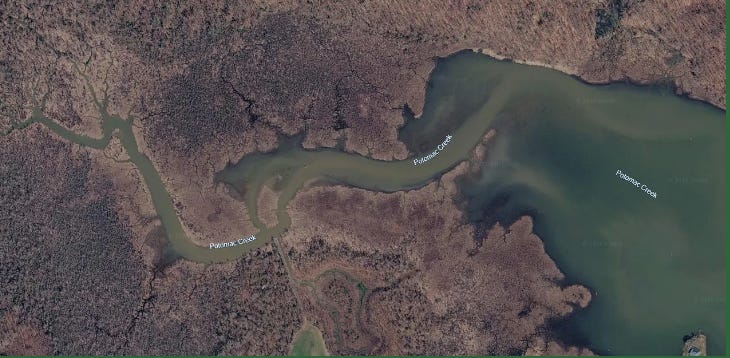
Stafford County. Jesse Adams, founder of Waterway Cleanups, an environmental non-profit located in Stafford County, discovers raw sewage leaking above Accokeek Creek. Accokeek Creek runs into Potomac Creek in the area of the 3,000-acre Crow’s Nest Natural Area Preserve. Water from both creeks ultimately flows into the Potomac River. The 18-inch sewage pipe leak is believed to date June 7 at least, when Adams first smelled a foul odor at Stafford’s Civil War Park. This means the sewage probably flowed for about six weeks. Adams relates his experience, the aftermath, and the likely impacts here.
That’s quite a list of sewage spills. But it’s not the whole story.
It’s important to note that all these events were observed and reported. Our list doesn’t include the daily abuses of local waterways that typically go unnoticed. These include chronically-leaking pipes from aging subdivisions, fertilizers washed into streams by a downpour, the guy who pours used engine oil into a ditch or storm drain, and so on. This “normal” pollution often puts our local creeks in the worst of the Environmental Protection Agency’s five water quality categories.
So, why create a list of the raw sewage spills of the first seven months of 2026?
At this time of year, many people are enjoying local rivers and creeks. They’re out swimming and fishing, or simply taking in the summertime bloom of the native yellow lotus. Many people love our local waterways.
Both of us are proud to serve on Stafford County’s Wetlands and Chesapeake Bay Boards, helping to ensure healthy rivers and creeks. And we know there is no greater ally in the fight to contain waterway pollution than nature’s own remedy, wetlands. As the Chesapeake Bay Program explains, wetlands do far more than provide necessary habitat for hundreds of species of fish, birds, mammals, and invertebrates:
Wetlands act like a sponge, soaking up stormwater and dampening storm surges. By trapping polluted runoff, they help slow the flow of nutrients, sediment and chemical contaminants into rivers, streams and the Bay.
In other words, wetlands protect us from ourselves.
Evidence of this protection is abundant even at the local level. Take the July 21 event in Stafford County. When Jesse Adams and Sarah Balon tested the water at the Accokeek Creek spill site, they found nearly three times the acceptable limit for E. coli, a bacteria that can cause severe illness in humans. Yet, when a day or two later they tested the water downstream at the Crow’s Nest preserve’s canoe launch, they found normal bacteria levels and zero E. coli.
The difference? Wetlands. As Adams writes,
…the wetlands had successfully filtered out the harmful bacteria that could have posed significant health risks to residents who recreate in lower Accokeek Creek every day.
There’s a big problem, though.
Wetlands are in serious trouble, both locally and nationwide. Longstanding federal protections on wetlands dating back to the 1972 Clean Water Act are being dramatically rolled back at the request of energy and business groups. Combined with the impacts of development and rising sea levels, it’s projected that almost 90 percent of Virginia’s wetlands will be gone by 2080.
This would be an environmental disaster—one that would certainly come back to haunt us. To quote the Norfolk-based nonprofit Wetlands Watch,
We need to view our wetlands, dunes, and shorelines as critical infrastructure, deserving protection in its own right.
We couldn’t agree more.
Wetlands preservation is self-preservation.
***
Ranjit Singh teaches in the Department of Political Science and International Affairs at the University of Mary Washington. He’s also an active environmentalist. His “No Lines in Nature” Substack blends history, science, and philosophy to explore our relationship with the natural world world. Jeff Eastland is a retired antique dealer, lifetime activist and writer, and one-time Environmental Studies major. He lives on a seven-acre farm in farm that is a certified Wildlife Habitat in Stafford, Virginia. A version of this essay originally appeared in No Lines in Nature.

Another great informative article, and one that demonstrates the need for a lot of patience, thought and tough decisions as we search for solutions. We’re gonna have to feel a lot of pain before we feel any gain because we are starting in a deep hole and, counter-intuitive as it may seem, the biggest villains are not the local governments. And perhaps those most to blame includes we citizens.
If the environment is important to you, whether John Q Citizen, government official, or any level politician, you risk being labeled with what these-days is a negative-connotation term. Take your pick: tree hugger, environmental nut, one-issue idiot, and the like.
And if you advocate for budget increases and legislative authority necessary to fix these problems, you’ll very likely be a final-term and soon-to-be expol.
Putting America first has had many negative consequences and most that have shined (or stunk) their way into our consciousness involve national and/or international issues; and now they’re also poking up their heads in all our backyards. And most are foisted upon us via slogans that falsely claim or imply that everything derived from putting America first will improve our lives.
Federal budget cuts (including loss of federal grants to local water and sewer treatment systems) and Doge-style agency gutting have done huge harm locally. Hungry people, lives shattered by reimbursement-lacking disaster aid programs, and trespass and tragedy perpetuated by poorly trained federal immigration staff are obvious examples, but the impacts are more far reaching; ask a family farmer, for example.
Just as foreboding to our healthy local selves are the executive orders and congressional action/inaction that gut pollution limits, enforcement and remedy funding.
Water and air quality, things we take for granted, are gonna get much worse, if elected official allow quality standards and enforcement to be cut in the name of making America first. Cut the red tape, free our economic beast, what bad could come from that?
Should Fredericksburg residents be forced to pay for the upgrades that they’ve been struggling for decades to fund for the very issue these two authors bring to our attention. Because it has been decades. And it has been decades because of money. It takes money and staff to prevent, monitor, repair and replace infrastructure. The federal grants are gone, state help is lacking and the Sunshine Lady is in heaven. So, pay up Fredericksburgers! Certainly, they should pay their fair share but so should the state and the feds. We are all responsible for creating these issues, and we should all be responsible for fixing them.
If you aren’t happy with today’s update article, you’re gonna have to think deeply about environmental issues when you vote in any election. And you’re gonna have to learn to bite your tongue when your taxes and user fees go up. Because we need elected official to say no to environmentally damning things that gobble-up wetlands, and who vote YES to fix the systems that are broken, and to cleanup all the messes that short-sighted, slogan-driven leaders have inflicted upon us.
We need short term clean up and long term solutions, and a bridge to get us from where we are to where we need to be. And I think that starts with truthful information, like that presented in the articles co-authored by these two fine gentlemen.
Thank you for your well thought out and truthful comments here. And I hope many others catch on the way you have.