
OPINION: We're Losing More Than a Paper ... We're Losing a Polestar
The recent cuts at the Washington Post are not just distressing for a career journalist, but for anyone who has ever looked to a newspaper as the anchor of a community.
By Donnie Johnston
COLUMNIST
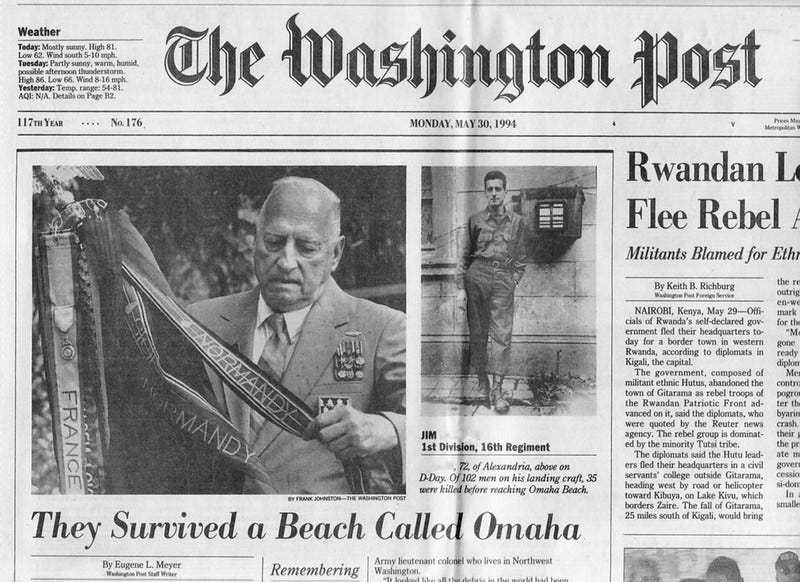
For a lifelong journalist, it is beyond sad to watch the demise of the newspaper business.

I sat in disbelief last week as the man on the TV announced that The Washington Post had cut one-third of its staff, on top of earlier layoffs.
Having been through the same situation a few years ago, I felt compassion for those who were let go, men and women who had planned a life in journalism and were now out in the cold.
In another time these people could have found jobs with other papers. Now there are few other newspapers to go to.
Three generations ago, the newspaper was what kept you informed about what was going on in your community, your state, your country and the world. Now we turn to other media. It is hard to even find a print copy of a newspaper anymore.
The Washington Post! After Watergate it was the bible of newspapers, sacred in the world of journalism after the reporting of Bob Woodward and Carl Bernstein brought down the Nixon Administration.
The Sunday Post seemed as thick as the snow on Mt. Everest and there was something in that publication that appealed to every reader. Just to get through the contents was an all-day job for even the fastest reader.
Now, like almost every other major paper, the Post is only a fraction of what it was in its heyday. Features have disappeared and now, in this latest cut, the sports section is going.
The sports section! In a nation where sports are too often more important than religion, to eliminate the sports section is akin to heresy. Sure, you can get all the scores on TV or on the internet, but there was something sacred about reading them in the newspaper.
When I was a child there was an elderly blind man that boarded with my family and after school I would read him the daily racing charts from tracks like Aqueduct, Gulfstream and Hialeah. Those charts were printed in The Washington Post.
I went through an old baseball scrapbook recently, with stories and clippings about Mickey Mantle, Henry Aaron and Warren Spahn. Those clippings came from The Washington Post sports section.
I began my journalistic career as a high school junior covering sporting events for my hometown newspaper. Ten cents per copy inch! Big bucks. By my senior year I was both covering sports for the local paper and covering hard news for the Daily Progress in Charlottesville, writing up board of supervisors meetings, taking pictures with my Brownie Starflash camera and putting the film on a bus to get it to the paper 40 miles away in time to make the afternoon addition.
The Charlottesville paper paid fifteen cents an inch.
That led to a reporter’s job with my local paper when I graduated, and a sports editor’s position. Then, I covered hard news and became the staff photographer.
Today, every reporter who writes a story has his name at the top. I worked more than a year before I saw my name in print. My old managing editor, Bill Diehl, made me earn my byline.
The sports page got subscribers. You could get state and national news on the radio or TV, but you couldn’t get local sports anywhere but the hometown newspaper. I suffered the ire of the press room many Friday nights as I held for the last basketball or football scores. I knew readers wanted to read them over breakfast.
Now The Washington Post sports section is going away. Shame on Jeff Bezos!
But this column is not just about the loss of a sports section, it is an obituary of sorts of the newspaper as a whole.
Earlier I mentioned my old baseball scrapbook, but my personal scrapbook, like those of many people my age, is filled with newspaper clippings. High school and semi-pro baseball feats, a writing contest I won in the sixth grade, the time I was bitten by a rabid cat, obituaries of family members.
Local newspapers printed engagements, wedding announcements, birth announcements. The newspaper was a vital part pf the community. And all these things were printed for free, as a community service to sell papers.
Then newspapers got greedy and started charging to print engagement pictures, wedding announcements and obituaries and more readers opted out. Then came the internet and online newspapers, which provided the news faster and without the expense of newsprint.
Yes, you can print an online story and paste it in your scrapbook, but it looks nowhere near as official as a newspaper clipping. Sorry.
With the demise of the newspaper, too many readers now depend on social media for their “news.” With fictionalized stories and artificial intelligence, they have no idea what is true or not true. Controlling the thoughts of the public has never been easier. It is 1984 in 2026.
I could go on and on, but I won’t. It is just a sad time for journalists like me who have worked a lifetime to bring the truth to the public.
RIP, Washington Post sports section and all the other features that are now part of a newspaper that was.
I shed a tear of printer’s ink.


Local Obituaries
To view local obituaries or to send a note to family and loved ones, please visit the link that follows.

I've noticed lately that my daily email of the Washington Post the 7 now often includes puff pieces like how to make the best coffee instead of real news
The Washington Post
"Journalism dies in propaganda."