
By Phil Huber
ADVANCE CONTRIBUTOR
I owe an apology, and a thank you.
June 12 was Women Veterans Recognition Day, the anniversary of President Harry S. Truman’s 1948 signing of the Women’s Armed Services Integration Act—the law that finally allowed women to serve as permanent, regular members of the United States Armed Forces, not merely as wartime auxiliaries to be thanked and then sent home. Virginia recognizes the day by statute, the governor proclaimed it again this year, and the Commonwealth is home to more women veterans per capita than any state in the nation. And yet, in this publication and in this community, the day came and went largely unmentioned. I include myself in that failure. I should have written about it before June 12, not after. For that, I am sorry.
The reason I can’t let the date pass without comment is that I owe a personal debt to the women whose service that law made possible.
From April 1972 through June 1974, I was assigned on active duty to Fort McClellan, Alabama — then the home of the United States Women’s Army Corps Center and School. I returned in January 1975 as a Department of the Army civilian and stayed until 1979. Those seven years coincided almost exactly with the final chapter of the WAC as a separate branch of the Army, which was disestablished on October 20, 1978, and folded into a fully integrated force. I had a front-row seat to that history. More importantly, I had the privilege of working alongside — and for — the people who made it.
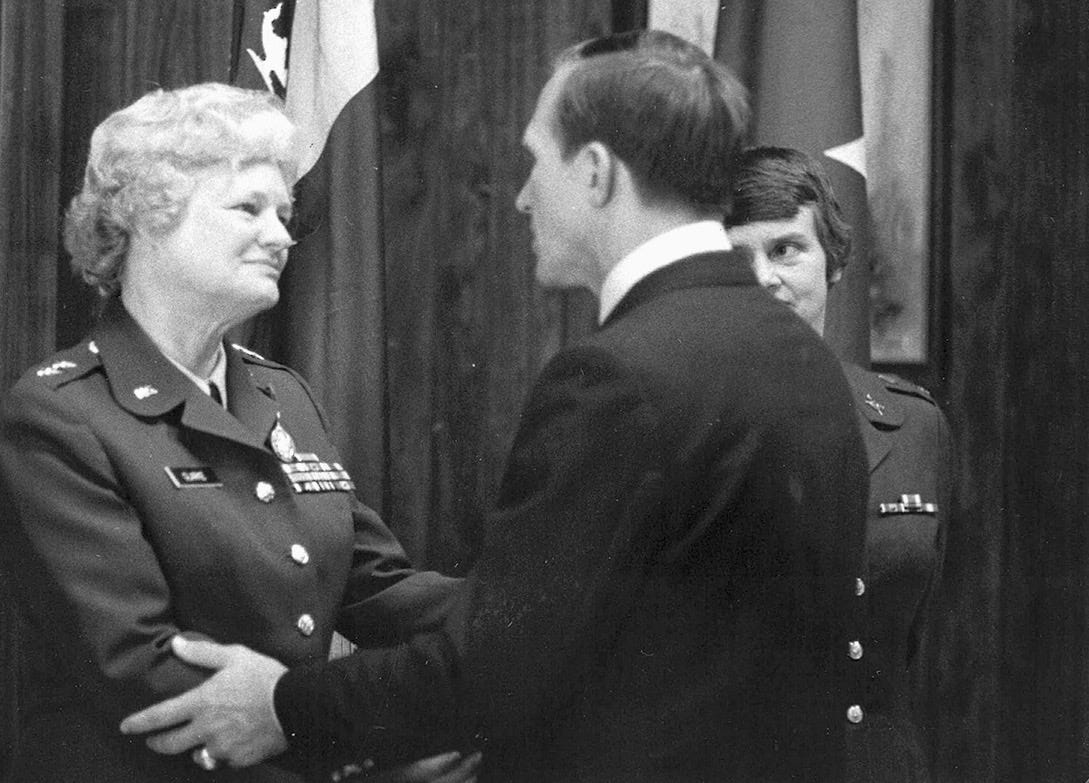
Among them was the post’s commanding officer, then-Colonel (later Major General) Mary E. “Betty” Clarke. Colonel Clarke took command of the WAC Center and School in 1972, the year I arrived. In August 1975, she pinned on her first star and became the ninth and last Director of the Women’s Army Corps. In November 1978, she became the first woman in the United States Army ever to wear the two stars of a major general, and shortly after, the first woman ever to command a major U.S. Army installation — our installation, Fort McClellan. She was, in every respect that mattered to a young officer trying to learn his trade, the standard. Calm, exacting, fair, and utterly competent. She set a tone that ran through the entire command.
I want this column to be less about her, though, than about the women whose names will not appear in any history book:
The women commissioned officers at Fort McClellan in those years — captains and majors who had often come up through the WAC when promotion ceilings were low, billets were narrow, and the uniform itself signaled “auxiliary” rather than “soldier.”
The non-commissioned officers — the sergeants and senior NCOs who ran the training companies, the schools, the staff sections, and the day-to-day life of the post with a professionalism I have not seen exceeded in any organization, military or civilian, in the fifty years since.
And the enlisted soldiers — young women, many of them still teenagers, who reported to Fort McClellan from every corner of the country to be made into Soldiers, and who were.
They were professional. They were dedicated to the mission. They treated everyone — male or female, officer or enlisted, soldier or civilian — fairly and with respect. They did this in an Army that did not always return the favor, and in a nation that had only recently decided, by act of Congress, that they belonged in uniform at all. They did it without fanfare. They did it because that is what soldiers do.
The Women’s Armed Services Integration Act capped women’s strength at 2 percent of the force and barred them from combat units and combat aircraft. Those ceilings are gone now. Today, more than 2 million American women have worn the uniform of the United States since 1948. Women fly combat aircraft, command warships, lead infantry battalions, and serve at every level up to and including the Joint Chiefs of Staff. None of that would have been possible without the women who served when it was harder, who were told they could not, and who quietly proved otherwise, at posts like Fort McClellan, in the years I was lucky enough to be there.
As noted before, Virginia has the highest concentration of women veterans in the country. They are our neighbors in Fredericksburg, Spotsylvania, Stafford, and King George. They are at our HOA meetings, on our school boards, in our churches, in line at Wegmans. Most of them will never tell you they served unless you ask. So ask.
I can’t end this column, however, with only gratitude. Honesty requires more.
Today, women make up roughly 18 percent of the active-duty force and more than 21 percent of the Selected Reserve. They fly our combat aircraft, command our warships, lead our soldiers in the field, and stand watch on every continent. And yet, under the current administration, they are being treated with a contempt I never witnessed in the Army I served — not at Fort McClellan, and not in the decades that followed.
In the past year, the Secretary of War has publicly questioned whether women should serve in ground combat at all, ordered a fresh review of their “effectiveness” in those roles, and announced that combat physical standards must revert to the “highest male standard only” — saying that if no women qualify, “so be it.” He has also disbanded the Defense Department’s Women, Peace, and Security program that Congress itself created, shuttered the service-level Women’s Initiative Teams (which Congress has now had to restore by statute in the 2026 National Defense Authorization Act), and removed senior women officers including the Commandant of the Coast Guard and the Chief of Naval Operations. The message being sent, directly and indirectly, to every woman in uniform is unmistakable: You are tolerated, not valued.
I know these women. I served alongside their mothers and grandmothers. And I know what will happen if this campaign of disrespect continues. They will keep volunteering — because that is who they are — but many of the most experienced among them will not stay. Mid-career officers and senior NCOs will quietly retire or decline to re-enlist. Talented young women will decide the recruiter’s pitch is not worth the indignity. And the force that remains will be smaller, less experienced, and less ready. You cannot remove one in every five or six soldiers, sailors, airmen, Marines, and Guardians from the ranks — or signal that you would like to — without causing profound dysfunction. There is no version of American military readiness that does not depend on the women already wearing the uniform.
So, this is my ask. If you agree that the women who serve this country deserve better, tell your elected leaders. Call Senator Warner. Call Senator Kaine. Call Representative Vindman. Call the Governor. Write a letter to the editor of this paper. Speak up in your veterans’ post, your church, your civic club. And please — forward this column to anyone you know who has a mother, wife, sister, daughter, aunt, or grandmother serving in uniform now or retired from the services. They have earned the right to know that their neighbors see them, value them, and will not stay silent on their behalf. Silence at this moment will be remembered as consent.
To the women I served with at Fort McClellan from 1972 to 1979 — officers, NCOs, and enlisted soldiers alike — thank you. You taught a young soldier what right looked like, and the lesson took. To the women in uniform today: this old crusty colonel sees you, and he is grateful. I am sorry I did not say so before June 12. I am saying it now, and I will keep saying it.
***
Phil Huber, is a retired U.S. Army Reserve colonel, a retired federal civil servant, and a retired consultant living in Fredericksburg, VA.