
By Phil Huber, ADVANCE COLUMNIST
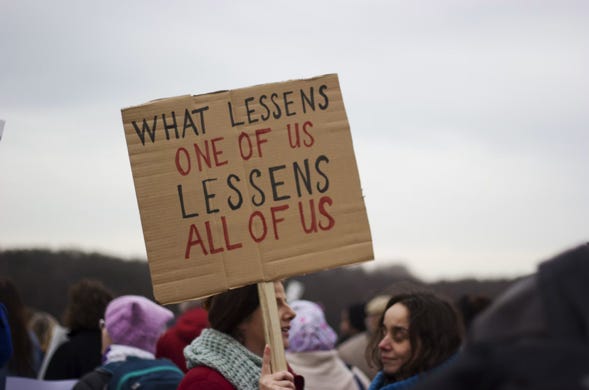
A reader recently challenged something I wrote about Donald Trump, Congress, and the Supreme Court. He largely agreed with my argument but thought I stopped before reaching the hardest question: What are citizens supposed to do about it?
Voting matters, he argued, but voting alone is not enough. Neither are letters to Congress, occasional demonstrations, or complaints about elected officials. He raised an even more personal question: What about relatives, friends, and neighbors who continue to support things we believe are damaging the country? Why aren’t we confronting them? And if talking, voting, and protesting are not enough, what comes next?
Those are fair questions. They deserve more than another list of things citizens could do. They require us to confront responsibility—our own as well as everyone else’s—and ask what one person can realistically accomplish, where individual action reaches its limits, and how citizens can combine their limited resources into something powerful enough to matter.
I have been trying to answer those questions myself.
I am not, by education or experience, an opinion writer. Most of my working life was spent in the military, federal government, and consulting, where my writing was technical: define the problem, examine the evidence, analyze alternatives, and recommend what should be done.
I wasn’t particularly political, either. That changed when Trump decided to run for president again. I began paying closer attention not only to what was happening in the country but also to what I had been doing—or not doing—as a citizen. I came to believe that my generation had helped leave behind problems we failed to solve and institutions we too often took for granted. Complaining about what others were doing no longer seemed sufficient. I needed to examine what I was doing.
In many ways, I became a babe in the political woods. Politics requires far more study than I had appreciated: history, government, the Constitution, current events, competing arguments, and conversations with people who see the world differently. The more I read, the more I realized how much I didn’t know.
Writing became part of that education and, frankly, a way of coping. I had strong feelings about what I was seeing and needed somewhere constructive to put that energy. Writing forced me to slow down, research an issue, organize my thoughts, and explain why I believed something rather than simply being angry about it.
Then I attended a briefing about the responsibilities of citizenship and had an uncomfortable realization. I had always considered myself a responsible citizen. I served in the military, worked for the federal government, paid taxes, and voted. Yet citizenship in a constitutional republic asks more of us. It requires us to remain informed, participate, question government, communicate with one another, and accept some responsibility for keeping the system working.
I had not done enough of that. I suspect many Americans haven’t.
That realization gave me something larger to write about: citizenship itself. It also raised another question. If I was going to write about politics and citizenship, what was I trying to accomplish?
My answer became persuasion.
I have tried talking directly with relatives, friends, and neighbors whose political views differ sharply from mine. Those conversations can be painful. My experience is that direct confrontation rarely changes anyone’s mind. Eventually we tend to retreat to familiar ground: “Everyone is entitled to an opinion,” or “I’m an independent; I look at the person or the policy and make my own choice.” Sometimes nothing changes except the relationship. Two people leave believing exactly what they believed when the conversation began, but liking each other a little less.
That doesn’t mean we stop talking. It means understanding the difference between confrontation and persuasion. Persuasion is slow. One conversation may change nothing. Another may raise a question. Something someone else says may plant a doubt. An event months later may cause a person to reconsider an assumption. I may never see that change, and that’s all right. The person being persuaded ultimately decides whether to change.
My responsibility is smaller: make the best argument I can, support it with facts, respect another person’s right to disagree, and keep trying. Persuasion requires persistence.
But my reader was right about something else. Citizens are responsible for their political choices. We choose the people who govern us, and those choices have consequences. Responsibility, however, is not the same as condemnation. If I believe another citizen has made a bad political choice, humiliating him or her is unlikely to persuade him or her to make a different one next time.
The same standard applies to me. I cannot spend all my time assigning responsibility to other voters without examining my own. If I believe something is seriously wrong and my response consists of complaining, voting every few years and waiting for someone else to fix it, I have made a choice too.
That brings us back to the reader’s real challenge. What do we do?
One person can write, talk with a neighbor, vote, contribute $25, knock on a door, or register a voter. One person can plant a seed. One person cannot maintain a national legal organization, finance years of constitutional litigation, organize thousands of volunteers, or match millions of dollars in political spending.
For that, individual conviction has to become collective capacity. That is why I now work on two tracks. I continue trying to persuade as an individual. At the same time, I join organizations, contribute resources, volunteer, recruit others, and persist.
That brings us to the word at the center of this discussion: power.
Politics is about power—who has it, how it is obtained, how it is restrained, and what people without governing power can do to influence those who possess it. Losing an election means losing certain governmental powers. It does not require a political minority to become powerless. But power does not appear because we are angry or convinced we are right. It must be organized, financed and sustained.
History has already taught us this. In Montgomery, Alabama, in 1955, Black residents did not control city government. After Rosa Parks was arrested, they used power they did possess: they stopped riding the buses. The Montgomery Improvement Association coordinated carpools, fundraising, meetings, and legal challenges during a boycott that lasted more than a year.
People walked. Drivers contributed cars and time. Churches and organizations raised money. Families rearranged their lives. Lawyers pursued cases. The comparison here is organizational, not historical; today’s political disputes should not casually be equated with Jim Crow. The lesson is simpler: individuals acting separately possessed limited leverage. Organized citizens acting together possessed considerably more.
The larger civil-rights legal campaign demonstrated the same principle. Charles Hamilton Houston developed a legal strategy that Thurgood Marshall and others pursued through a series of cases culminating in Brown v. Board of Education. They did not merely express opposition. They built institutions capable of making that opposition consequential.
That distinction matters. The objective is not simply to express our opposition more loudly. The objective is to make our opposition consequential.
That can take many lawful forms. Citizens can organize sustained peaceful demonstrations, support litigation, conduct lawful economic boycotts, organize voters, petition government, and campaign to change laws. Americans may advocate structural changes in government, and Article V of the Constitution provides a process for proposing and ratifying constitutional amendments. The First Amendment protects speech, peaceful assembly, and petitioning government for redress of grievances.
The important boundary is not between passive citizenship and forceful citizenship. It is between lawful and unlawful action. Citizens can be persistent, demanding, and difficult for government to ignore while remaining peaceful and within constitutional bounds.
Much of the machinery needed to do this already exists. Legal organizations have lawyers and researchers. Civic organizations have members, communications networks, and expertise. Political parties and campaigns have voter information and election experience. States possess governmental powers of their own, and state attorneys general can bring or join litigation when legal requirements are satisfied.
The organization does not even have to be local. Someone in Virginia can support litigation occurring hundreds of miles away. A person in Fredericksburg may be able to provide volunteer assistance to an organization elsewhere. Money and professional expertise travel even more easily.
Start with the mission, not the ZIP code. Find organizations already working on the issue that concerns you. Read what they actually do. Check their methods and how they use their resources. Don’t join everything. Pick a mission, find an organization whose methods you support, and strengthen it.
Then comes something else we cannot avoid: money.
Money buys lawyers, organizers, research, advertising, technology, and time. Most citizens cannot individually compete with concentrated wealth. Organization provides another approach. Ten thousand people contributing $25 create $250,000. Those same people are also 10,000 potential volunteers, callers, canvassers, and participants.
One $25 contribution cannot hire a lawyer. Thousands of contributions can help sustain a legal organization. Three volunteer hours cannot operate a voter-registration effort. Thousands of three-hour contributions can.
Organization pools what ordinary citizens possess: money, time, expertise, labor, relationships, votes, and persistence.
And that brings us to perhaps the hardest word in this column: sacrifice.
We sometimes behave as though citizenship should fit comfortably around everything else in our lives. We volunteer if Saturday happens to be free. We contribute if money remains after everything else we wanted. We attend the meeting unless something more enjoyable comes along.
Sacrifice does not mean impoverishing ourselves or neglecting our families. It means giving up something we could have kept because we have decided something else matters more. Maybe $50 means one less dinner out. Maybe three volunteer hours mean giving up a football game. Someone with money can contribute money. Someone with time can contribute time. A lawyer has legal expertise. An accountant understands finances. A writer can communicate. A retiree may have decades of experience. A younger person may bring energy and technological skills.
Everyone does not have to contribute to the same thing. But if something matters as much as we say it does, we should be willing to ask: What am I prepared to give up for it?
At this point, however, I need to turn my own argument around.
A Trump supporter reading this may believe I have the problem exactly backwards. They may believe Trump is correcting problems rather than creating them. They may distrust institutions I want to protect, support policies I oppose, and believe his vote was a responsible decision based on his understanding of what the country needs.
Fair enough.
If I am serious about citizenship, I must acknowledge their right to reach that conclusion. Americans sharply disagree about the role of government and the institutions they trust. In fact, public confidence in government and institutions often changes substantially depending on which party controls political power.
More importantly, everything I have written about citizenship applies to that Trump supporter too. They can study the issues, test their assumptions, persuade their neighbors, vote, organize, contribute, volunteer, demonstrate peacefully, support litigation, and work to change laws. The constitutional rights I claim for my side belong equally to theirs.
That leads to a test I think all of us should apply to our politics:
Would I accept this same rule if the other side were in power?
If I defend expansive presidential authority when my candidate is president, would I grant the same authority to a president I deeply oppose? If I demand congressional oversight of the other party, will I accept it when Congress investigates mine? If I defend peaceful protest when I agree with the protesters, will I defend the same constitutional right when I disagree with them?
Citizenship cannot mean one thing when my side is out of power and something different when my side controls it. If I demand constitutional limits when the other side holds power, I must be willing to live under those same limits when my side holds it.
Underneath even our strongest disagreements must be rules we are willing to apply to everyone.
That does not require us to abandon strong political convictions. Quite the opposite. We can argue vigorously about presidents, policies, courts, immigration, taxes, government spending, abortion, guns, or any of the other issues that divide us. But we should also be careful about assuming that Americans are divided about everything.
Research by the University of Maryland’s Program for Public Consultation suggests something more complicated. Its 2026 national surveys identified 112 policy positions supported by majorities of both Republicans and Democrats; on 88 of them, more than two-thirds of both groups supported the same position. The subjects included healthcare, housing, childcare, immigration, Social Security, taxes, abortion and birth control, energy, criminal justice, and government reform. In its public-consultation surveys, participants are given information about proposals and arguments for and against them before being asked what they recommend.
That tells me something important about persuasion. The Republican or Democrat across the table may not be as far away from us as the political labels suggest. We may disagree intensely about Trump, political parties, or particular institutions while agreeing on more specific problems and solutions than either of us realizes. Finding that common ground does not require surrendering our convictions. It may simply give us a better place to begin the conversation.
There is another choice. We can remain comfortable. We can complain from our living rooms, forward articles to people who already agree with us, and wait for somebody else to contribute the money, file the lawsuit, knock on the door, organize the boycott, attend the meeting, or spend Saturday doing the work.
That is a choice too. It means accepting that others will do the work—or accepting the status quo.
My reader wanted a harder answer. Here it is. Persuasion changes minds. Organization combines people. Money and volunteer labor provide resources. Sacrifice demonstrates commitment. Persistence sustains the effort. Together, they create power. And power is what can turn an opinion into something government and institutions must reckon with.
We can disagree about leaders, policies, institutions, and tactics. But once any of us decides that something is seriously wrong, we face a harder question than, “What do I believe?”
What am I willing to do about it?
Talk to the neighbor when conversation may help. Write to persuade. Vote. Join. Contribute. Volunteer. Organize. Participate peacefully. Support litigation when you believe the cause warrants it. Advocate changes in law through constitutional processes. Recruit others. And keep coming back.
If we are unwilling to spend some time, contribute some resources, accept some inconvenience, and surrender some comfort for what we claim to value, we should be careful about saying we have exhausted our options.
We haven’t.
We have decided not to use them.
***
Phil Huber is a retired Army Reserve colonel, federal civil servant and consultant who writes on civic education. He lives in Fredericksburg.

What a great and inspiring article here by Phil Huber which not only puts it in proper perspective, it also mirrors my own thoughts and and strategies and efforts in trying to leave something behind for future generations to enable them to have the same opportunities I have had:
Write. Communicate. Educate. Vote. Contribute $. Volunteer. Doorknock. Participate. Recruit others.
And continue to do that when you are tired & exhausted and maybe don’t feel like it.
And most importantly-make your positions known to your local officials, and show up at Planning Commission, Board of Supervisors, and Town Council meetings and speak out when all the marbles are on the table. When the votes are cast that decide our future direction.
Just do it. Because it is the right thing to do.