
By Michael Aubrecht, ADVANCE COLUMNIST
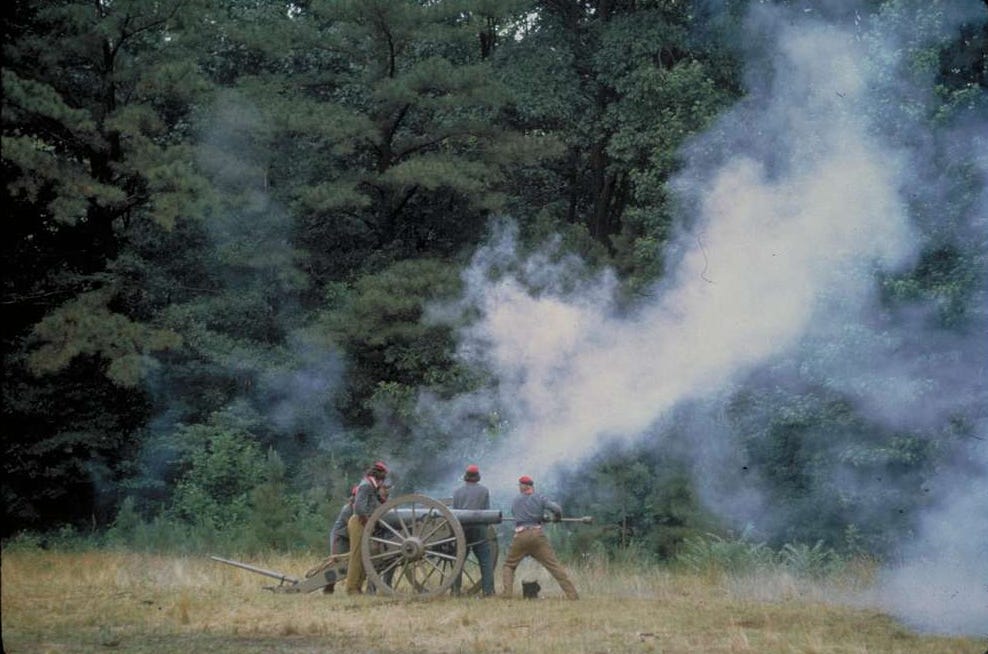
Let me start off by saying that I live in the midst of four of the most important southern Civil War battlefields in the country: Fredericksburg, Chancellorsville, Spotsylvania Court House and the Wilderness. As a result, there are Civil War reenactments that take place commemorating these battles on their anniversaries throughout the year.
I enjoy going to the encampments and seeing the recreations and demonstrations of life during the conflict. The living historians are generally authentic and knowledgeable, and I have a great deal of respect for the Civil War reenactors.
Perhaps this is why I felt compelled a few years ago to write a book about the camp life of Confederate soldiers encamped in Spotsylvania County. One aspect of reenactment, however, leaves me perplexed: The bloodless battle reenactments.
It seems strange to replicate moments in one of the worst episodes in American history. Why would anyone want to pretend to be fighting a battle that resulted in thousands of casualties? Is there any uplifting commemoration to be derived from such play acting?
What’s more, these reenactments are manufactured and orchestrated. Often reenactors decide by lottery in advance who will tumble to the ground as though they’ve been hit; some of the fallen inevitably try to lie still if they are supposed to be dead, while others try to simulate wounded men by crawling away from the battle lines.
I understand that these events can show spectators the troop movements during the course of an engagement, but the play-acting of faking the dead and dying, to me, is in bad taste. Is that truly honoring your ancestors? When remembering the dead, the last thing I think they would appreciate is a phony version of how they died.
Here’s how one participant at a battle reenactment recalled his assignment: “In my case, a volley from an advancing Confederate company knocked me down, and while I writhed in pain and screamed perhaps too dramatically from my simulated leg wound, a Rebel cavalryman galloped over, reared on his stallion 10 yards away and shot me ‘dead’ with his Colt revolver. The handful of spectators on my side of the park loved it.”
They “loved it”? I don’t know, but that disturbs me.
I’m all for the encampments, as I said, but pretending to die on a battlefield where men actually died isn’t entertaining. I would venture to say it could be considered contrary to the very respect most reenactors think they are paying. Perhaps I’m being too sensitive, but I predict that most observers don’t correlate the modern performance to the harsh reality of what made that event worth remembering in the first place.
There is a danger with these orchestrated recitals of glory romanticizing the war instead of commemorating it. Are we not trivializing death? Renowned Civil War historian Bruce Catton warned us about these Civil War reenactments.
“We are in serious danger of taking the most significant anniversary in American history and using it as a means of giving ourselves a bright and colorful holiday,” he wrote. “How the Civil War soldier fought his battles is no doubt worth examining, but infinitely more important is a consideration of why he fought and what he accomplished. Lay on the sentiment, the romance, and the dramatic appeal heavily enough, and we shall presently forget that the war was fought by real living men…”
Peter Carmichael, a former professor of history at Gettysburg College, told the Wall Street Journal that battle reenactments were an “unfortunate distraction.”
Or, to put it another way, war is not a spectator sport.
***
Michael Aubrecht is a historian, author, documentarian, and lecturer. You can find out more about his work, including his new book project on Virginia Loyalists During the Revolutionary War, at his website The Naked Historian.

Thank you. Well written with excellent points.
They are simulating war and in war, people die. Get over yourself.