


As we move toward America's 250th year, the Declaration should not be something we merely quote on the Fourth of July. It should be a living challenge
By Phil Huber, Advance Columnist
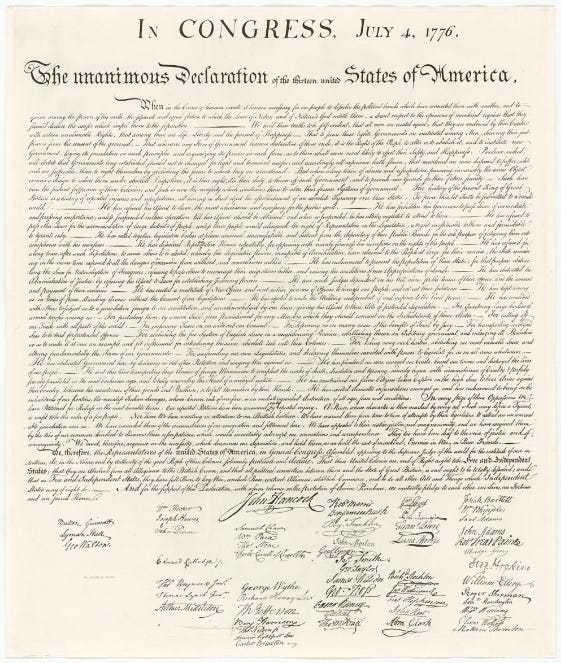
The Declaration of Independence is only about 1,300 words long, but for nearly 250 years it has served as something like America’s marriage contract with itself. The promises are brief; living up to them is hard. Like any long-term relationship, a country cannot just pull out the old vows once a year and admire them. It has to decide, again and again, whether those words still guide how we actually live together.
When the Declaration was written, the problem was clear: a king and a distant Parliament claimed authority over people who had no real voice. No one in Fredericksburg worries about King George III today. But many people, whatever their politics, feel a familiar frustration—that major decisions are made far away, by people and institutions that don’t seem answerable to them.
If we were writing a declaration for our own time, we would not address it to a monarch across the ocean. We would aim it at any form of power—public or private—that shapes our lives without real accountability. We would say plainly that a self-governing people should not accept systems that treat their voices as decoration and their needs as an afterthought.
Today’s version of “being ruled by a king” is not a crown; it is a set of arrangements. When large majorities of Americans want lower drug prices, stronger rules against corruption, or fairer elections, and those ideas die quietly in committee year after year, something is wrong in the bond between the people and their government. When districts are drawn so that most races are decided before a single vote is cast, we have created safe little kingdoms for politicians—protected not because they serve well, but because the lines on the map shield them from consequences. When our information comes from systems designed to keep us angry and hooked, those systems become gatekeepers of what we see and believe, with no real duty to the public interest.
None of this means we should give up or tear everything down. But it does mean we should renew our vows in a serious way. A good marriage is not free of conflict; it is one where both sides keep coming back to their basic promises and checking whether they still mean them. For a democratic republic, that means asking direct questions.
Do we still believe government should get its just powers from the consent of the governed—not from the cleverness of map-drawers, the size of campaign checks, or the skill of media consultants? Are we willing to insist that our institutions reflect the broad areas where the public already agrees, not just the narrow interests that profit from delay and division?
Recent research (vop.org) suggests ordinary Americans are often ahead of their institutions. When people are given clear background information and asked to weigh tradeoffs, they find common ground on more issues than our daily shouting matches suggest. Majorities of Democrats, Republicans, and independents agree on practical steps to lower prescription drug costs, strengthen ethics rules, improve childcare and housing, and set basic guardrails on technologies like artificial intelligence. We still disagree on plenty, and always will. But on the basics of fair play and honest dealing, there is more agreement than our politics admits.
Here in the Fredericksburg area, we feel the effects of national gridlock. But we also see what a quiet renewal of vows can look like. We see neighbors who vote differently but agree that local government should be open, that meetings should be civil, and that public money should be handled responsibly. We see volunteers from different parties working together at polling places to make sure elections run smoothly. These are not grand gestures, but they are how a community keeps faith with the idea of self-government.
So what might it mean, in practice, to renew our vows as the country approaches 250 years? It would mean standing up for the idea that no official is above the law, and that rules on conflicts of interest and ethics are not optional. It would mean supporting reforms that give voters a real choice—fairer maps, accessible voting, straightforward election rules—so that “consent of the governed” is not just a phrase in a textbook. It would mean taking seriously what good surveys tell us, then pressing our representatives, at every level, to act where the people already agree.
It would also mean resisting the constant pressure to treat fellow citizens as enemies. The signers pledged “our Lives, our Fortunes and our sacred Honor.” We are not asked to risk that much today. But we are asked to do something that is not easy: to stay engaged, to argue honestly, to listen, and to remember that the point of the whole experiment is government that serves the many, not the few.
We do not need a brand-new Declaration to replace the old one. What we need is to let its core ideas question us. Are we really governing ourselves, or drifting into new patterns of rule that just wear different clothes? Are we content to be managed—by money, by media, by maps—or do we still want to be citizens in the full sense of that word?
As we move toward America’s 250th year, the Declaration should not be something we merely quote on the Fourth of July. It should be a living challenge—one that shows up in city council meetings, school board races, party committees, civic groups, and at the ballot box. Our task is not to write new founding words. It is to say, in our own time and in plain language, what kind of power we will no longer accept—and what kind of self-government we are finally ready to live up to.
***
Phil Huber is a retired Army Reserve colonel, a federal civil servant, and a retired consultant who writes on civic education. He lives in Fredericksburg.


This article is published under Creative Commons license CC BY-NC-ND. It can be distributed for noncommercial purposes and must include the following: “Published with permission by FXBG Advance.”
Sadly, renewing vows only works if both sides are trying to save the relationship/republic.