

By Martin Davis
EDITOR-IN-CHIEF
Email Martin
This is the first in an occasional series on the journalism craft, taking readers inside the minds and hearts of the writers who cover this region and beyond.
The early October air was uncharacteristically cool. A perfect night to throw on pajamas, eat warm comfort food, and unwind from another week relentlessly pursuing news.
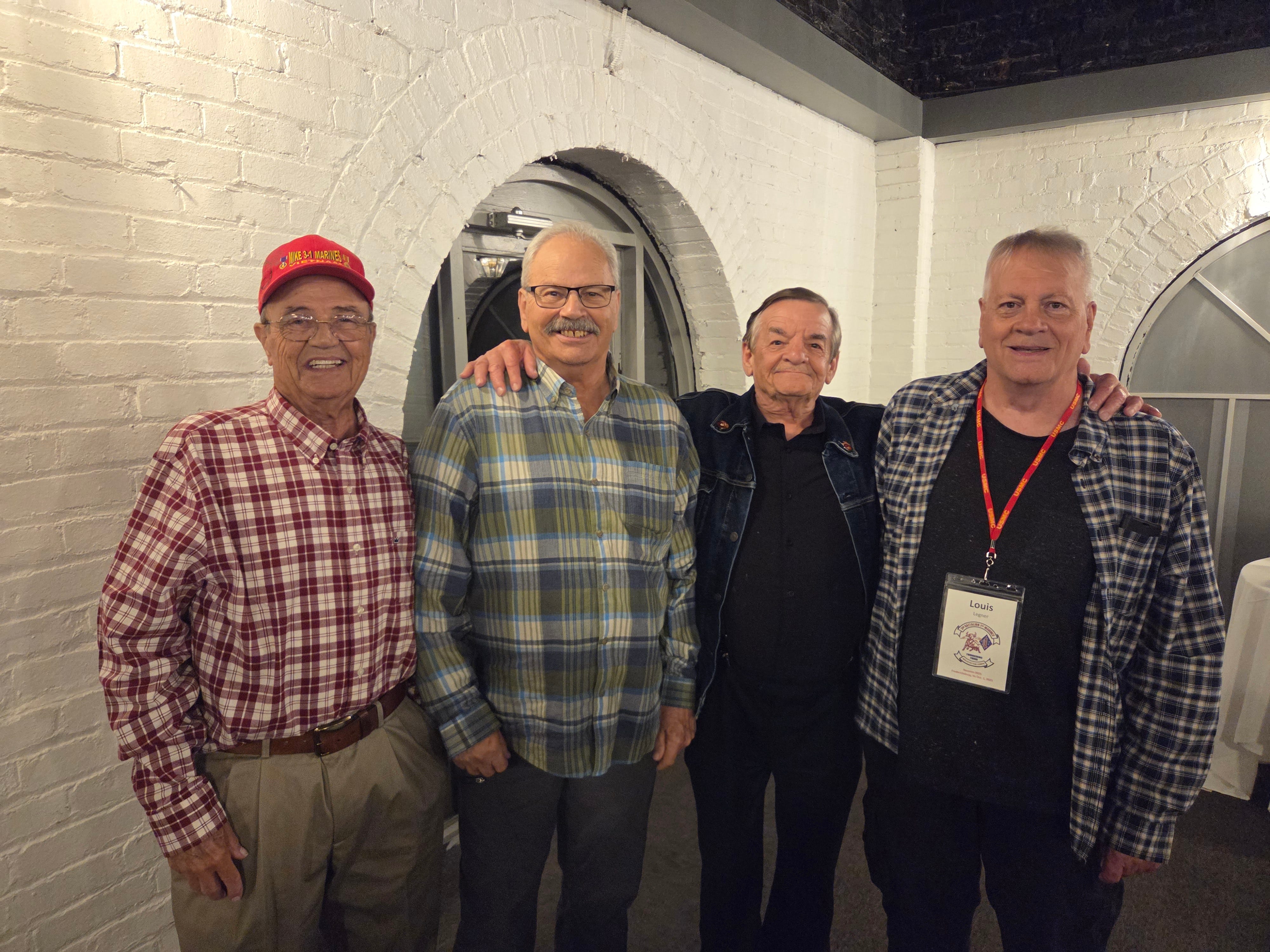
Instead, I switched into slacks and a golf shirt, picked up my notebook, and headed to Brock’s to write about a reunion for a group of Marines I’d never met, and who insofar as I knew had no real tie to the Fredericksburg community.

Why go? Because that’s what journalists do.
Less than two months later, on the Friday after Thanksgiving, I was pursuing my daily ritual of walking my dog through Chancellorsville Battlefield, fighting back tears.
An email earlier in the day said that Sgt. John Potts, a veteran of the United States Marine Corps and the Vietnam War with whom I’d spent that cool October evening, had died.
Why shed tears over a man I’d met once, for about 4 hours, and never saw again?
Because journalism worth reading requires a level of connection and vulnerability that is too often dispensed with in the name of “objectivity” and “unbiased reporting.” And tears, very often, are the price a journalist pays for capturing those stories.
Journalism as Obligation
To write another’s story is not simply a gift, it carries an obligation to connect — insofar as is possible within the time restraints journalism places on the writer — human-to-human with your subject.
This connection operates on a plane separate from objective facts and story details. These are the bare bones of any story, the bleached skeleton upon which the framework of any story hangs.
Since the 1940s, when the idea took hold that journalism should be “objective” and “nonbiased,” readers and writers alike have labored under the false idea that the perfect story is that which just gives “the facts.”
Facts alone, however, are not the story. A person’s humanity is the story. And that can only be discovered when writers and their subjects can connect in a moment where they are mutually vulnerable. That can only occur when the two find a touchpoint in human experience.
This is what Ta-Nehisi Coates is explaining in his book on writing, The Message, where he says:
I think this tradition of writing, or drawing out a common humanity, is indispensable to our future, if only because what must be cultivated and cared for must first be seen….
… You cannot act upon what you cannot see.
For Potts and myself, that moment occurred when he began to recall in great detail the moments of his days in Vietnam. More than a half-century later, his preternatural recall of each moment in-country — the weather, the hour, the fear, the love, the brutality, the bonds — is what caught my attention.
While I have never served, I recall with the same level of clarity the day we bid our son farewell as he left for deployment, and those moments throughout his time away when the thoughts you do not wish to entertain are there.
Potts and I talked briefly about those moments. My experience did not grant me entre into his time in Vietnam. Not did it allow me to pretend that our experiences were equivalent. But in a small way, the intensity of those moments — when you live daily with the idea that death could be a moment away, be it one’s own or one you are close to — was something we could share.
That connection allowed John and I to talk. And it gave me an anchor to hold onto as he shared with his comrades-in-arms the memories of those days.
That connection became the centering idea of the story I wrote, “Thank You for Coming Home.”
“Ask someone where they were on September 11, 2001,” the piece began, “and the memories and details will likely flow — even a quarter-century later. But the day before? Most people would be hard-pressed to recall any details.
“For the Marines of Mike 3-1 — Mike Company, Third Battalion, First Marines — every moment of every day of their time in Vietnam from late 1966 to 1970 is seared in their memories.”
It was one journalist’s look into one subject’s life. It is neither definitive, nor authoritative.
It is, in the end, human.
Journalism’s Price
The notion of “time off” is an odd one for many journalists.
Yes, the burden to daily write can be lifted, allowing one to think about something other than meeting deadline. But the motivation to tell stories doesn’t leave just because there’s no demand to file by 4 o’clock.
That’s because journalism is not about facts alone. Facts can be captured easily at any time — especially in this age.
Journalism is about connecting as humans, and then faithfully conveying those stories in a way that helps readers not just understand a problem, but to appreciate others and their perspectives.
That connection comes with a price.
It can be laughter, it can be conflict, and then there is the most difficult price a journalist pays. The pain of losing not simply a source, but a human connection.
A price for which tears seem the only appropriate currency.


ocal Obituaries
To view local obituaries or to send a note to family and loved ones, please visit the link that follows.

Support Award-winning, Locally Focused Journalism

The FXBG Advance cuts through the talking points to deliver both incisive and informative news about the issues, people, and organizations that daily affect your life. And we do it in a multi-partisan format that has no equal in this region. Over the past year, our reporting was:
First to break the story of Stafford Board of Supervisors dismissing a citizen library board member for “misconduct,” without informing the citizen or explaining what the person allegedly did wrong.
First to explain falling water levels in the Rappahannock Canal.
First to detail controversial traffic numbers submitted by Stafford staff on the Buc-ee’s project
Our media group also offers the most-extensive election coverage in the region and regular columnists like:
And our newsroom is led by the most-experienced and most-awarded journalists in the region — Adele Uphaus (Managing Editor and multiple VPA award-winner) and Martin Davis (Editor-in-Chief, 2022 Opinion Writer of the Year in Virginia and more than 25 years reporting from around the country and the world).
For just $8 a month, you can help support top-flight journalism that puts people over policies.
Your contributions 100% support our journalists.
Help us as we continue to grow!


This article is published under Creative Commons license CC BY-NC-ND. It can be distributed for noncommercial purposes and must include the following: “Published with permission by FXBG Advance.”