
By Phil Huber, ADVANCE COLUMNIST
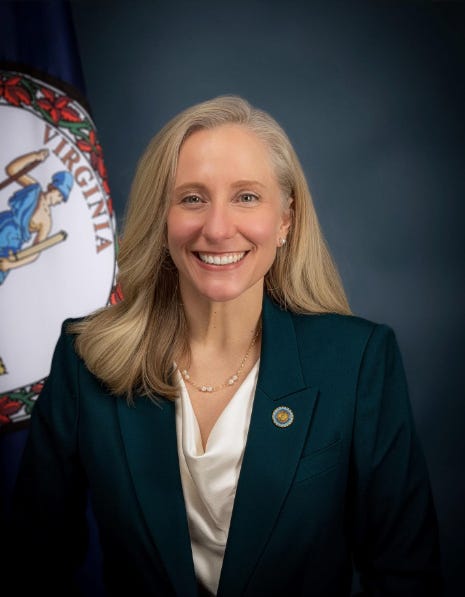
Not Dramatic. Just Grown-Up Governing
We just watched a race in Richmond that most Virginians never signed up for: the race to pass a state budget before July 1. From the sidelines, it looked odd. The runners started with energy, then seemed to slow down the closer they got to the finish line. At times, it looked like they might stop altogether.
Yet in the end, they crossed the line. The state did not shut down. Teachers will be paid, troopers will stay on the roads, and services our communities depend on will continue. Here in the Fredericksburg area, that means paychecks for school staff and state employees, support for local services, and continuity for families who rely on public programs. How they finished matters—and it tells us something about our new governor, Abigail Spanberger, and the promises she made to Virginia voters.
Spanberger took office on a clear set of goals. She said she would focus on affordability for families: housing costs, energy bills, childcare, and healthcare. She promised to strengthen public education and raise pay for teachers and other public employees. She talked about making powerful industries, including big data centers, “pay their fair share” for the strain they place on our electric grid and our communities. And she pledged to keep government working, not push us toward shutdowns.
Those ideas are not abstract in Fredericksburg. We are a community of commuters, veterans, small-business owners, public servants, and working families. Many neighbors feel the pinch of rising housing costs and utility bills. Our local schools depend on reliable state support. State offices around our region need stability to plan staffing and services. A budget is the difference between promises on paper and reality in classrooms, offices, and households.
This budget was Spanberger’s first big test. It did not deliver everything she or her supporters might have imagined in one sweep. But in plain terms, we can see how compromise—and even a measure of bipartisan cooperation—moved the Commonwealth, and our region, toward those goals.
First, pay and public services. The budget includes raises for teachers and state employees over the next two years. That is a concrete step toward valuing the people who keep our schools and agencies running, from Fredericksburg classrooms to state offices along I-95. It gives local schools and offices something solid to plan around. This is not just talk about “respecting public servants”; it is money in the budget.
Second, affordability. The budget puts new resources into programs that touch housing, childcare, health coverage, and other cost pressures. Not every idea floated during the campaign made it into law. But the basic direction is consistent with what voters were told: use the budget to ease the squeeze on ordinary families, not to design it around corporate priorities. For Fredericksburg households watching rent, groceries, and utilities climb faster than paychecks, that focus matters.
Third, data centers and fairness. Some of the sharpest fights this year were about how fast to change tax treatment for huge energy users. Some wanted tougher changes; others warned about losing investment and jobs. The final budget gives neither camp exactly what it wanted. But it moves in the direction Spanberger described: data centers facing higher costs over time and a clear message that their impact on our grid and neighborhoods is now on the agenda, not off in a protected corner. In a region where growth and infrastructure are constant concerns, that shift matters.
None of this happened smoothly. The regular session ended without a budget. A special session had to be called. Negotiations stalled over data centers, marijuana rules, and revenue. Critics had plenty of chances to say, “See, Democrats can’t legislate.” Many voters here reasonably worried we might drift toward a shutdown.
This is where the race picture helps. The closer the runners got to the July 1 deadline, the more they slowed, argued about the last turns, and second-guessed themselves. That is frustrating to watch, especially if you are a teacher, trooper, or public employee wondering whether your paycheck is secure. But it is also what governing often looks like in a real-world democracy. When the stakes are high, speed gives way to bargaining.
Bargaining is where compromise and bipartisanship, even modest, come in. Most of the hard talks were inside the Democratic camp: House and Senate, governor and legislators, progressive ideas and business-friendly caution. But in the end, both parties had to decide whether to accept the budget. Republicans had to decide if they could support a plan that invested in schools and public workers without sweeping new taxes. Many did. Democrats had to decide if they would live with a package that fell short of their ideal on data centers and cannabis but still moved the ball forward. They did.
That is not dramatic. It is grown-up governing.
Spanberger’s part matters. She made her priorities clear early—raises, affordability, fair treatment of big energy users—and stayed in the mix as legislators struggled. She told Virginians there would be a budget, not a shutdown, then accepted a compromise where her goals are visible but not absolute. In doing so, she strengthened the chances of achieving those goals over time: locking in raises now, keeping affordability central, and putting data centers on a path toward closer scrutiny later.
For Fredericksburg, and for citizens who care about civic education, the lesson is simple. Compromise is not weakness. It is recognition that in a democracy, no faction gets everything without consequences. Bipartisanship is not pretending we agree on everything. It is sharing responsibility for keeping the lights on and the paychecks going out, even when we disagree about the route.
If we only reward leaders who deliver pure victories, we will see more races that end at the brink and fewer that end with a passed budget. If we value leaders who work toward their aims while accepting real-world trade-offs, we will get more budgets like this one: imperfect, contested, but done on time and grounded in the everyday needs of Virginians.
The budget race this year was messy. The runners slowed near the end. But Virginia crossed the line with a plan that reflects many of the governor’s promises and the legislature’s priorities, and avoids the self-inflicted wound of a shutdown. For Fredericksburg families, workers, and businesses, that quiet success is part of the foundation under everything else we hope to build. And if Washington could learn to govern as wisely as Virginia did this summer—choosing compromise over collapse—the whole country would be better for it.
***
Phil Huber is a retired Army Reserve colonel, a federal civil servant, and a retired consultant who writes on civic education. He lives in Fredericksburg.

One may also indulge in Mr. Huber's MAGAphobia on the pages of one of FXBG Advance's competitors "Free Lance-Star." Mr. Huber's mellifluous paeans to the Democratic "Socialists" also appear there. He states on FL-S, "more than three-quarters expect political violence to increase in the next five years." With Tyler Robinson on trial, too many (known) attempts on the sitting president's life to count, a pharma CEO assassin moldering in a cell... and countless property and violent crimes being excused by Leftist courts as "Social Justice" it cannot be disputed that Mr. Huber's side of the aisle has been fomenting violence. D.C. used to be Kharjackistan til it was cleaned up by the Natl. Gd. Even a young Leftist lady I know said the Metro and D.C. streets are far safer. One of Mr. Huber's Big Deals is housing costs. Shall we assume that the Biden Admin's 15 M unvetted hordes entering our nation alleviated housing costs, especially for those on the lower socioeconomic rungs? Mr. Huber's Free Stuff for the masses has a sweet ring to it for the self-indulgent, instant-gratification set who can't pay their bills because they are too lazy, too stoned, have a degree in Marxist Relevancy to Ontology or are, a journalist. (Or all of the above.)