By Steve Watkins, ADVANCE EDITOR
THE FXBG ADVANCE MONDAY 11/23/26 AFTERNOON READ
On October 8, Stafford resident Alyson Azzara sent a lengthy email to a dozen county officials with the subject heading “Health and Safety issues NOT addressed by Kings Highway Proposal.”
The longtime federal environmental protection specialist, who earned her Ph.D. in 2012 from Texas A&M University, brought up significant technical and environmental concerns under three headings—“Generators,” “Noise,” and “Traffic Impact Analysis and Safety”—leading her to the conclusion that “there is no way the County can reasonably approve the development application for a conditional use permit” for 37 data center buildings on 9 million square feet of land along King’s Highway in south Stafford.
The massive combined project was scheduled to go before the county Planning Commission—and did—five-and-a-half weeks later, on November 18.
Azzara didn’t receive a response to her email. Instead, Deuntay Diggs, chair of the Stafford County Board of Supervisors and one of the recipients, forwarded it to Charlie Payne, the attorney representing the Peterson Companies, the developer seeking county approval for the projects on 1400 acres of rural land near the Rappahannock River.
A few days after that, Payne send a confidential email back to Diggs. two county officials, and the chair and vice chair of the Planning Commission refuting Azzara’s concerns—or attempting to. Payne’s email even included a “Professional Corporation Confidentiality” warning:
“This e-mail and any attachments are confidential and may be protected by legal privilege. If you are not the intended recipient, be aware that any disclosure, copying, distribution or use of this e-mail or any attachment is prohibited.”
Azzara had no knowledge of the behind-the-scenes exchange, and didn’t learn about it until three days after the November 18 Planning Commission hearing on the Kings Highway “Assemblage” when she was sent a copy of emails between Diggs and Payne with Payne’s secret refutations to county officials of Azzara’s data center concerns.
Despite Payne’s efforts, and Diggs’ apparent complicity, the Planning Commission voted 4-3 to recommend denial of the conditional use permit for the data center complex. The proposal is now scheduled to go before the Board of Supervisors, which can accept or override the Planning Commission recommendation, in mid-December.
Azzara emailed Diggs on Saturday, November 21, after she learned about his secret exchange with the developer’s attorney. The editor of The FXBG Advance also contacted the Stafford Board Chair, on Sunday, November 22, to ask about the exchange.
“I’ve recently been made aware of an email exchange between you and Charlie Payne relative to an email I sent to the County with respect to health impacts of the Kings Corridor assemblage,” Azzara wrote in her November 21 email.
“I’ve attached the exchange for ease of reference,” she continued. “While I have no express issue with you consulting the applicant regarding clarification of concerns raised by constituents, I do take exception to you not then sharing those responses back with me. Particularly because the responses he provides are not relevant to the points that I raised—and it is very clear that he does not understand the concerns, or is actively choosing not to address them.
“Had you shared those responses with me, I would have been happy to provide additional information on the questions that remain unaddressed by the applicant’s responses. Instead, I must assume that you took those responses as sufficient and then also asked that they be shared with Planning Commissioners without providing any commentary on the completeness or relevance of the responses.
“Which raises the question: Are you sending all of my emails to the developer to offer them a chance to respond? And if so, why aren’t you sharing their responses back with constituents? I know I am not the only one emailing you and other Supervisors and Commissioners with questions and concerns about this development and data center development in general. It is incredibly disingenuous, particularly for someone who claims to value transparency, to be sharing with the developer but not with the people you represent.”
Diggs responded to Azzara and The Advance early this morning, Monday, November 23, to say that he hadn’t responded to Azzara’s October 8 email—sent to him 46 days ago—because he was “still looking into these matters.” He hadn’t told Azzara about forwarding her original email to Payne, he said, “because I did not want to create the impression that I was endorsing his explanations or presenting them as definitive answers to your concerns.”
Diggs didn’t address questions about why he had forwarded to Planning commissioners Payne’s refutations of Azzara’s data center concerns, nor did Diggs say whether he has been sending other residents’ and critics’ emails to data center developers and their attorney—and secretly forwarding the data center responses to county planners and supervisors as well.
Here are the emails:
Deuntay Diggs’ November 23, 2026 email to Alyson Azzara (cc to The FXBG Advance)
Good morning, Mrs. Azzara,
Thank you for your email and for the continued time and effort you have put into raising these concerns. I want to clarify a few things. When I seek information from an applicant, it is not because I consider their response the final answer or because I necessarily agree with their position. Rather, I use that information as a starting point for my own research, follow-up questions, and further examination of the issues raised.
I also made a deliberate decision not to forward Mr. Payne’s response to you because I did not want to create the impression that I was endorsing his explanations or presenting them as definitive answers to your concerns. The reason you have not received a substantive response from me is that I am still looking into these matters. Specifically, I have been examining Loudoun County’s experiences with data centers, particularly as they relate to potential health and environmental impacts. Additionally, Vice Chair Guy and I are awaiting information from the Virginia Department of Environmental Quality (DEQ) regarding what data and analysis they can provide to help us better understand these concerns.
I believe it is important to gather information from multiple sources rather than rely solely on the applicant’s representations or any single perspective. That takes time, particularly when dealing with technical matters that could affect the health, safety, and quality of life of our residents. I also want to emphasize that asking an applicant to respond to concerns does not mean those concerns have been dismissed, nor does it suggest that I have reached a conclusion about the applications. I appreciate your willingness to share additional information and your continued engagement. My responsibility is to carefully evaluate the information presented, ask questions where necessary, and make an informed decision based on the full record.
Respectfully,
Deuntay T. Diggs, MPA, Stafford County Chairman
***
Alyson Azzara’s November 21, 2023 email to Deuntay Diggs
Subject: Sharing Constituent Emails with Developers
Chairman Diggs,
I’ve recently been made aware of an email exchange between you and Charlie Payne relative to an email I sent to the County with respect to health impacts of the Kings Corridor assemblage.
I’ve attached the exchange for ease of reference. While I have no express issue with you consulting the applicant regarding clarification of concerns raised by constituents. I do take exception to you not then sharing those responses back with me. Particularly because the responses he provides are not relevant to the points that I raised— and it is very clear that he does not understand the concerns, or is actively choosing not to address them.
Had you shared those responses with me, I would have been happy to provide additional information on the questions that remain unaddressed by the applicants responses. Instead, I must assume that you took those responses as sufficient and then also asked that they be shared with Planning Commissioners without providing any commentary on the completeness or relevance of the responses.
Which raises the question: Are you sending all of my emails to the developer to offer them a chance to respond? And if so, why aren’t you sharing their responses back with constituents? I know I am not the only one emailing you and other Supervisors and Commissioners with questions and concerns about this development and data center development in general. It is incredibly disingenuous, particularly for someone who claims to value transparency, to be sharing with the developer but not with the people you represent.
For the good of the order:
The generator question is apples to apples as those measurements were taken during emergency conditions. Which is what I was referencing with the running of 1000 generators at kings corridor.
It IS important to recognize that DEQ regulates air emissions - it is equally if not more important to recognize that DEQ is not allowed to consider cumulative impacts. Thus, as they permit each individual location - since these are all, in fact, separate permits, they will NOT consider whether the emissions from one set of emergency generators combined with all the other generators will have outsized impacts.
I would note it is rich that in this case Mr. Payne “cannot speak to what has occurred in NOVA” when it comes to negative impacts, but is only too happy to wax poetic about the positives that NOVA has experienced.
On Noise: USDA guidance from 2001 (so they’ve known about and provided guidance on negative impact for 25 years) says that noise from substations (which data centers have) should NOT exceed 5 dB above the ambient sound levels measured between midnight at 4am. Mr. Payne provides a range to show he is potentially within the limits of the ordinance - although their model assumptions are specious to begin with - but that does not provide assurances that levels will not be nuisance levels or cause health impacts. Which are critical elements under the CUP.
Finally - The TIA has absolutely no assessment on safety. It is based on wait times and traffic flow. So his response is completely irrelevant. It just further demonstrates that he has either no idea what is actually in the application, or cannot or will not address the actual questions at hand. Or both. Which does not surprise me.
Please, if you are going to ask Charlie Payne to respond to technical questions posed by PhDs, at least do us the courtesy of sharing his answers back so we can see if he is even close to responding with any actual validity.
Regards, Alyson Azzara
***
Deuntay Diggs’ October 13, 2026 Email to Charlie Payne
From: Deuntay T. Diggs
Subject: RE: Health and Safety issues NOT addressed by Kings Highway Proposal
Good morning, all,
I would prefer that you send the response to them.
Deuntay T. Diggs, MPA
Stafford County Chairman
Charlie Payne’s October 13 Email to Deuntay Diggs (with annotated responses imbedded in Azzara’s original email)
Subject: FW: Health and Safety issues NOT addressed by Kings Highway Proposal
Importance: High
Mr. Chairman, I hope this finds you well.
Please see below responses in red
Did you also want me to also send to Chair Barnes and Vice Chair Caudill?
Charles W. Payne, Jr.
Hirschler Fleischer, A Professional Corporation Confidentiality Note: This e-mail and any attachments are confidential and may be protected by legal privilege. If you are not the intended recipient, be aware that any disclosure, copying, distribution or use of this e-mail or any attachment is prohibited. If you have received this e-mail in error, please notify us immediately by returning it to the sender and delete this copy from your system. Thank you for your cooperation.
From: Alyson Azzara
Sent: Thursday, October 8, 2026 3:27 PM
To: Kristen Barnes; Kelsey V. Caudill; Willie Shelton, Jr. ; Carlos Bratton; Marcus Oats; Maureen Siegmund; Neil Hamblin. Cc: Donna S. Krauss; Emilie C. Wolfson; Amy G. Taylor; Deuntay T. Diggs
Subject: Health and Safety issues NOT addressed by Kings Highway Proposal
Dear Chairwoman Barnes, Vice-Chairwoman Caudill, Commissioners, and Staff,
Again, I apologize for the long missive. It is, however, worth the read as this email addresses outstanding critical health and safety issues that the applicant for the Kings Highway assemblage fails to address in a manner sufficient to meet the Standards required under the CUP.
I have spent a lot of time looking through the combined proposals and information for the King’s Highway Corridor data centers and associated infrastructure. I have a number of health and safety concerns that are not adequately assessed in the application materials. I understand that not everything is required to be, however CUP standard (4) requires the applicant to respond in the affirmative to the statement that “The use shall not adversely affect the health or safety of persons residing or working in the vicinity of the proposed use”. This has not been demonstrated, or even sufficiently evaluated by the applicant.
There are three major health and safety issues that are not adequately evaluated or addressed in the application. Some of these have other requirements, such as ordinances or statues, however, while the development may meet those regulations, it does not adequately mitigate the overall health and safety risks of the operation of the data center based on known health risks to exposure. Thus, the applicant cannot claim to meet this standard.
Generators:
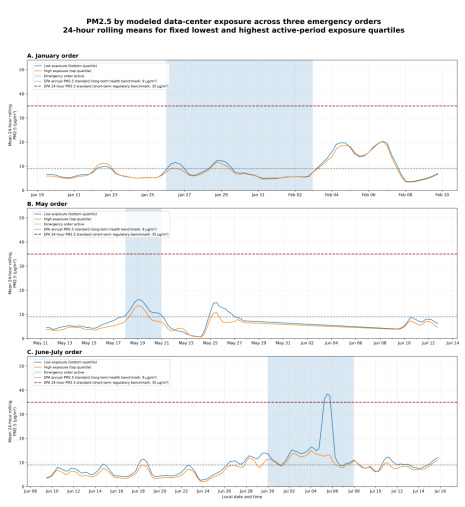
The combined proposed data centers likely include upward of 1000 generators. While the normal operations and testing include cycling these generators in groups, a power outage—like the one GW experienced on Monday—would require that all locations start and run their generators until power is restored. On Monday, that was approximately 2 hours. While I understand that the applicant is required to use Tier IV generators, lower emissions are not no emissions. They also include a proffer to be able to build out independent power generation, which would further increase emissions. As an example, over the summer, the data centers in northern VA received emergency orders to run their generators. This graph (also attached) shows the air quality comparison across three emergency orders relative to EPA air quality standards. Note the summer outage exceeds both the annual and 24-hour emissions limits for PM2.5. Particulate matter such as PM2.5 can carry toxic substances and is associated with many harmful health impacts, cardio-vascular disease, asthma, COPD, and cancer. Particularly those particles that have heavy metals, polycyclic aromatic hydrocarbons (PAH), and organic components—like those found in diesel fuels. No analysis has been provided for the emergency operation of these generators with respect to acceptable health limits. Yes, they have permits that limit what can be emitted, but as we saw this summer—those limits were exceeded. So, then what? My children, neighbors, and I just have to deal with breathing unhealthy air and the health consequences that ensue? We are not talking about a handful or even a dozen or a hundred generators; 700-1000 diesel generators the size of a shipping container or a trailer home are what we are talking about. With no protections for my kids.
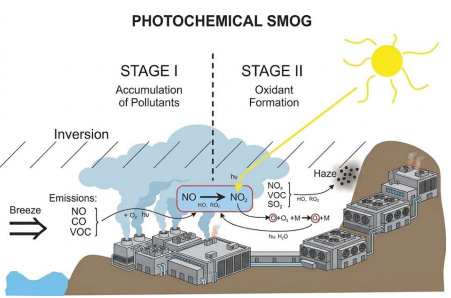
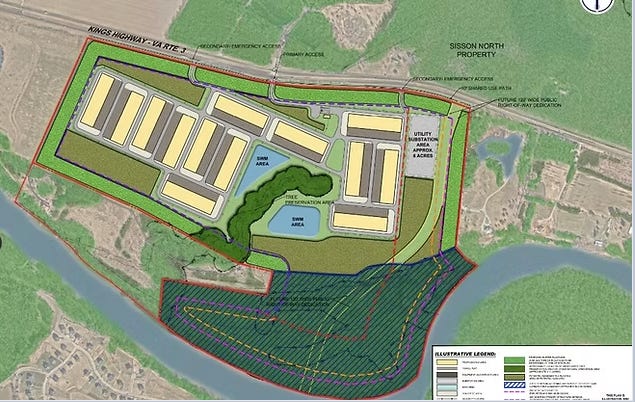
Furthermore, the location of this assemblage is in the Rappahannock River valley. This area regularly experiences temperature inversions where moist air is trapped at ground level. Adding emissions from generators will create the necessary components for increasing ozone levels that lead to smog. According to the Virginia Administrative Code (9VAC5-20-204), Stafford County is included in the Northern Virginia Ozone Nonattainment Area for the 1-hour ozone standard (which was the 1979 NAAQS). So, Stafford is already experiencing levels of air pollution that are considered unhealthy.
Adding emissions, even on a rolling basis, from testing generators will exacerbate this issue, particularly in the unique microclimate created by the valley connecting the upland Sherwood Forest to the Rappahannock river (see below for more extensive discussion of smog formation). I note that there is always a lot of discussion about schools and school funding and transportation
funding and access—in this case—we need to be talking about our children and their health and wellbeing.
CWP: It’s important to note that DEQ regulates air emissions in Virginia. To my knowledge, all DEQ preliminary analysis of generator air quality issues in NOVA (so called “data center alley”) conclude that data center generator usage is operating in compliance with the Clean Air Act. Meaning, carbon monoxide (CO), nitrogen dioxide (NO2) and particulate matter (PM2.5) concentrations remain well below applicable federal air quality standards. The testing is ongoing and below is a link to the DEQ testing process. In addition, we are required to use Tier 4 (EPA recommended) generators for this project. All air permitting for generators must be approved by Virginia’s Department of Environmental Quality. Again, generators are only utilized for emergencies or testing and maintenance. We cannot speak to what has occurred in NOVA and would note this is not an apples to apples comparison, and would remind the community Kings Corridor is sited near already established transmission facilities and we are not anticipating any onsite generation requirements.
https://www.deq.virginia.gov/news-info/shortcuts/topics-of-interest/data-center-air-monitoring-project
Noise
I know we have talked a lot about sound and noise. Once again, it is going to be an issue. I will not address the methodological failings of the sound study in detail here - suffice to say, that at this point, it seems the county is only looking to check a box for whether the study has been completed, not whether the study has been completed well or comprehensively. The rough equivalent is giving full marks to a kid for writing their name at the top of a test and handing the rest in blank.
The 55dB limit was set by EPA in 1974 to protect public health and welfare with an “adequate margin of safety”. It has never been updated to reflect current health and medical standards. The World Health Organization calls environmental noise an “underestimated threat” that contributes to chronic sleep disruption, increased cardiovascular risk (including high blood pressure), impaired cognitive function, reduced academic and workplace performance, mental health issues such as anxiety and stress, and long-term hearing damage. WHO also finds that children are particularly vulnerable to these impacts. Furthermore, the WHO recommends nighttime levels not to exceed 30dB inside a dwelling or 40dB outside; That is a 20dB increase over current outdoor ambient nighttime levels adjacent to the Forest Lane data center proposal. This equates to nighttime sound levels 4-times their current level or a 300% increase in constant, continuous noise. Even based on the sound study submitted by the developer, ALL sound levels will exceed 40dB. For comparison, the sound of a rain shower when you are sitting outside is about 42dB. Any emitted sound above that will mask or cover the sound of rain.
Residents living in close proximity to the Kings highway assemblage will never be able to enjoy the quiet pit-pat of the rain again once these buildings are operating. Thus, the obvious conclusion is that the operations of the data center will absolutely have negative health impacts on the surrounding residents and families, including our children.
CWP: Our sound studies, along with proposed mitigation measures, demonstrate not only compliance with the County’s strict noise standards for data center uses (55 dBA), but we overall exceed them with projected levels ranging 37-49 dBA for data center operations and 37-51 dBA for generator testing and maintenance periods. We will also proffer a 70dBC for low frequency sounds. Please note our current findings are for preliminary development standards as required by the County’s ordinance. At site plan, we will have to update our sound study once again. Same after construction and every 10 years thereafter on the anniversary date of the issuance of a certificate of occupancy permit. This is a County requirement and will ensure compliance. The County ordinance also requires mitigation measures where necessary. Please see Section 28-39 (q) of the County’s ordinance.
Traffic Impact Analysis and Safety
I reviewed the traffic analysis a while ago when the applications first came out and have seen the notes in the first and second review phase asking for additional details to be provided by the applicant. I’ve reviewed the subsequent submissions as well. There are some notable errors or omissions in the traffic study and more importantly there is NO visual evaluation of the conditions of the roads and intersections where certain points of entry are proposed for the data center campus and there has been no evaluation of the appropriateness of these locations to serve as reasonable points of entry.
One of the major use omissions is the lack of accounting for bicycle traffic along the route. We have many cyclists on a daily basis that use Forest Lane Rd and McCarty; several each hour and more on weekends. The route from Caisson down Forest lane toward rt 3, turning onto McCarty is a rural bike route that is widely known and used. None of this use or patterns are reflected in the traffic study which creates the first major safety concern. Likewise, there is no recognition of the narrowness of the road or the fact that we don’t have sidewalks. There are at least four bus routes along McCarty and Forest Lane despite the road not being wide enough to fully accommodate cars and buses to pass. We also have lots of residents that walk along McCarty with no sidewalks. None of this is mentioned anywhere in the traffic assessment or impacts statement.
The other element not reflected in the study is the safety of the Forest Lane Rd and McCarty Rd intersection. I welcome you to drive over here to experience it first hand. The intersection has three blind turns. If you are driving from rt 3 up Forest lane, the left hand turn onto McCarty is blind. It is so bad that you’ll note the base of McCarty is super wide so that cars can actually pass the intersection and make a very wide left hand turn with enough space to overcompensate and still make it onto McCarty. School buses and larger trucks will actually pull well past McCarty and then back up to make the left when it is safe to do so. We are the first driveway past that intersection and regularly have cars and particularly motorcycles that will turn around in our driveway to go back and make the right onto McCarty instead.
If you are turning either right or left onto Forest Lane Rd from McCarty, the turn is blind. I witness near misses daily for folks trying to make the turn from McCarty onto Forest Lane because not only is the turn blind, the crest of the hill is as well. None of the cars can see each other from any of the three directions if they are traveling toward rt 3 on Forest Lane or coming up the crest of the hill away from rt 3.
The traffic impact assessment proposed only to add right hand turn lanes on McCarty and on Forest lane into the proposed entrance. These adjustments do NOTHING to make the intersection safer and, in fact, add a whole new dynamic of right and left blind turns. We’ve already had a bad accident on Forest Lane recently and over the winter, the road was closed by my house because two cars on separate occasions drove off the road. It is so bad, and people drive so fast that I have, separately from this, reached out to our GW Supervisor to see if it is possible to reduce the speed limit or add speed bumps or rumble strips to improve the safety of that portion of the road and intersection. There is no way adding a main entrance to a data center and increasing the trips around that intersection by 5000 trips per day is going to keep our kids, neighbors, and drivers safe. We already have a safety issue there, this development is only going to make it worse.
CWP: Our traffic impact analysis concludes that with mitigation measures the project will not degrade the level of services at studied intersections, including at Forest Lane. As you may be aware, VDOT and the County must approve the applicant’s scoping agreement (e.g. what intersections should be studied by the applicant to address potential impacts to intersections that will likely be impacted by the project). We studied several intersections along Rt. 3 including the Forest Lane intersection. We are proffering significant improvements at Forest Lane, which we have included in our proffers and GDP. We have also capped our overall number of traffic trips. Below is a link to our TIA, which should be helpful as to the approved recommendations.
https://hirschlerlaw.sharefile.com/public/share/web sb204cbb0f9974ee9a72b2dc62d2c6594
Based on these impacts to safety and health of those residing in the vicinity of the proposed development, there is no way the County can reasonably approve the development application for a conditional use permit.
Thank you for taking this into consideration.
Alyson Azzara
GW District
Diesel Emissions and Smog Formation
What is smog?
Smog is caused by pollutants—mainly nitrogen oxides, volatile organic compounds, sulfur oxides, and particulate matter—released from vehicles, industry, and fuel burning, which then react in the atmosphere (often with sunlight) and become trapped by weather conditions like temperature inversions.
How It Forms
Sunlight breaks down nitrogen dioxide, releasing oxygen atoms that form ozone. This ozone mixes with other pollutants to create the brownish haze typical of modern urban smog. A layer of warm air traps cooler air (and pollutants) near the ground, preventing dispersion (temperature inversion); common in valleys and during winter high pressure systems.
Humidity and Smog
High humidity can both enhance and alter smog formation often worsening air quality in warm, sunny conditions. Smog is a mixture of ground level ozone, particulate matter (PM), and other pollutants.
Humidity affects this in several ways. When relative humidity rises, fine particles like PM2.5 can absorb water vapor, causing them to swell and become larger. This can make smog appear thicker and reduce visibility. While larger particles may settle faster, they can also carry more pollutants and remain suspended longer in certain conditions. Humidity can trap pollutants near the ground by reducing vertical mixing, increasing local concentrations. Humidity can worsen smog by promoting chemical reactions, enlarging particles, and increasing ozone formation, while also influencing how pollutants disperse and are removed from the air.
Health effects
Smog poses serious health risks, affecting the respiratory, cardiovascular, and other organ systems, and can lead to chronic diseases and increased mortality.
PM2.5
Particulate matter such as PM2.5 can carry toxic substances and is associated with many harmful health impacts, cardio-vascular disease, asthma, COPD, and cancer. Particularly those particles that have heavy metals, polycyclic aromatic hydrocarbons(PAH), and organic components - like those found in diesel fuels and emitted from the operation of diesel generators.
Kings Highway Micro-climate
Because of the connection to the upland forest, data center emissions from diesel generators, cars, delivery trucks, and increasing traffic will increase prevalence of smog forming emissions. The valley between the Forest and the Rappahannock creates a natural bowl where temperature inversions are common. These temperature inversions tend to trap and hold air in the valley, concentrating these emissions (think LA and the smog there trapped between the ocean and the mountains). We already have fog banks most mornings. That naturally occurring fog will form more readily and disperse less rapidly when also combined with diesel emissions and associated particulates. As the sun warms the air triggering the conversion of pollutants to ozone, the increasing humidity will further compound the formation of smog and residence time of particulate matter in the air, extending the exposure time of residents to this unhealthy air quality and particulate matter.