
By Phil Huber, ADVANCE COLUMNIST

For decades, Washington has sold Americans a comforting promise.
We could cut taxes, increase spending, strengthen the military, expand public programs, respond to every crisis, and still leave future generations with a manageable national debt.
It was good politics.
It was never good arithmetic.
Last week, the arithmetic caught up with us.
For the first time since the years immediately following World War II, federal debt held by the public is roughly equal to the value of everything the American economy produces in a year. Economists measure this as debt relative to Gross Domestic Product (GDP). Crossing the 100 percent threshold does not mean America is bankrupt. It does mean our financial margin for error has become much smaller.
Many Americans hear that we remain the richest nation on Earth and conclude that debt cannot really be a problem.
They are only half right.
America is extraordinarily wealthy. But wealth and fiscal discipline are not the same thing.
Imagine a retired Fredericksburg couple who own a million-dollar home, have substantial retirement savings, and receive comfortable pensions. They are undeniably wealthy. Yet if they spend far more each year than they earn, no financial adviser will say their wealth makes the imbalance irrelevant. Their assets give them the ability to borrow. They do not eliminate the need to manage money wisely.
The United States enjoys the same privilege.
Because our economy is large, innovative, and trusted, investors around the world willingly buy U.S. Treasury securities. The dollar remains the world’s principal reserve currency. That allows America to borrow on terms unavailable to almost every other nation.
But borrowing capacity is not the same as fiscal discipline.
How did we arrive here? Not because of one president. Not because of one Congress. And certainly not because of one political party.
This has been a bipartisan journey spanning more decades.
One useful way economists evaluate presidents is by estimating how much their policies added to—or reduced—future federal borrowing. While every estimate has limitations, the overall pattern is remarkably consistent.
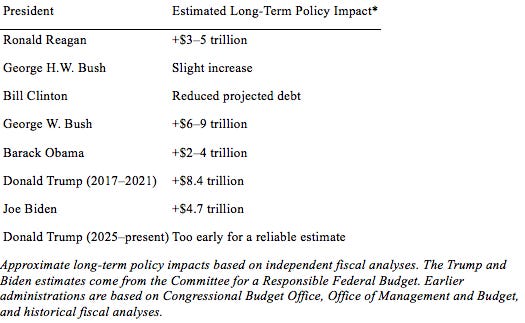
The lesson is uncomfortable.
Republicans have often pursued tax reductions without equivalent spending reductions.
Democrats have generally expanded public investments and social programs without fully financing them.
Bill Clinton remains the notable modern exception. Working with a Republican Congress and aided by a strong economy, his administration helped produce budget surpluses and improved the nation’s fiscal outlook. Neither side achieved everything it wanted. Both compromised because governing required it.
That example reminds us that fiscal responsibility is not a Republican achievement or a Democratic achievement.
It is a governing achievement.
Instead of making those difficult choices, borrowing has increasingly become Washington’s preferred way to postpone them.
Understanding the difference between deficits and debt explains why that matters. The annual deficit is the gap between what government spends and what it collects in revenue. The national debt is the accumulation of decades of those annual deficits. Today’s deficit becomes tomorrow’s debt. Tomorrow’s debt generates interest. That interest enlarges future deficits.
The cycle feeds on itself.
Today, interest on the national debt is one of the fastest-growing expenditures in the federal budget—not because Congress created a new program, but because yesterday’s borrowing has become today’s obligation.
Some dismiss this concern by arguing that no one can force the United States to repay its debt. In one sense, that is true. America borrows in its own currency. No foreign government can send debt collectors to Washington. But that misses the real issue.
The issue is confidence.
America’s greatest financial asset is not simply its wealth. It is the world’s confidence in our economy, our institutions, our legal system, and the U.S. dollar. That confidence allows us to borrow at interest rates most nations could only envy.
Confidence, however, is earned.
It should never be assumed.
China and several other countries have spent years encouraging greater use of other currencies in international trade. They are unlikely to replace the dollar anytime soon, but that is not the real danger. If investors gradually lose confidence in America’s fiscal discipline, they will not demand immediate repayment. They will simply demand higher interest rates before lending us more money.
For a nation carrying debt measured in the tens of trillions of dollars, even small increases in borrowing costs translate into enormous additional interest payments. That is how markets impose discipline.
Current policy illustrates the broader challenge.
Supporters of the administration argue that stronger economic growth, tariff revenue, and spending restraint will offset the cost of recent tax legislation. Independent budget analysts generally agree those factors help but conclude they are unlikely to eliminate the projected increase in borrowing over the coming decade.
Military policy raises similar questions.
The administration reports roughly $37.5 billion in military costs associated with operations against Iran and has requested another $67 billion from Congress. Independent analysts believe the ultimate cost could exceed $100 billion once replacement weapons, equipment, and other obligations are included.
Reasonable people can disagree about military strategy. They cannot disagree that wars, tax cuts, infrastructure, disaster relief, and domestic programs all carry costs that must eventually be paid.
Here in the Fredericksburg region, where many of our neighbors have worn the uniform and where Quantico, Dahlgren, and Fort Walker are part of our community, we understand that freedom is not free.
Borrowing is not free either.
Every dollar financed today eventually becomes an obligation for tomorrow’s taxpayers. This is why the debt reaching the size of our annual economy matters.
It is not simply another statistic.
It is a warning that America is approaching the limits of governing through postponement.
For too long, both parties have treated fiscal responsibility as campaign rhetoric rather than a governing discipline. Each criticizes the other’s borrowing while defending its own priorities from meaningful scrutiny. Crossing this fiscal threshold should end that habit.
America remains wealthy enough to solve this problem.
What is increasingly in doubt is whether our political system has the discipline to do so.
Responsible government requires difficult choices. If we want lower taxes, what spending should be reduced? If we want expanded public programs, how should they be financed? If we want a stronger military, where should the money come from?
Those questions cannot be answered with slogans.
They require compromise.
Families across Fredericksburg make those choices every month. They balance priorities, postpone purchases, and understand that every dollar spent in one place cannot also be spent somewhere else.
Government cannot repeal that arithmetic simply because it operates on a larger scale.
The debt reaching the size of our annual economy should not become just another campaign talking point. It should become a turning point.
Republicans and Democrats alike should stop treating fiscal responsibility as applause-line rhetoric and start treating it as one of the first responsibilities of governing.
The arithmetic has already been spoken.
Now our leaders need to listen.
***
Phil Huber is a retired Army Reserve colonel, federal civil servant and consultant who writes on civic education. He lives in Fredericksburg.

I prefer social safety nets and children's lunch programs to $$$ spent on testosterone testing!
Another interesting and thoughtful article, Phil. Thank you.
Bravo