
By Ranjit Singh and Eric Bonds, ADVANCE CONTRIBUTORS
Henry David Thoreau believed mightily in individual acts of conscience. For instance, here’s Thoreau on the topic of slavery, which he vehemently opposed:
I know this well, that if one thousand, if one hundred, if ten men whom I could name — if ten honest men only — aye, if one HONEST man, in this State of Massachusetts, ceasing to hold slaves, were actually to withdraw from this co-partnership, and be locked up in the county jail therefore, it would be the abolition of slavery in America. For it matters not how small the beginning may seem to be: what is once well done is done for ever.
Philosophically, Thoreau is as American as it gets. We’re all taught from childhood about the power of the individual to effect change. Curiously, when analyzing how big corporations speak to us, one might well think that they, too, swallowed Thoreau’s Essay on Civil Disobedience whole.
Case in point: Remember the “carbon footprint calculator?”
In 2004, global oil giant BP unveiled this device for measuring one’s daily impact on climate change. A brainchild of the PR firm Olgivy & Mather, the calculator asked questions in order to help people assess their culpability in effecting climate change. The idea was that by making a few changes to our lifestyles, we could all move forward and bring this disastrous problem to heel. Consume less, travel less, buy smarter.
BP invested huge sums in the PR campaign. It tweeted an ad for the calculator decorated with pictures of bicycles and broccoli and cute sayings like “Eat Local” and “Feed Tums, Not Bins.”
In fact, BP’s massive campaign made “carbon footprint” the household term it is today.
Going back in time, older folks may recall the 1971 ad where a dignified Native American man shed a tear after seeing trash tossed out of a car window. Over stirring music, a stern narrator informed us that “People start pollution. People can stop it.” The ad showed a New York mailing address you could write to for a list of “71 things you can do to stop pollution.”
The “Crying Indian” ad won prestigious advertising awards (even though the actor wasn’t really Native American). One of your coauthors recalls firsthand how that guy’s single tear wreaked havoc on the mind of a child. He felt guilty for every gum wrapper he’d ever tossed aside.
What ties these two influential ad campaigns together? A very simple deception.
They put the responsibility for solving big problems on us, the little people.
BP’s products, along with those of other oil giants like Chevron, Exxon, and Shell, have been responsible for 10 percent of global carbon emissions just in the period from 1965 to 2022. According to the environmental action group ClientEarth, just 100 companies like BP are responsible for 71 percent of all global CO2 and methane emissions.
And Coca Cola, a major funder of the “Crying Indian” ad campaign, has been deemed the “World’s Biggest Plastic Polluter.” Fifty-plus years after the ad appeared, the Center for Biological Diversity estimates that Coke produces 134 billion single-use plastic bottles every year. The iconic anti-litter ad’s other backers included Pepsi and Anheuser Busch. It’s their plastic bottles and packaging that are filling up the oceans.
Clearly, nothing we as individuals ever do will in any way heal the environment compared to what these global corporations could do, if they were serious about it.
But they don’t want you thinking that. Their way of doing business is immensely profitable. So, they point the cannon at you.
Decades after we tallied our carbon footprint and cried with the “Indian,” climate change and pollution remain basic problems. But environmental threats change over time, too. Today, no issue flummoxes our region more than the rapid proliferation of data centers.
The data center boom has hit Virginia harder than any other state. Logically, many residents worry about its effects, which makes the industry nervous. So now we’re being carpet-bombed with pro-data center ads on TV and online. Virginia Connects, the voice of data center supporters like Amazon, The Data Center Coalition, and the Fredericksburg Regional Chamber of Commerce, produces many such ads.
Filled with optimism, Virginia Connects’ ad campaign pushes a distinct message: Data centers are here to help people shoulder their responsibilities.
This cheery ad is titled “Virginia’s Data Centers Are There For You.” Which begs the question — for you to do what?
“We help your family conserve energy and live more sustainably,” the narrator answers over the kind of anodyne, upbeat music one associates with modern electoral campaigns.
You ARE doing that, aren’t you, dear reader? Conserving energy and living sustainably? Because the data centers are here to help you.
Certainly, the industry knows how much you’ve already helped them. But its PR campaign is more evasive about that. Another Virginia Connects ad, titled “Businesses are Rethinking Data Centers: Tax Revenues,” tells viewers that “[Data center] businesses are rethinking about how data centers are built. That means paying for every watt of energy they use…”
“Rethinking?” What a nice admission that they haven’t been getting an electric bill like everyone else’s, but rather one that funnels costs to ratepayers like us.
And what the ads won’t even touch is that we’ve also been paying for the expanded energy infrastructure needed to support this handful of uber-wealthy corporations, even though most of what’s being built for them today has nothing to do with current individual consumer demand. There’s plenty enough data center capacity out there to meet our needs on “the cloud.” What they’re doing now is speculating on the future importance of AI — a prospect many Virginians find disturbing in terms of surveillance, lost jobs, etc.
We’ve done enough already. Yet the whole industry pushes you to do more. The Director of Sustainability at NTT Global Data Centers (an IT consulting firm) advises each of us to manage our emails more efficiently, turn off our video cameras, and better organize our digital folders. No behavior modification is too small — for you to make.
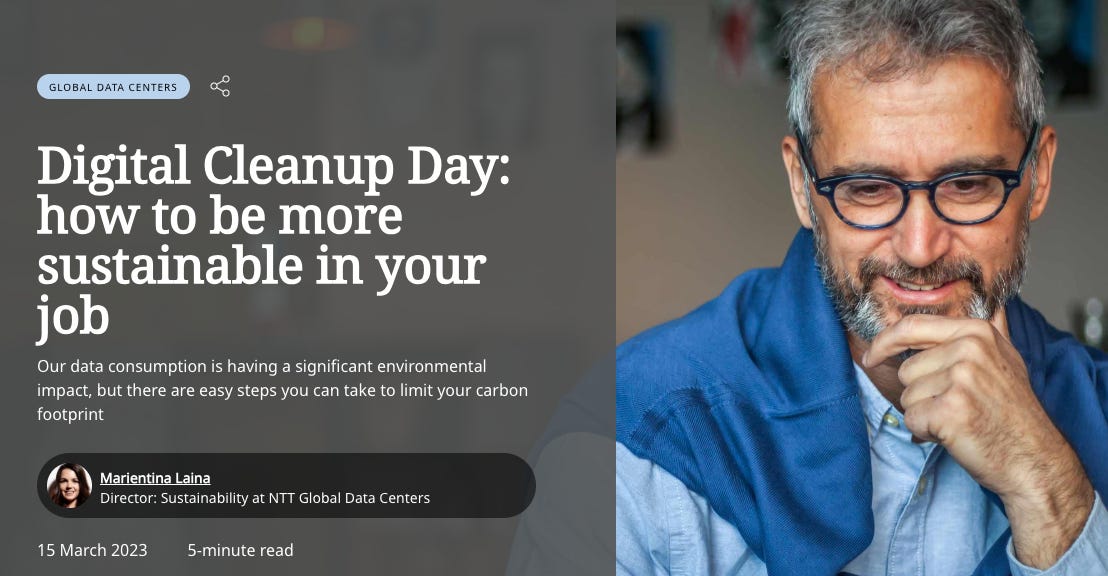
Such PR campaigns artfully place data center owners and developers in unobtrusive roles when it comes to spiking prices, rising infrastructure demands, and depleting resources. Throughout, they imply that data centers aren’t the cause of anything bad.
We know this misdirection to be utterly disingenuous. According to the World Resources Institute, data centers impact their communities in many ways, including:
They consume massive amounts of energy. “A single modern AI data center can use as much power as 100,000 homes; many of the larger ones now being built are expected to consume up to 20 times that amount.”
They consume massive amounts of water. “Mid-sized facilities can use up to 300,000 gallons of water a day, while large facilities can consume as much as 5 million gallons daily — comparable to what a small town uses.” [Some data centers use “reclaimed” rather than potable water, but with evaporation most of that water escapes, depleting local water supplies by reducing replenishment. As the Lincoln Institute of Land Policy observes, water is a finite resource, and “what goes unacknowledged, from a natural systems perspective, is that all water is local.”]
They significantly add to air pollution and climate change. “Many facilities rely on gas-fired generation for routine operations alongside diesel generators for emergency backup. Both come with climate and health risks.”
Energy and water consumption, air pollution, climate change, and health risks. You’re doing something about that, right?
Indeed, many of us do answer the call. When we keep our home thermostat a few degrees warmer in summer, or take shorter showers, we lessen our personal impact on the environment.
But let’s not fool ourselves.
Serious environmentalists know that focusing on individuals is an incredibly inefficient way to fix big problems. Elizabeth DeSombre, author of Why Good People Do Bad Environmental Things, writes:
If you think about the number of people one would have to individually persuade to change behavior (and how many behaviors each would have to change), in a country of millions or a world of billions, it’s easy to see how a solution that focuses on changing individual behavior has no hope of creating change as quickly as ecological conditions require.
What would produce real change? DeSombre concludes, “The best way to change a lot of behavior of a lot of people reasonably quickly is for that change to be structural or systemic.”
Which is to say — contra Thoreau — that if one Virginian pledges to consume less energy — aye, if ten thousand commit to such a pledge — it would not have anywhere near the impact of a single piece of good legislation. Legislation that, for example, demands all developers pay the costs associated with building a clean energy infrastructure, or slaps stringent emissions standards on every data center built in our state.
Or pauses data center construction until we have a handle on things.
Be assured that the data center owners and operators know all this. And systemic change via public-minded legislation is precisely what they don’t want to see. It might hurt their bottom lines.
So, Virginia Connects and the actors behind it want you worrying about your consumption habits, not theirs.
Luckily, we citizens have choices.
First, please continue to recycle plastics. Maybe even wear that musty old jacket for one more season. But don’t let corporate jiu jitsu trick you.
As one of us recently wrote, “Let’s not expect the IT and digital infrastructure industry (and the billionaires behind it) to act like angels.” These are people like Jeff Bezos, who spent $46-56 million on a single wedding. Climate change and our region’s air and water quality aren’t keeping them up at night. In the name of profit, their data centers will visit far more lasting environmental harm on our region than any of us ever could. So choose not to be fooled.
Second, the fact remains that the data center industry needs our representatives’ permission to build in our region. And we don’t need angels to fix our problems.
We need elected officials and city and county administrators who will protect our air, water, and land — the fundamentals of our children’s futures. They have to ask tough questions, view every data center claim with skepticism, and deliver strong legislation that minimizes environmental harm.
Corporations put the onus of a healthy environment on us as individuals. Confound them, and do exactly that — vote for leaders who see through their deceptions.
***
Ranjit Singh teaches in the Department of Political Science and International Affairs at the University of Mary Washington. He’s also an active environmentalist. His “No Lines in Nature” Substack blends history, science, and philosophy to explore our relationship with the natural world world. You can find it HERE. Eric Bonds is a professor of Sociology at the University of Mary Washington where he studies climate change and environmental inequality in Virginia. A version of this essay was first published in No Lines in Nature.

Reminiscent of the tobacco ads that touted the taste and sociability of cigarettes, bur concealed their deadly effects .
Compelling