
By Phil Huber, ADVANCE COLUMNIST

Turn on the news and the script is familiar. When Donald Trump talks about the law, he rarely begins with evidence, procedure, or the hard work of governing. He begins with slogans: “law and order,” “weaponized justice,” “pure vandalism,” “election integrity.” The pattern is the same as the culture-war stars I wrote about earlier: a bright story tossed into the air to make us look one way while the real trick happens somewhere else.
But every shiny star has a partner, and it’s the one that matters. Call it the dagger. The star is the loud, easy-to-repeat phrase that grabs your eye. The dagger is what that phrase is pointed at while your eye is elsewhere—the power being moved, the money being protected, the accountability being dodged. You cannot follow the dagger by staring at the star; you have to look away from it, on purpose.
That trick is not just cultural. It is legal. It reaches into the Department of Justice and out into the courts, changing how people see prosecutors, judges, and grand juries. It makes corruption look like enforcement and enforcement look like persecution. Over time, that framing does real damage to the rule of law.
In the first op-ed, I turned the culture-war version of this into a game: Count the stars, then ask what each one hides. Playing that same game on Trump’s Department of Justice, I found the same pattern, but sharper—in the justice system, the dagger is never just rhetorical. It’s a case, a fund, or a rule. Ask three questions of any law-and-order headline: Who benefits from stopping at this sentence rather than reading the next one? What official, dollar figure, or decision gets mentioned once, in passing, and never explained? And if this exact story had happened to the other side, would the coverage still be running a week later? Wherever that unexplained detail lands, that’s the dagger.
Consider the Lincoln Memorial Reflecting Pool case. Trump’s Justice Department charged former Olympic canoeist David Hearn with felony destruction of property for touching the Reflecting Pool. The public story was simple and emotional: a “pure case of VANDALISM” against a national monument. The president repeated it, his allies echoed it, and the case became another proof point in a familiar narrative: vandals, chaos, disrespect for history. That was the star.
The reality was more complicated. Interior officials had pushed a $14 million renovation of the Reflecting Pool. The liner installation was flawed, the coating peeled, and documents later showed the damage came from the government’s own project, not from Mr. Hearn’s brief contact with the water. DOJ eventually admitted the renovation was “botched” and moved to dismiss the case. The dagger was aimed at a mismanaged contract, not a canoeist—but Trump attacked his own U.S. Attorney for dropping the case anyway, insisting, again, that this was “pure vandalism.” That’s what a shiny star looks like in the justice system: a simple phrase, easier to repeat than a detailed explanation of procurement failures, that lets a president posture as defender of monuments while hiding the government’s own mistake.
The justice system has six stars like this right now. Ask the three questions of each one, and a dagger shows up every time.
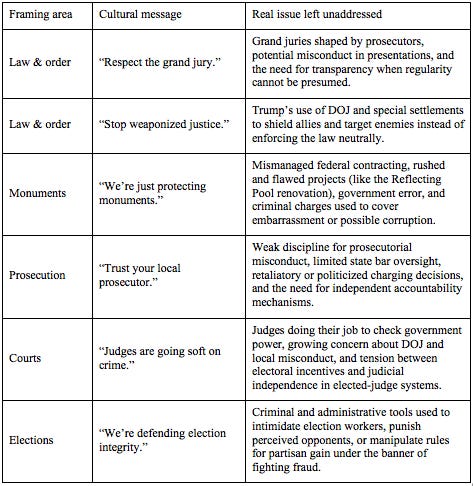
1. Respect the grand jury” sounds like tradition—the star. The dagger: Judges around the country are finding “irregularities” in how Trump’s DOJ presents evidence to grand juries or coaches jurors in proceedings involving his critics. Defense lawyers in cases like Hearn’s and James Comey’s are asking courts to pierce grand-jury secrecy because they no longer trust the government to act in good faith. “Irregularities” gets mentioned once and buried—exactly what the slogan asks you not to look at.
2. We’re just protecting monuments” sounds like civic pride—the star. The dagger is aimed at a $14 million renovation contract, not a man who touched some water.
3. Trust your local prosecutor” can become a star too. Many prosecutors do honorable work, yet misconduct in discovery, charging, or grand-jury practice rarely leads to discipline. The dagger here is a policy: Trump’s Justice Department has proposed rules to suspend state bar investigations of federal lawyers. The star says, “trust us.” The dagger says “don’t look too closely”—aimed at the one mechanism, outside review, that could catch abuse before it becomes routine.
4. Judges are going soft on crime” turns any dismissal of a tainted case into alleged weakness. In states where judges are elected, that’s a campaign weapon—the dagger is aimed at judicial independence itself.
5. We’re defending election integrity” sounds like civic duty—the star. Some of the same voices talk about prosecuting election workers or political opponents under that banner. The dagger is aimed at whether the law is applied evenly or aimed at people.
6. Save the sharpest example for last, because it’s still moving. “Stop weaponized justice” sounds like a defense of fairness—the star. Trump spent months pushing a $1.8 billion “Anti-Weaponization Fund” meant to compensate his allies, plus a slush-fund settlement that would have shielded himself, his sons, and the Trump Organization from past tax claims and future audits. This week, under pressure from Senate Republicans ahead of a confirmation vote, acting Attorney General Todd Blanche formally rescinded the fund. Watch the star get killed in public, then ask the three questions before you look away.
Who benefits if you stop reading at “fund rescinded”? DOJ, which gets to look reformed for the price of one fund.
What gets mentioned once and never explained? A separate audit-immunity arrangement for the president, his sons, and the Trump Organization stayed in place—new terms, same basic shield.
Would this still be running a week from now if the other party had done it? You already know the answer. The star is gone. The dagger, aimed at whether DOJ is a personal shield for one man’s finances, is right where it was.
The lesson from the Reflecting Pool and the Blanche fund is not that law is hopelessly political. It’s that framing matters inside the justice system just as much as it does in school board fights or immigration debates. Shiny stars can turn a flawed renovation into a crime, a slush fund into a fairness program, judicial oversight into supposed weakness. The dagger is aimed at something specific and identifiable the whole time—we just weren’t looking at it.
Voters and readers can do something simple about this: treat law-and-order slogans the same way you’d treat culture-war slogans. Ask the three questions, then ask the last one: what problem did that message solve?
If the answer is “none,” you’re looking at a shiny star. Ask where the dagger is headed, and you’ll usually find the real story.
***
Phil Huber is a retired Army Reserve colonel, federal civil servant and consultant who writes on civic education. He lives in Fredericksburg.

I would think that a Lt. Col. (ret) would know the difference between a Marine Fighting Knife and a dagger. Another symptom of your TDS?