
By Ranjit Singh, ADVANCE ENVIRONMENTAL COLUMNIST
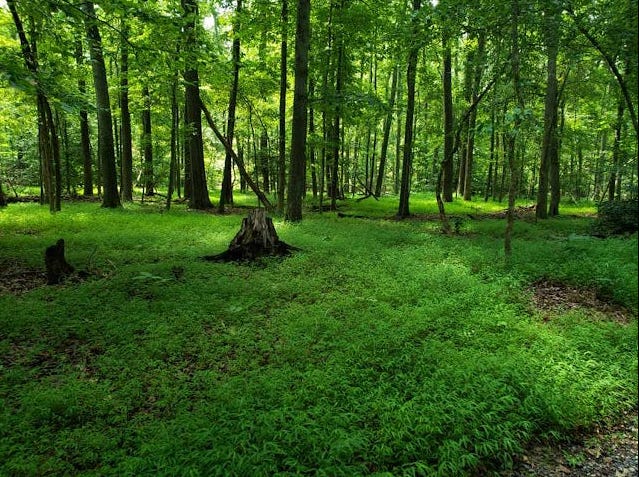
Japanese stiltgrass is everywhere.
This easily overlooked grass is emblematic of Potomac Creek’s intimacy with the rest of the world—an intimacy so quiet and obvious it hides in plain sight. For all our hopes, brainpower, and planning, the story of stiltgrass underscores that we haven’t the faintest idea what the creek will be like in a hundred years.
A pretty plant with silver-striped lanceolate leaves, stiltgrass is found where paths are worn in the forest surrounding the Creek, or where the ground has been disturbed by deer or scouring floods.
And it may be the most damaging invasive plant species in the country—outcompeting forest floor rivals in shady, humid areas, spreading to create thickly-matted, pasture-like areas that block the natural development of an understory, causing significant damage to plant diversity and wildlife habitat.
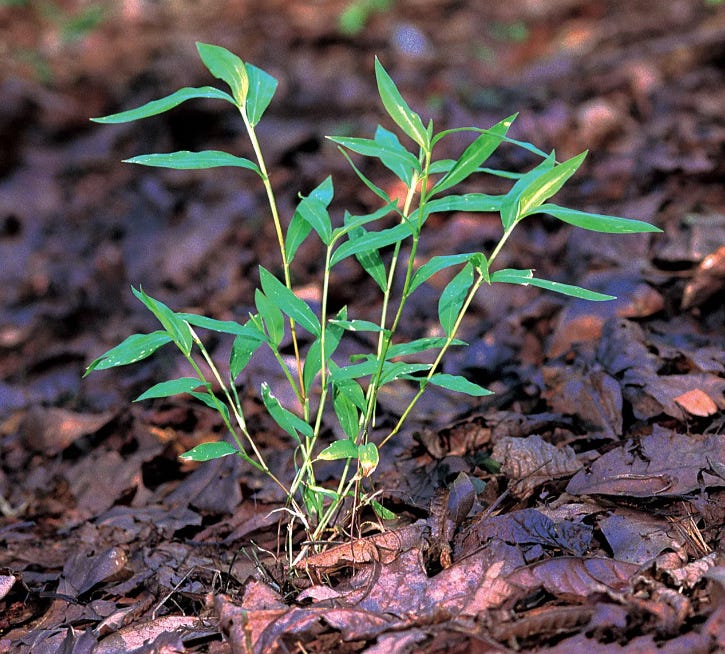
The Forest Service lists stiltgrass as a Category 1 invasive plant—the worst in terms of displacing natives—and ranks it as the invasive plant of greatest concern among researchers and land managers in the eastern U.S.
In other words, if anti-foreigner paranoia propels you towards QAnon and fear of a “great replacement,” then stiltgrass is your botanical foe. Except it’s not a conspiracy.
Stiltgrass is more like what the CIA calls “blowback”: the unintended, harmful result of one’s own actions.
***
The story of stiltgrass is a small tale lost within the dramatic push and pull of nineteenth century geopolitics.
National interest in the Pacific grew after the United States successfully annexed California in 1848. According to the official history of the State Department, the resulting U.S. policy was an extension of the doctrine of Manifest Destiny that drove settlers west across the American continent. But now, after the annexation, Americans wanted more trade and influence with China and Japan, including missionaries, and secure ports and coaling stations for their whalers, merchants, and naval vessels.
The isolationist Tokugawa shogunate in Japan resisted American designs. But strategically Japan was the right place to be, so to stiffen U.S. diplomacy, President Millard Filmore sent a squadron of U.S. Navy ships led by Commodore Matthew Perry across the Pacific. Perry’s armed ships sailed into forbidden Tokyo Bay in 1853, and within a short time, America and Japan were literally in business.
This was one of many historical moments where global politics and biogeography—the branch of biology that studies the geographic distribution of plants—came together, as Commodore Perry’s coerced opening of Japan quickly led to botanical exchanges. The late botanist Les Mehrhoff picks up the story in a lecture delivered to the 2010 “Stiltgrass Summit” (yes, such events exist). But it’s unlikely that anyone planned for stiltgrass to take root across the world’s largest ocean.
Instead, that achievement took something as fickle as a fashion trend.
Europeans had long coveted East Asian ceramics. The Perry mission and Japan’s subsequent participation in the 1876 Centennial Exhibition in Philadelphia induced yet another “Japan Craze,” this time in the United States. Americans of the rapidly industrializing nineteenth century came to see Japanese and Asian porcelain as symbolic of a less harried life, where artisanship and harmony with nature still mattered. Basically, they were nostalgic for a rural life that supposedly existed in another country. The export market for Japanese art boomed. And merchants used readily available weeds to package the goods for safe transport.
Stiltgrass, as it turned out, was the packing peanut of its day.
The first time anyone noticed it growing in the United States was in 1919 when George G. Ainslie, an entomologist studying borers (insects that bore into plants), found stiltgrass growing on a creek bank in Knoxville, Tennessee. Unable to identify it, he sent a sample to the Smithsonian in Washington D.C.
***
The trouble with stiltgrass isn’t just its destructive effects on native ecology, but its remarkable fecundity. As an annual plant, it flowers, then sets seed in late summer and early autumn. Each stiltgrass may produce as many as one thousand seeds which can remain viable for several years.
In fact, once you’ve walked through a patch of stiltgrass, it’s probably harder not to spread the seeds than it is to spread them. The seeds can be disseminated in nearly infinite ways: wildlife, rains and floods, and people: Think mowers, backpacks, tents, car tires, shoelaces, and so on. There’s a small colony at my house where I rinse off my hiking boots.
Stiltgrass was first recorded in Virginia in 1931. It continues to colonize new states, especially those of the south and east. It was confirmed in Rhode Island in 2005, and Wisconsin in 2020. For all anyone knows, it rode in on the fur of another migrant we’ve released onto Potomac Creek, the eastern coyote.
Stiltgrass needed neither a plan nor planner to conquer the world.
It had us.
***
Ranjit Singh teaches in the Department of Political Science and International Affairs at the University of Mary Washington. He’s also an active environmentalist. His No Lines in Nature Substack blends history, science, and philosophy to explore our relationship with the natural world world. You can find it, along with an earlier version of his Japanese stiltgrass column, HERE.

Does this hit home. I have been battling stiltgrass on my property for years. Usually losing the battle. It's best to pull it and dispose of it properly off site (extremely tedious and time consuming however necessary), weed eating (marginally effective) mowing (not effective) but the key is to get it gone before it goes to seed. Even then, you are victim to any growing on neighboring properties.
This might just be about a weed but it was beautifully written and informative! Japanese stiltgrass has been in my yard and surrounding woods for years and I’ve slowly been taking care of it in the yard but I have no idea how to stop it in the woods besides pulling it up and disposing of it as I go along. I am baffled that it was used as the “packing peanuts” of its day but it goes to show the many ways invasive species makes its way to other lands.